
What Hurts Your Credit Score? 11 Costly Mistakes You’re Probably Making
INTRODUCTION
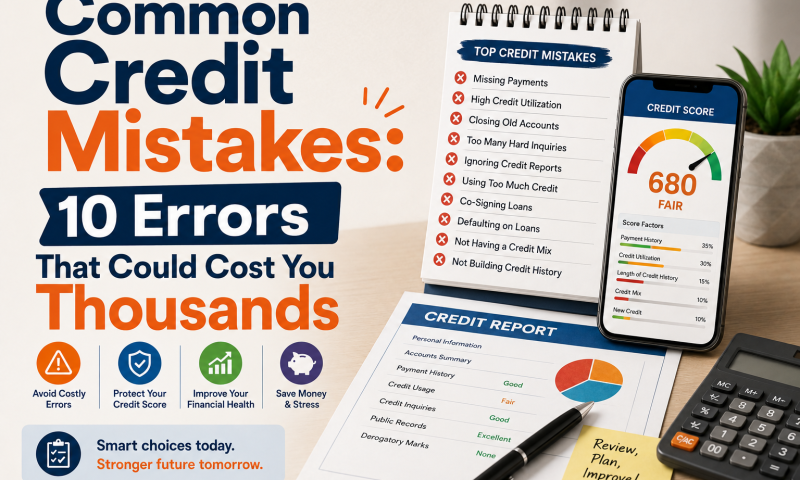
Your credit score is a delicate number. One mistake can drop it by 100 points or more, costing you thousands of dollars in higher interest rates and lost opportunities. The frustrating part is that many people make these mistakes without even realizing it. They are not being reckless—they simply do not know how certain actions affect their credit.
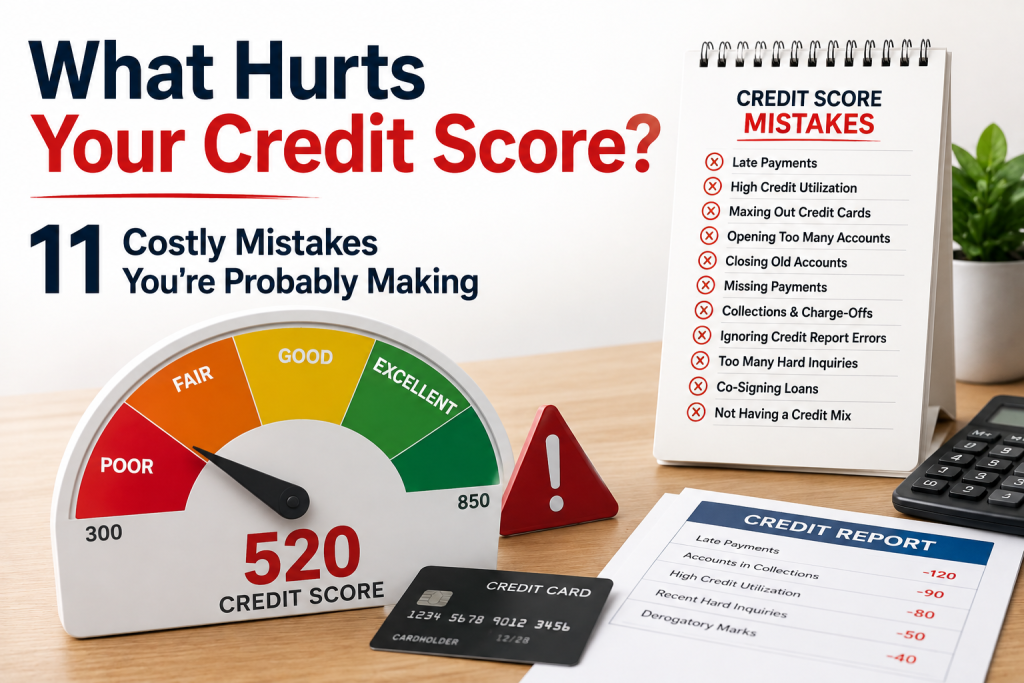
This guide reveals 11 costly credit mistakes that could be hurting your score right now. More importantly, it provides actionable solutions to fix each mistake and prevent future damage. Whether you have a good score that you want to protect or a low score that you need to rebuild, understanding these mistakes is essential for your financial health.
MISTAKE 1: MISSING PAYMENTS OR PAYING LATE
Missing a payment is the most damaging mistake you can make. Payment history accounts for 35% of your FICO Score, making it the single most important factor. A single 30-day late payment can drop your score by 60-110 points, depending on your starting score. The higher your score, the more damaging a late payment can be.
Late payments stay on your credit report for seven years, though their impact diminishes over time. Creditors report late payments in 30-day increments. A 60-day late payment is worse than a 30-day late payment, and a 90-day late payment is worse still. The best way to avoid this mistake is to set up automatic payments for at least the minimum amount due on all your accounts. If you cannot set up automatic payments, create calendar reminders or use a bill-tracking app.
If you have already missed a payment, bring the account current as soon as possible. The impact of a late payment lessens over time, especially if you maintain a consistent record of on-time payments afterward. Contact your creditor and ask if they will waive the late fee or remove the late payment from your report. Some creditors offer a one-time goodwill adjustment for customers with a history of on-time payments.
MISTAKE 2: MAXING OUT YOUR CREDIT CARDS
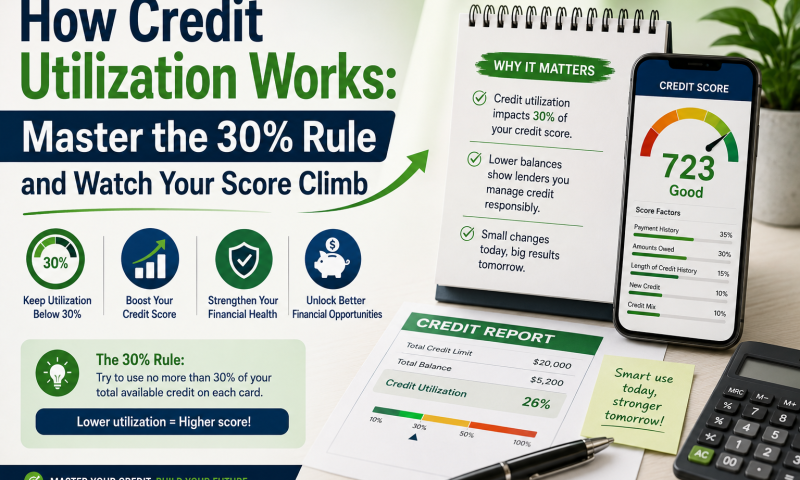
Your credit utilization ratio—the percentage of your available credit that you are using—accounts for 30% of your FICO Score. Maxing out your credit cards signals to lenders that you are financially stressed and may struggle to repay debt. Even if you pay your balance in full each month, using a high percentage of your available credit can lower your score.
The rule of thumb is to keep your credit utilization below 30% of your total available credit. However, those with excellent credit scores typically have utilization rates below 10%. If you have a credit card with a $10,000 limit, you should aim to keep your balance below $3,000, and ideally below $1,000.
To fix this mistake, focus on paying down your credit card balances. Even a small reduction can improve your score because utilization is evaluated on a monthly basis. You can also request a credit limit increase, which lowers your utilization ratio if you do not increase your spending. Another strategy is to spread your balances across multiple cards rather than maxing out one card. Avoid closing old credit cards, as this reduces your total available credit and can increase your utilization ratio.
MISTAKE 3: CLOSING OLD CREDIT CARDS
Many people believe that closing old credit cards is a good way to simplify their finances or avoid annual fees. In reality, closing old cards can significantly hurt your credit score. When you close a credit card, you reduce your total available credit, which increases your credit utilization ratio. You also shorten your credit history, as the closed account stops aging and may eventually fall off your credit report.
The length of your credit history accounts for 15% of your FICO Score. Closing an old card can lower the average age of your accounts, which can lower your score. Even if you are not using an old credit card, keeping it open contributes to your average age of accounts and available credit.
If you have an old card with an annual fee and you do not use it, consider asking the issuer to downgrade it to a no-fee card rather than closing it. This keeps the account open and preserves your credit history while eliminating the fee. If you must close an account, close newer accounts first to minimize the impact on your credit history.
MISTAKE 4: APPLYING FOR TOO MUCH CREDIT AT ONCE
Each time you apply for credit, a hard inquiry is placed on your credit report. Multiple hard inquiries in a short period can lower your score by several points. While the impact of a single inquiry is small—typically around 5 points—multiple inquiries can add up.
Rate shopping for mortgage, auto, and student loans is treated differently. FICO counts multiple inquiries for the same type of loan within a 45-day window as a single inquiry, minimizing the impact on your score. However, rate shopping for credit cards does not receive the same treatment. Each credit card application results in a separate hard inquiry.
To avoid this mistake, only apply for credit when you need it. Space out your credit applications. If you are shopping for a mortgage or auto loan, do your rate shopping within a 45-day window. Be cautious about opening store credit cards just for a one-time discount—these can hurt your score more than the savings are worth.
MISTAKE 5: CO-SIGNING FOR SOMEONE ELSE
When you co-sign a loan, you become equally responsible for the debt. If the primary borrower misses payments or defaults, it hurts your credit as much as it hurts theirs. You are not just helping someone—you are putting your credit on the line.
Before co-signing, consider the risks carefully. Ask yourself: can you afford to make the payments if the primary borrower cannot? Are you willing to risk your credit score for this person? Is there another way to help them without putting your credit at risk? If you do co-sign, monitor the account regularly to ensure payments are being made on time.
If the primary borrower is struggling to make payments, work with them to find a solution. You may need to take over payments temporarily or help them refinance the loan. The worst-case scenario is a default, which can stay on your credit report for seven years.
MISTAKE 6: IGNORING YOUR CREDIT REPORTS
Your credit reports contain the information that determines your credit score. If your reports contain errors—and many do—your score could be lower than it should be. A study by the Federal Trade Commission found that one in five consumers had an error on at least one of their credit reports.
Common errors include accounts that do not belong to you, incorrect personal information, payment history errors, and accounts that should have been removed due to age. These errors can significantly lower your score, and correcting them can give you an immediate boost.
Get your free credit reports from AnnualCreditReport.com. You are entitled to one free report from each of the three major credit bureaus—Equifax, Experian, and TransUnion—every 12 months. Review each report carefully for errors. If you find an error, dispute it with the credit bureau. The dispute process is free and can be done online, by mail, or by phone. The credit bureau must investigate your dispute within 30 days and correct any errors they find.
MISTAKE 7: CARRYING A BALANCE ON YOUR CREDIT CARDS
Many people believe that carrying a balance on their credit cards helps build credit. This is not true. You do not need to carry a balance to build credit. Paying your balance in full each month is better for your finances and still builds a positive payment history.
Carrying a balance not only costs you money in interest, but it also increases your credit utilization ratio. The higher your utilization, the lower your credit score. If you are working to improve your credit score, pay your balance in full each month. This reduces your utilization and saves you money on interest charges.
MISTAKE 8: USING YOUR ENTIRE CREDIT LIMIT
Using your entire credit limit—even if you pay it off each month—can hurt your credit score. Credit utilization is calculated based on your balance at the time your statement is generated, not your balance at the end of the month. If your statement shows a high balance, your utilization will be high, even if you pay it off the next day.
To avoid this mistake, make multiple payments throughout the month to keep your balance low. You can also pay your balance before the statement closing date to reduce the balance reported to the credit bureaus. If you regularly use a large portion of your credit limit, consider requesting a credit limit increase to lower your utilization ratio.
MISTAKE 9: NOT HAVING ENOUGH CREDIT ACCOUNTS
Having no credit accounts or too few credit accounts can limit your credit score. Credit scoring models consider both the number of accounts you have and the mix of account types. A thin credit file—one with few accounts—makes it harder to achieve a high score.
Building a healthy credit profile involves having a mix of revolving accounts (credit cards) and installment accounts (loans). You do not need to take on debt to build credit, but having a few active accounts that you manage responsibly can help you achieve a stronger score. If you have only one credit card, consider adding a second card or a credit-builder loan to diversify your credit mix.
MISTAKE 10: DEFAULTING ON STUDENT LOANS
Defaulting on student loans is particularly damaging to your credit score. Student loan defaults can stay on your credit report for seven years and can significantly lower your score. Defaulting on federal student loans has additional consequences, including wage garnishment and loss of eligibility for future financial aid.
If you are struggling with student loan payments, explore your options before defaulting. Income-driven repayment plans, deferment, and forbearance can help you manage payments. Loan consolidation or refinancing may also be options. Contact your loan servicer to discuss your situation. They are often willing to work with borrowers who are proactive about finding solutions.
MISTAKE 11: COLLECTION ACCOUNTS
When an account goes to collections, it is a serious negative mark on your credit report. Collection accounts can stay on your credit report for seven years, and they can significantly lower your score. Even after you pay off the collection account, it remains on your report for the full seven years from the date of the original delinquency.
If you have a collection account, the best strategy is to negotiate a “pay for delete” agreement with the collection agency. This means you agree to pay the debt in exchange for the collection agency removing the account from your credit report. Not all collection agencies will agree to this, but it is worth asking. If they will not delete the account, paying it off can still help your credit by showing the account as paid, which is better than an unpaid collection.
HOW TO RECOVER FROM THESE MISTAKES
If you have made any of these mistakes, do not panic. Credit scores are not permanent, and you can recover with time and consistent effort. Here is a recovery plan:
Step 1: Check your credit reports for errors and dispute any inaccuracies.
Step 2: Make all future payments on time, every time. This is the most important step.
Step 3: Pay down your credit card balances to lower your credit utilization.
Step 4: Avoid applying for new credit unless absolutely necessary.
Step 5: Consider using a secured credit card or credit-builder loan to rebuild your credit.
Step 6: Monitor your credit regularly to track your progress and catch new errors.
HOW LONG DO NEGATIVE ITEMS STAY ON YOUR CREDIT REPORT?
| Negative Item | Time on Report |
|---|---|
| Late payments | 7 years |
| Collection accounts | 7 years |
| Chapter 7 bankruptcy | 10 years |
| Chapter 13 bankruptcy | 7 years |
| Foreclosure | 7 years |
| Hard inquiries | 2 years |
CONCLUSION
Your credit score is a valuable asset. Protecting it means avoiding common mistakes that can significantly lower your score. From missing payments and maxing out cards to closing old accounts and ignoring your credit reports, these 11 mistakes are costly—but they are also avoidable.
The good news is that credit scores are not permanent. With time, consistency, and the right strategies, you can recover from mistakes and build a strong credit score. The key is to learn from these mistakes and take proactive steps to protect your credit in the future.
Your credit score is a reflection of your financial habits. By avoiding these mistakes and practicing good credit habits, you can achieve the financial freedom that comes with a strong credit score.