
Credit Report vs. Credit Score: The Critical Difference Most People Get Wrong

INTRODUCTION
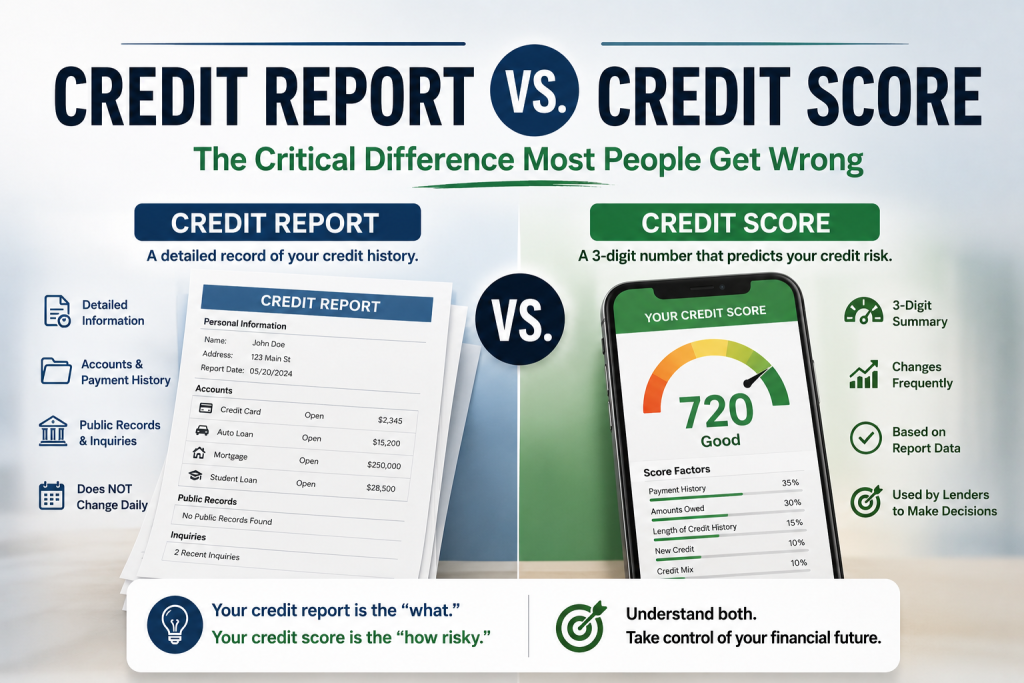
Most people use the terms “credit report” and “credit score” interchangeably. They assume they are the same thing. This is one of the most common and costly misunderstandings in personal finance. Your credit report and your credit score are two completely different things, and understanding the difference is essential for managing your financial health. Your credit report is a detailed document that contains your entire credit history. It is like a financial biography that tells the story of how you have managed debt over time. Your credit score is a three-digit number that summarizes that story. It is like a grade on a report card—a shorthand way for lenders to assess your creditworthiness. This guide explains the critical difference between credit reports and credit scores, why both matter, and how to manage both effectively.
WHAT IS A CREDIT REPORT?
A credit report is a statement that has information about your credit activity and current credit situation. It includes details about your loan paying history and the status of your credit accounts. Think of it as a detailed financial diary that tracks every credit transaction you have ever made. Your credit report contains several types of information. Personal information includes your name, address, date of birth, Social Security number, and employment history. Credit account information includes the types of accounts you have, when they were opened, your credit limits, your account balances, and your payment history. Public records include bankruptcies, foreclosures, and tax liens. Inquiries include a list of everyone who has accessed your credit report in the past two years. Credit reporting companies collect this information from your lenders and creditors. The three biggest credit reporting companies are Equifax, Experian, and TransUnion. They each maintain their own credit reports on you, and the information may vary between them because not all lenders report to all three.
WHAT IS A CREDIT SCORE?
A credit score is a numerical representation of an individual’s creditworthiness, which is based on the information in their credit report. It is a three-digit number that indicates the level of financial risk associated with lending money to an individual and the likelihood of repaying debt on time. Your credit score is calculated using a mathematical formula that analyzes the information in your credit report. The most commonly used credit scores are FICO scores and VantageScores. Both range from 300 to 850, with 850 considered exceptional. Your credit score takes the complex information in your credit report and distills it into a simple number that lenders can use to make decisions quickly. It is like a grade on a report card—a shorthand way for lenders to assess your creditworthiness.
THE KEY DIFFERENCES
While your credit report and credit score are related, they are fundamentally different in several important ways. Content vs. Summary: Your credit report is a detailed document that contains all your credit information. Your credit score is a three-digit number that summarizes that information. Free vs. Fee: You are entitled to one free credit report from each of the three major credit bureaus every 12 months. You typically have to pay for your credit score, though many credit card companies and banks now offer free score monitoring. Static vs. Dynamic: Your credit report is a snapshot of your credit history at a specific point in time. Your credit score changes as new information is added to your credit report. Many vs. One: You have one credit report from each credit bureau, but you have many credit scores. Different lenders use different scoring models, and the same lender may use different scores for different products. Detail vs. Number: Your credit report contains detailed information that you can review for errors. Your credit score is a simple number that does not explain why you have that score.
WHY BOTH MATTER
Both your credit report and your credit score matter, but they matter for different reasons and in different ways. Why Your Credit Report Matters: Your credit report is the source of all your credit information. If your credit report contains errors, your credit score will be calculated based on incorrect information. This is why it is so important to review your credit reports regularly. Your credit report is also used by lenders to make lending decisions. While your credit score is often the first factor considered, lenders also review your credit report for specific details that may not be reflected in your score, such as recent inquiries or the types of accounts you have. Why Your Credit Score Matters: Your credit score is used by lenders to make quick decisions about whether to approve your application and what interest rate to offer you. A higher credit score means lower interest rates, which can save you thousands of dollars over the life of a loan. Your credit score can also affect other areas of your life. Insurance companies may use your credit score to determine your premiums. Landlords may use it to decide whether to rent to you. Employers may use it to make hiring decisions.
HOW THEY ARE CONNECTED
Your credit score is calculated using the information in your credit report. If your credit report contains errors, your credit score will be based on incorrect information. This is why reviewing your credit report for errors is the first step to improving your credit score. The information on your credit report that affects your credit score includes your payment history, credit utilization, length of credit history, new credit, and credit mix. Each of these factors is weighted differently in the calculation of your credit score. Your credit report also contains information that does not affect your credit score, such as your personal information, employment history, and soft inquiries. Soft inquiries occur when you check your own credit or when a company pre-approves you for an offer.
HOW TO CHECK YOUR CREDIT REPORT
Checking your credit report is free and easy. You are entitled to one free credit report from each of the three major credit bureaus every 12 months. You can request your free reports at AnnualCreditReport.com. When you request your credit reports, you can choose to receive them all at once or stagger them throughout the year. Staggering your requests allows you to monitor your credit more frequently. You can also request free credit reports from other sources, such as your bank or credit card company. Once you have your credit reports, review each one carefully. Look for errors such as accounts that do not belong to you, incorrect payment history, and accounts that are past the reporting timeframe. If you find an error, dispute it with the credit bureau.
HOW TO CHECK YOUR CREDIT SCORE
Checking your credit score is also free, but the process is different from checking your credit report. Many credit card companies and banks now offer free credit score monitoring as a benefit to their customers. You can also get a free credit score from websites like Credit Karma and Credit Sesame. However, it is important to understand that the credit score you see for free may not be the same score a lender sees. Free credit scores are often “educational scores” that are intended to help you track your progress. Lenders typically use FICO scores, which may differ from the VantageScores provided by free services. If you want to see the exact credit score a lender will see, you may need to pay for it. You can purchase your FICO score directly from the FICO website or from a credit bureau.
COMMON MYTHS AND MISUNDERSTANDINGS
Myth 1: Checking your credit report lowers your score. Checking your own credit report is a soft inquiry and does not affect your credit score. Only hard inquiries from lenders can lower your score. Myth 2: Closing old accounts improves your credit. Closing old accounts can actually hurt your credit by reducing your available credit and shortening your credit history. Myth 3: You only have one credit report. You have a credit report from each of the three major credit bureaus, and they may differ. Myth 4: You only have one credit score. You have many credit scores depending on the scoring model and credit reporting agency used. Different lenders may see different scores. Myth 5: A credit score of 850 is perfect and necessary. While 850 is the maximum credit score, you do not need a perfect score to get the best interest rates. A score of 760 or higher is typically enough to qualify for the best rates.
HOW TO MANAGE BOTH EFFECTIVELY
Managing both your credit report and your credit score requires consistent effort. Start by getting your free credit reports and reviewing them for errors. Dispute any errors you find. Next, focus on building positive credit history by making all your payments on time, keeping your credit utilization low, and avoiding unnecessary credit applications. Monitor your credit score regularly to track your progress. Many free services allow you to check your score without hurting it. If your score is lower than you would like, review the factors that are affecting it and take targeted action to improve them. Remember that improving your credit takes time. Be patient and consistent, and your credit will improve over time.
CONCLUSION
Understanding the difference between your credit report and your credit score is essential for managing your financial health. Your credit report is a detailed document that contains your entire credit history, while your credit score is a three-digit number that summarizes that history. Both are important, but they serve different purposes and require different management strategies. By checking your credit reports regularly for errors, monitoring your credit score, and building positive credit history, you can achieve the strong credit that opens doors to better financial opportunities.
About the Author: The Financial Education Team is dedicated to helping individuals build strong financial foundations through clear, actionable guidance on credit, saving, and wealth-building.
Disclaimer: This article is for informational purposes only and should not be considered financial or investment advice. Always conduct your own research or consult a qualified financial advisor before making financial decisions.