
How Credit Scores Actually Work: The 5 Factors That Make or Break You
INTRODUCTION
Your credit score is not a mystery—it is a calculated number based on specific factors that you can control. Understanding these factors is the first step to taking control of your financial future. Credit scores use a formula that takes into account various factors. The FICO score, the most commonly used credit score, uses five main components. These five factors determine whether your score rises or falls, and knowing exactly how each one works gives you the power to improve your financial standing.
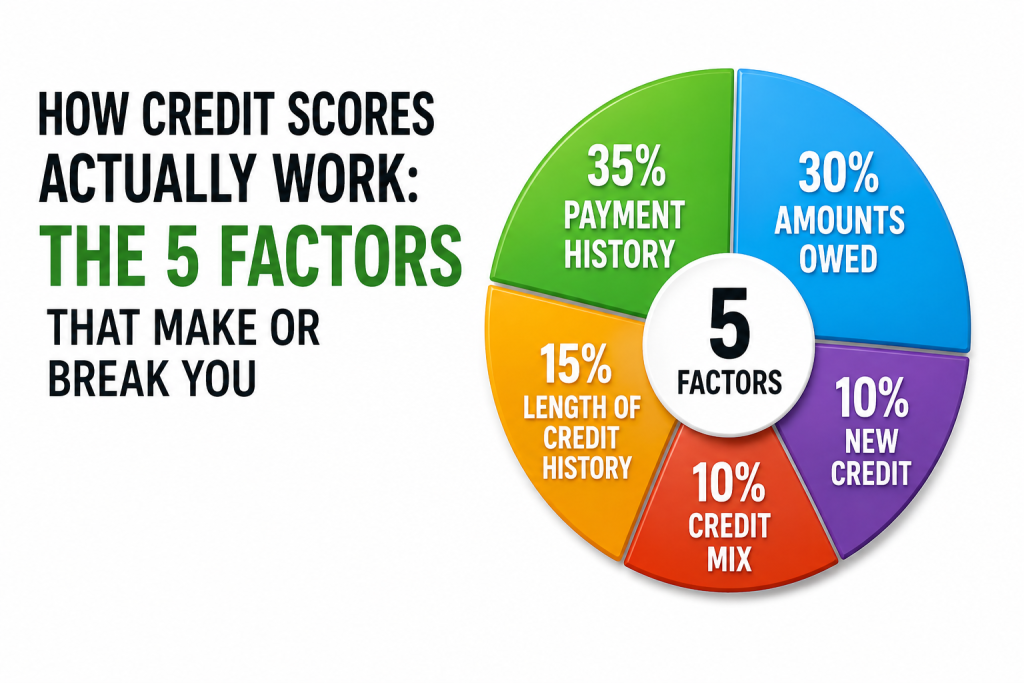
The five factors are: payment history, amounts owed, length of credit history, new credit, and credit mix. Each factor has a different weight in the calculation of your score. By understanding how each factor contributes to your score, you can take targeted actions to improve it. This article breaks down each factor in detail, explaining what they mean, why they matter, and how you can optimize them to achieve your financial goals.
FACTOR 1: PAYMENT HISTORY – 35%
Payment history is the single most important factor in your credit score. It makes up 35% of your FICO Score. Do you tend to pay your bills on time, or do you have a history of late or missed payments? “Payment history makes a bigger impact on a person’s credit score than anything else—35%,” says Brian Walsh, CFP® and Head of Advice & Planning at SoFi. “So the most important rule of credit is this: Don’t miss payments. Timely payments are crucial, and making at least the minimum payment on a revolving credit line can make a positive impact on a person’s credit score.”
Both installment loans (personal loans, mortgage loans, and student loans) and revolving credit such as credit cards can affect your payment history. Since it is such an important factor, making payments on time every time is the best way to make sure your payment history is a positive one. The most effective way to maintain a positive payment history is to automate your payments. Set up automatic payments for at least the minimum amount due on all your accounts. This ensures you never miss a payment, even if life gets busy.
Payment history includes several specific data points that lenders evaluate. These include whether you pay your bills on time, how late payments are (30 days, 60 days, 90 days, etc.), the frequency and severity of late payments, and how recent the late payments are. More recent late payments have a greater negative impact than older ones. A single 30-day late payment can drop your score by 60 to 110 points, depending on your starting score. The higher your score, the more damaging a late payment can be.
How to Optimize Payment History:
The most important step is to pay every bill on time, every time. Setting up automatic payments can help you avoid missed payments. If you have missed payments, bring your accounts current as soon as possible. The impact of a late payment lessens over time, especially if you maintain a consistent record of on-time payments afterward. Consider setting up payment reminders on your phone or calendar. Many credit card companies also offer text or email alerts to remind you when payments are due.
FACTOR 2: AMOUNTS OWED – 30%
The amount of debt you owe in relation to the amount of debt available to you via your various lines of credit is called your credit utilization ratio. It is the second-most important factor in the calculation of your FICO Score, accounting for 30% of your score. Having debt isn’t the issue, but using most of your available debt is seen as relying on credit to meet your financial obligations.
Credit utilization is based on revolving debt, not installment debt. If you are keeping your credit card balance well below your credit limit, it is a good indicator that you are not overspending. If you have more than one credit card, consider the percentage of available credit you are using on each of them. If one has a higher credit utilization than the others, it might be a good idea to use that one less often.
Understanding Credit Utilization:
Credit utilization is the percentage of your total available revolving credit that you are currently using. Revolving credit refers to accounts where you can borrow, repay, and borrow again—like credit cards and lines of credit. It does not include installment loans like car loans or mortgages. The basic formula is straightforward: Credit utilization = (total credit balances / total credit limits) x 100. For example, if you have a credit card with a $10,000 limit and your current balance is $2,000, your credit utilization on that card is 20%.
The 30% Rule:
Financial experts generally recommend keeping your credit utilization below 30% of your total available credit. However, the lower your utilization, the better. Those with excellent credit scores typically have utilization rates below 10%. This means if you have a total credit limit of $10,000 across all your cards, you should aim to keep your total balances below $3,000, and ideally below $1,000.
How to Optimize Amounts Owed:
The most effective strategy is to pay down your credit card balances. If you can pay your balance in full each month, that is even better. You can also request a credit limit increase, which automatically lowers your utilization ratio if you do not increase your spending. Another strategy is to spread your balances across multiple cards rather than maxing out one card. Avoid closing old credit cards, as this reduces your total available credit and can increase your utilization ratio.
FACTOR 3: LENGTH OF CREDIT HISTORY – 15%
Length of credit history accounts for 15% of your FICO Score. This factor’s percentage may not be as high as the previous two, but it is still important. As with payment history, lenders tend to look at a person’s credit history as predictive of their credit future. If there is no credit history or a short credit history, a lender does not have much information on which to base a lending decision.
The longer your credit history, the more data lenders have to assess your creditworthiness. This factor considers the age of your oldest account, the age of your newest account, and the average age of all your accounts. This is why it is often recommended to keep older accounts open even if you are not using them actively.
What Credit History Includes:
Credit history includes how and when you have managed paying off debts, such as credit cards and loans. This history is recorded in your credit reports. A longer credit history can help your score because credit scores are based on experience over time. Your score improves the longer you have credit, open different types of accounts, and pay back what you owe on time.
The average age of your accounts is calculated by adding the ages of all your accounts and dividing by the number of accounts. For example, if you have three credit cards that are 10, 5, and 2 years old, your average account age is approximately 5.6 years. The age of your oldest account is also considered. A consumer with a 20-year-old account will generally have a higher score than someone with a 2-year-old account, all else being equal.
How to Optimize Length of Credit History:
The most important strategy is to keep older accounts open. Even if you are not using a credit card, keeping it open contributes to your average age of accounts. Avoid opening too many new accounts at once, as this lowers your average age. If you are a young adult just starting your credit journey, consider becoming an authorized user on a family member’s old, well-managed credit card. This can give you a significant boost in length of credit history.
FACTOR 4: NEW CREDIT – 10%
New credit accounts for 10% of your FICO Score. Credit scores look at your recent credit activity as an indicator of your need for credit. If you apply for a lot of credit over a short period of time, it may appear that your money situation has changed for the worse. Frequently opening accounts and transferring balances can hurt your score too. Only apply for credit you need.
Each time you apply for credit, a hard inquiry is placed on your credit report. Multiple hard inquiries in a short period can lower your score. The impact of a single hard inquiry is typically small—around 5 points—but multiple inquiries can add up. However, FICO does group inquiries for certain types of loans (mortgage, auto, student loans) within a 45-day window, treating them as a single inquiry to allow for rate shopping.
How to Optimize New Credit:
The most important strategy is to apply for credit only when you need it. Avoid opening multiple credit card accounts in a short period. Space out your credit applications. If you are shopping for a mortgage or auto loan, do your rate shopping within a 45-day window to minimize the impact on your score. Also, be cautious about opening store credit cards just for a one-time discount—these can hurt your score more than the savings are worth.
FACTOR 5: CREDIT MIX – 10%
Credit mix accounts for 10% of your FICO Score. Having multiple types of credit can have a positive effect on your FICO Score. Being responsible with both revolving and installment credit accounts shows lenders that you can successfully manage debt.
Revolving accounts are those that are open-ended, such as a credit card. You can borrow money up to your credit limit, repay it, and borrow it again. Installment accounts are closed-ended. There is a certain amount of credit extended to you and you receive that money in a lump sum. It is repaid in regular installments over a set period of time. Credit mix won’t make or break your ability to qualify for a loan, but having different types of debt indicates to lenders that you are likely to be a good lending risk.
How to Optimize Credit Mix:
You should not take on debt you do not need just to improve your credit mix. However, if you have only credit cards, consider whether an installment loan makes sense for your financial situation. For example, if you are planning to buy a car, financing it responsibly can add an installment loan to your credit mix. Student loans also contribute to credit mix. The key is to manage all your accounts responsibly, regardless of the type.
HOW EACH FACTOR IMPACTS YOUR SCORE
| Factor | Weight | Impact |
|---|---|---|
| Payment History | 35% | Most important. A single late payment can drop your score significantly. |
| Amounts Owed | 30% | High utilization signals risk. Keep below 30%, ideally below 10%. |
| Length of Credit History | 15% | Longer is better. Keep old accounts open. |
| New Credit | 10% | Too many new accounts signals risk. Space out applications. |
| Credit Mix | 10% | Having both revolving and installment accounts is beneficial. |
COMMON MISTAKES THAT HURT YOUR SCORE
Mistake 1: Missing a payment. Even one late payment can drop your score by 60-110 points. The impact is greater for those with higher scores.
Mistake 2: Maxing out credit cards. Using more than 30% of your available credit signals financial stress to lenders. Keeping utilization below 10% is ideal.
Mistake 3: Closing old accounts. This reduces your available credit and shortens your credit history, both of which can lower your score.
Mistake 4: Applying for too much credit at once. Each hard inquiry can lower your score by a few points, and multiple inquiries can add up.
Mistake 5: Co-signing for someone who misses payments. When you co-sign a loan, you become equally responsible for the debt. If the primary borrower misses payments, it hurts your credit too.
HOW TO MONITOR YOUR PROGRESS
Regularly monitoring your credit score and credit report is essential for understanding how your actions affect your score. You can get free credit reports from each of the three major credit bureaus—Equifax, Experian, and TransUnion—once per year at AnnualCreditReport.com. Many credit card companies and banks also offer free credit score monitoring as a benefit to their customers.
When you check your credit report, look for errors that could be dragging down your score. Common errors include incorrect personal information, accounts that do not belong to you, and payment history errors. If you find an error, you can dispute it with the credit bureau. The dispute process is free and can result in significant score improvements if errors are corrected.
CONCLUSION
Your credit score is determined by five key factors, each with a different weight in the calculation. Payment history is the most important factor, accounting for 35% of your score, followed by amounts owed at 30%, length of credit history at 15%, and new credit and credit mix at 10% each. By understanding these factors and taking targeted actions to improve each one, you can steadily build a strong credit score that opens doors to better financial opportunities.
The journey to a great credit score is not a sprint—it is a marathon. Small, consistent actions over time yield the best results. Pay your bills on time, keep your credit utilization low, maintain older accounts, apply for new credit sparingly, and manage a healthy mix of credit types. With patience and discipline, you can achieve the credit score you deserve.
About the Author: David Williams is a financial journalist with over 15 years of experience covering global financial markets, technology, and investing. He has worked for leading financial publications and is a frequent contributor to major financial news networks.
Disclaimer: This article is for informational purposes only and should not be considered financial or investment advice. Always conduct your own research or consult a qualified financial advisor before making financial decisions.