
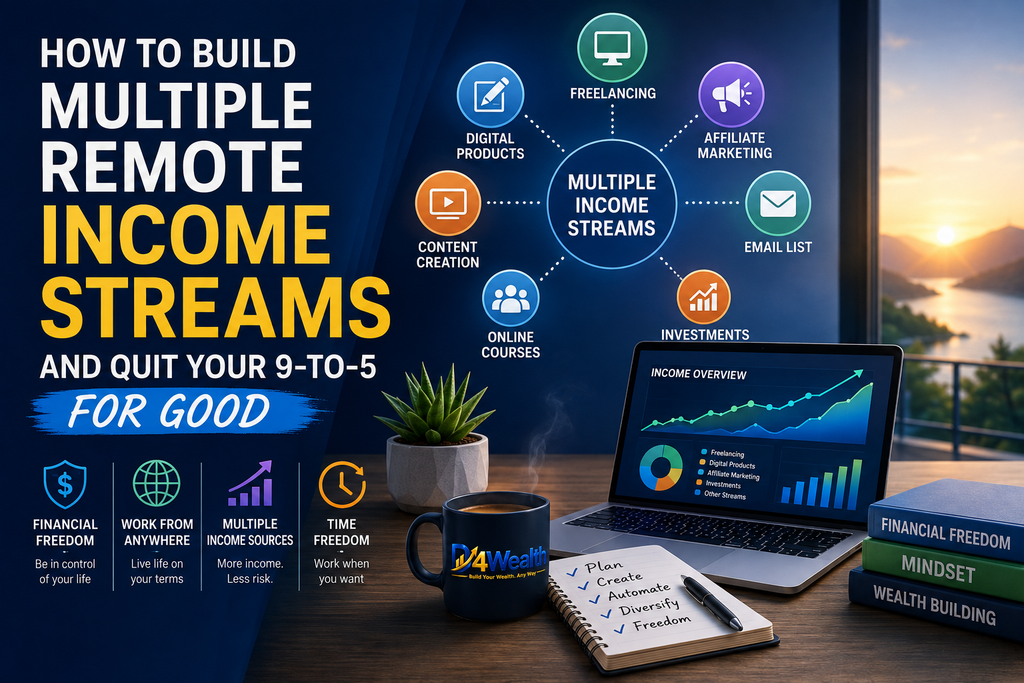
How to Build Multiple Remote Income Streams and Quit Your 9-to-5 for Good

INTRODUCTION
Imagine waking up without an alarm clock. No commute. No boss breathing down your neck. No dread of Monday mornings. This is not a fantasy—it is the reality of financial freedom. And it is achievable by building multiple remote income streams that replace your 9-to-5 income.
The average millionaire has at least seven sources of income. The wealthy do not rely on a single paycheck—they build portfolios of income streams that work for them around the clock. In 2026, building multiple remote income streams is more accessible than ever. The tools, platforms, and opportunities exist for anyone willing to take action.
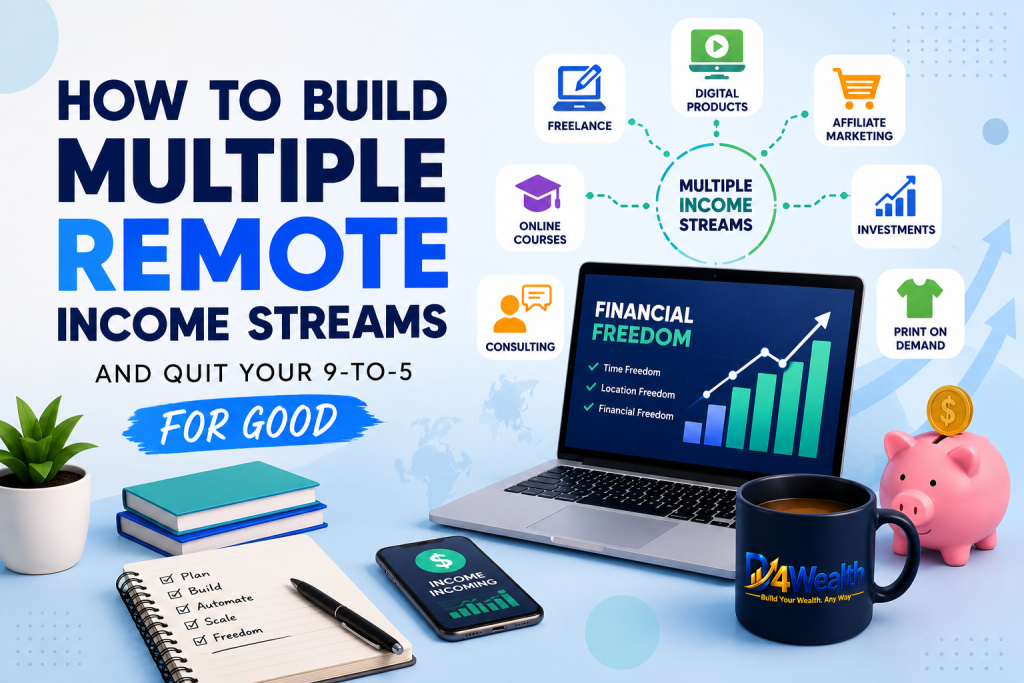
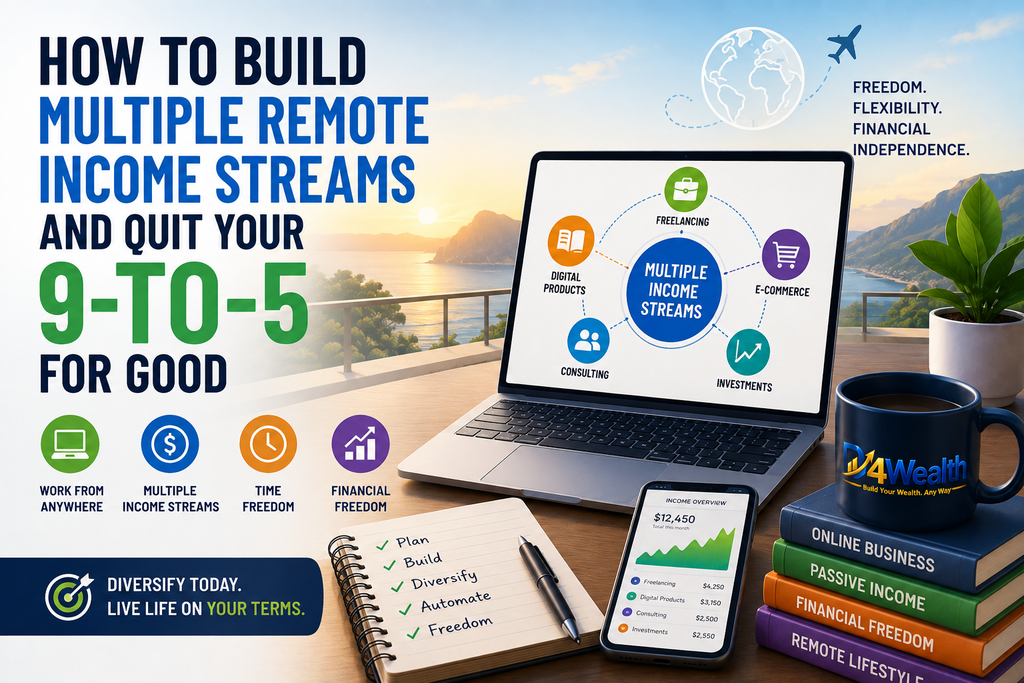
This article reveals a proven framework for building multiple remote income streams—from freelancing and consulting to digital products and investments. Whether you want to quit your job entirely or simply create a safety net, this guide provides the blueprint.
According to recent data, 47 million Americans are freelancing, and the number of people with multiple income streams has grown by 45% since 2020. The traditional single-income model is dying. The future belongs to those who diversify their income.
1. Why Multiple Income Streams Are Essential
Relying on a single income source is risky. If you lose your job, your entire financial life crumbles. The traditional 9-to-5 model is increasingly unstable. Companies are downsizing, automating, and outsourcing. Job security is a myth.
The Risks of a Single Income Source:
The first and most obvious risk is financial vulnerability. One lost client, one company restructuring, or one recession can wipe out your only source of income. This vulnerability creates stress and anxiety that affects every aspect of your life. The second risk is limited growth potential. When you trade your time for money, your income is capped by the number of hours you can work. There is only so much you can earn in a traditional job, regardless of how good you are.
The third risk is lack of freedom. A single income source often means a single location, single schedule, and single boss. You do not control your time or your life. The fourth risk is reduced resilience. When you have multiple income streams, you can absorb shocks. If one stream dries up, others continue to flow. This resilience provides peace of mind and freedom.
The Benefits of Multiple Income Streams:
Multiple income streams provide financial security. When one stream experiences a downturn, others continue to generate income. This diversification reduces the impact of any single loss. They also offer the potential for exponential growth. While a salary grows linearly (a few percent per year), multiple income streams can compound, creating wealth that grows faster than inflation.
Multiple income streams create freedom and flexibility. When you are not dependent on a single job, you can choose where to live, when to work, and what to do. This freedom is the ultimate benefit of building multiple income streams. They also accelerate wealth building. Each new stream adds to your total income, accelerating your ability to save, invest, and build wealth.
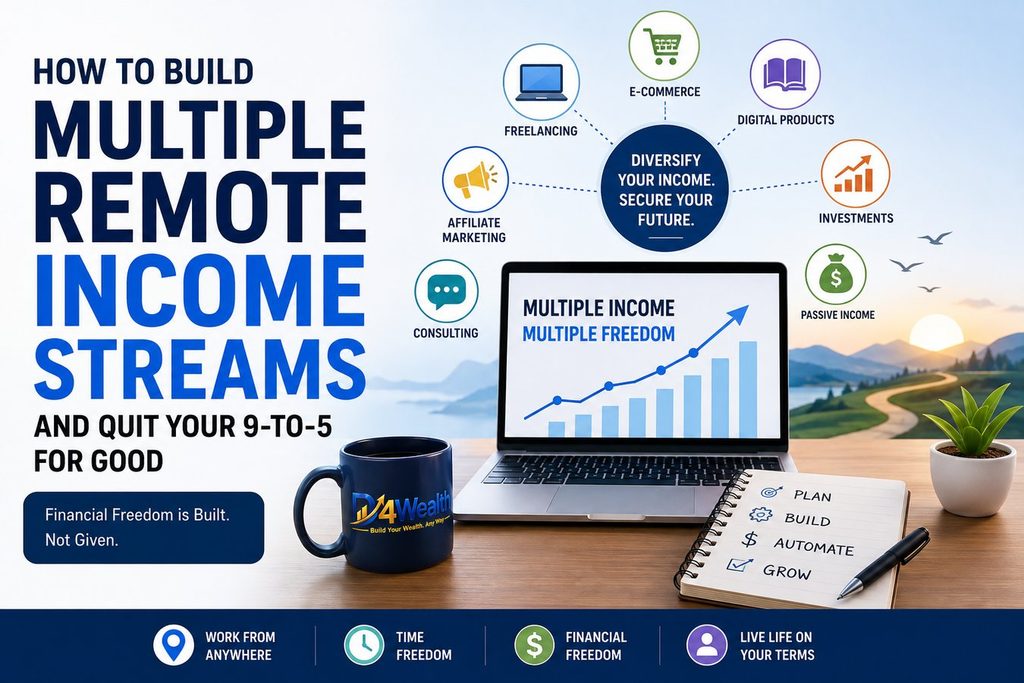
2. The Four Types of Income Streams
Understanding the different types of income streams helps you build a balanced portfolio. Each type has different characteristics in terms of effort, scalability, and time commitment.
Active Income:
Active income is earned through direct work. You trade your time and effort for money. This includes freelancing, consulting, coaching, and service-based work. Active income is the foundation of any income portfolio because it provides immediate cash flow. The downside is that it is not scalable—you are limited by your time and energy.
Active income is the fastest way to generate cash. If you need money quickly, active income is the answer. It is also the most controllable because you directly determine how much you earn. However, it is also the most limited because you cannot work more than 24 hours per day.
Passive Income:
Passive income is earned with minimal ongoing effort. Once you create an asset, it generates income without requiring constant attention. Examples include digital products, affiliate marketing, and investments. Passive income is the ultimate goal because it decouples your income from your time.
Passive income provides freedom. When you have passive income, you can choose how to spend your time because you are not trading hours for dollars. Passive income is also scalable because you can create assets once and sell them to thousands of people. However, passive income requires significant upfront work to create the asset and build the systems.
Semi-Passive Income:
Semi-passive income requires some ongoing effort but not full-time commitment. Examples include coaching, consulting, and membership sites. These income streams require active management but are not as time-intensive as pure active income.
Semi-passive income offers flexibility. You can manage these streams around your other commitments. They also provide a bridge between active and passive income. They generate more income than pure passive income but require less effort than active work.
Portfolio Income:
Portfolio income comes from investments. This includes dividends, interest, and capital gains from stocks, bonds, and real estate. Portfolio income requires capital to generate, but it can become a significant source of income over time.
Portfolio income is highly scalable because you can invest as much capital as you have. It is also truly passive because investments require minimal ongoing management. However, portfolio income requires capital, which takes time to accumulate.
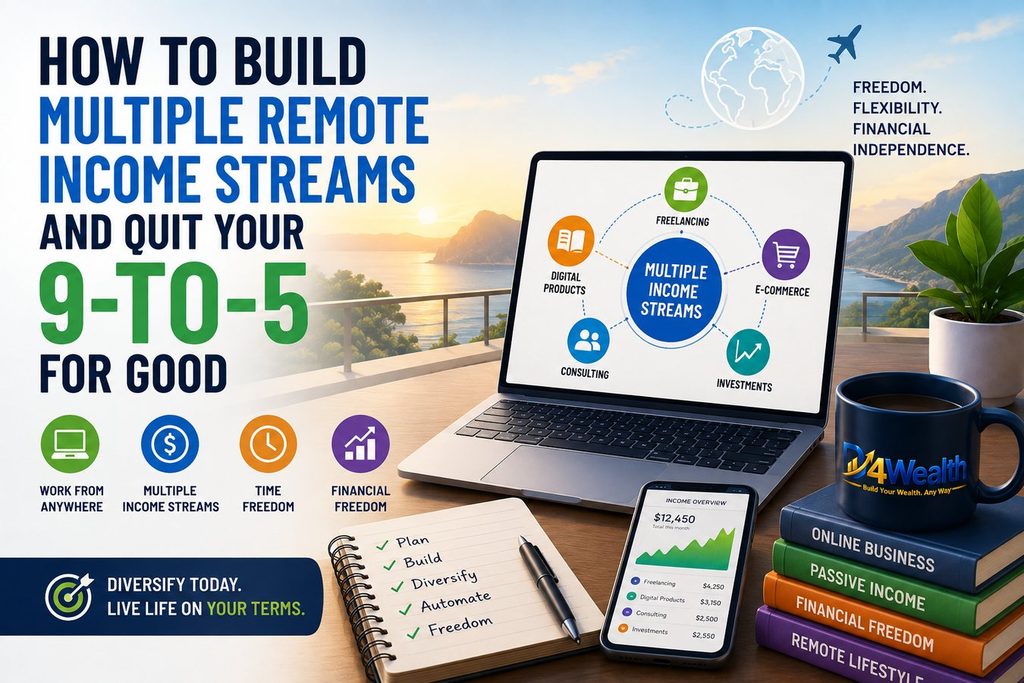
From skill to income: a five-stage path from monetizing skills to long-term investing
3. The Five-Stage Framework
Building multiple income streams is not a one-step process. It follows a predictable progression from active to passive income.
Stage 1: Build Your Core Skill
The journey begins by building a high-value skill. This skill is the foundation of your income portfolio. It is what you will use to generate your first income streams. Your core skill could be writing, design, development, consulting, coaching, or any other in-demand capability.
The key is to choose a skill that has market demand and that you can develop to a professional level. This skill will be your primary income generator in the early stages. You can build this skill through courses, practice, and real-world experience.
Stage 2: Monetize Your Skill
Once you have a skill, you need to monetize it. This starts with active income—freelancing, consulting, or service-based work. You sell your time and expertise to clients who need your skill.
The goal at this stage is to generate consistent cash flow while building your reputation, portfolio, and client base. This income will fund your transition to more scalable income streams.
Stage 3: Create Scalable Assets
Once you have consistent active income, you can invest time in creating scalable assets. These are digital products, courses, templates, and tools that can be sold repeatedly without additional time investment.
Creating scalable assets is the transition from active to passive income. It requires upfront effort but pays off through ongoing revenue. This stage is where your income starts to decouple from your time.
Stage 4: Build Systems and Automate
As your income streams grow, you need to build systems to manage them efficiently. This includes automating marketing, sales, and delivery processes. Automation frees your time to focus on creating new streams.
Systems and automation are essential for scaling your income. Without them, you become the bottleneck, and your income is limited by your capacity to manage the business.
Stage 5: Invest for Long-Term Growth
The final stage is investing your surplus income into assets that generate portfolio income. This includes stocks, bonds, real estate, and other investments. These investments generate income that is truly passive and does not require your time or attention.
Investing for long-term growth creates wealth that grows independently of your efforts. It is the ultimate expression of financial freedom because your money works for you.
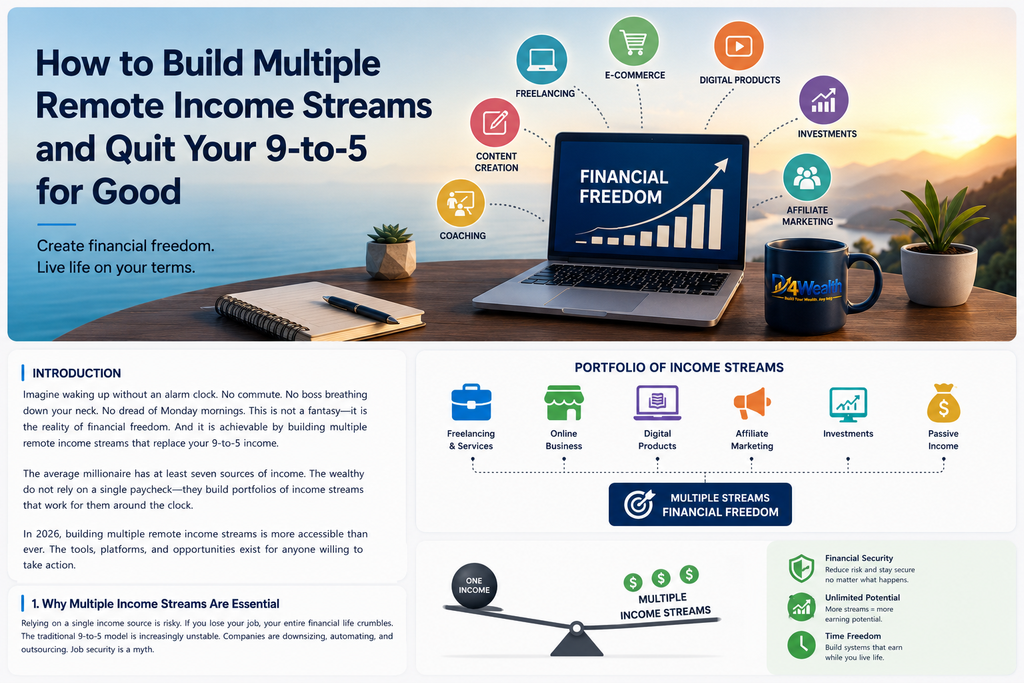
Building your first income streams with digital products, affiliate marketing and online services
4. Building Your First Streams
Building your first income streams is the most critical step. Here are practical strategies for each type of income stream.
Active Income Strategies:
Start by offering your services on freelance platforms. Upwork, Fiverr, and Contra are excellent starting points. Create a compelling profile that highlights your expertise. Target small to medium projects to build your portfolio and reviews. Once you have reviews and a portfolio, raise your rates and target larger projects.
Consider offering coaching or consulting in your area of expertise. Coaching and consulting pay significantly more than freelance work because you are selling your expertise rather than your time. Many freelancers transition to coaching after building their reputation.
Passive Income Strategies:
Digital products are the most accessible passive income stream. Create an ebook, a course, a template, or a guide. Sell it on Gumroad, Etsy, or your own website. Once created, digital products generate income indefinitely without additional effort.
Affiliate marketing is another accessible passive income stream. Promote products you trust and earn commissions on sales. Amazon Associates and ShareASale are popular affiliate programs. Build a blog, YouTube channel, or social media following to share your affiliate links. Affiliate marketing works best when you recommend products you genuinely use and trust.
Semi-Passive Income Strategies:
Membership sites provide recurring income. Create a community where members pay a monthly fee for exclusive content, coaching, or resources. Platforms like Patreon make it easy to set up memberships.
Coaching programs that run in cohorts are semi-passive. You run a cohort once or twice a year and generate significant income from each cohort. The preparation is front-loaded, but the delivery is ongoing.
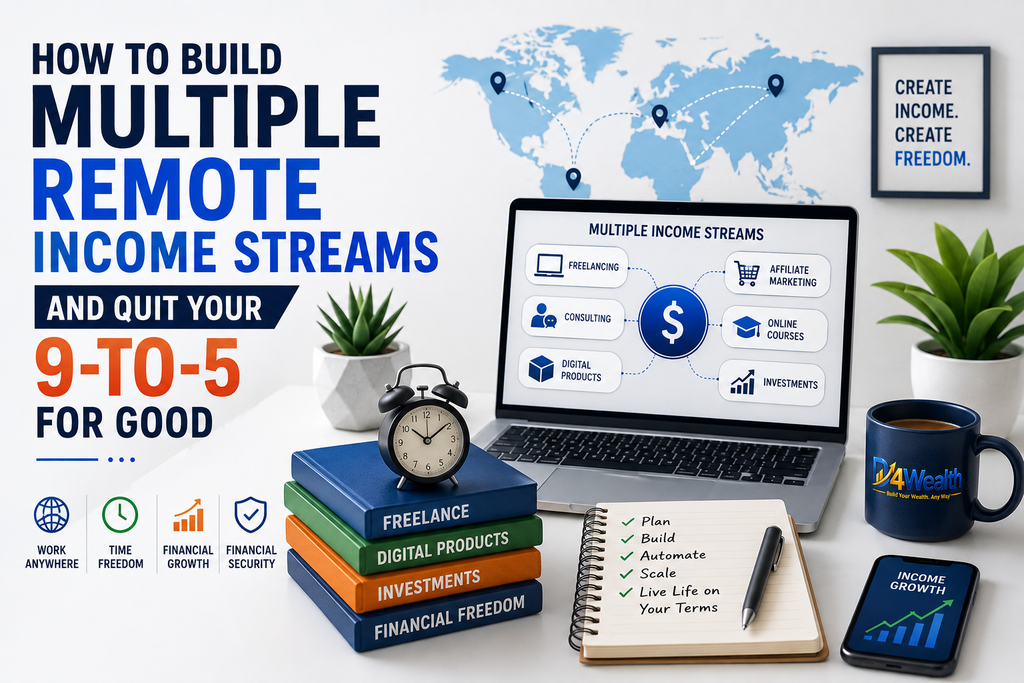
Scaling your income portfolio through automation, systems, outsourcing and compounding
5. Scaling Your Income Portfolio
Once you have your first income streams, the goal is to scale them. Scaling means increasing your income without proportionally increasing your time investment.
Scaling Principles:
The first principle is to focus on what works. Once you find a profitable income stream, double down on it. Stop spending time on things that are not producing results. The second principle is to automate. Use tools to automate marketing, sales, and delivery processes. Automation frees your time to focus on high-value activities.
The third principle is to outsource. Hire freelancers or virtual assistants to handle tasks that are not your core strength. This allows you to focus on the work that generates the highest return. The fourth principle is to compound your efforts. Invest your surplus income into creating new income streams. This accelerates your growth and builds wealth faster.
Advanced Scaling Strategies:
Consider creating multiple digital products rather than focusing on a single product. Each product adds another income stream. Offer a product suite or bundle to increase average order value. This can significantly increase your revenue without much additional effort.
Consider building an audience through content marketing. An audience provides a platform to promote your products and services. This makes it easier to launch new income streams and scale your income.
Consider partnerships and joint ventures. Partner with other creators or businesses to expand your reach and income. Joint ventures allow you to leverage someone else’s audience and expertise.
Financial independence: turning multiple income streams into greater time and location freedom
6. The Financial Independence Number
To quit your 9-to-5, you need to know your financial independence number. This is the amount of passive and semi-passive income you need to cover your living expenses. Once you achieve this, you have the freedom to choose whether to work or not.
Calculating Your FI Number:
The first step is to calculate your annual living expenses. Include all essential expenses like housing, food, transportation, insurance, and healthcare. Be honest and thorough. The second step is to divide your annual expenses by your desired withdrawal rate. The standard withdrawal rate is 4%, but you can choose a more conservative rate.
For example, if your annual expenses are $50,000, and you use a 4% withdrawal rate, you need $1,250,000 in investment assets. This is your financial independence number. However, you can achieve financial independence with passive income without requiring a million dollars. If you build $50,000 in annual passive income through digital products and affiliate marketing, you have achieved financial independence.
The Freedom to Choose:
Financial independence does not mean you stop working. It means you have the freedom to choose whether and how to work. You can choose work that is meaningful and fulfilling. You can take a sabbatical to travel. You can start a nonprofit. The choice is yours.
Financial independence provides peace of mind. You are not at the mercy of a boss, a company, or an economy. You control your time, your income, and your life. This freedom is the ultimate benefit of building multiple income streams.
The 90-Day Action Plan
📋 Your Step-by-Step Guide
Month 1: Foundation
Identify your core skill and develop it. Create profiles on 2-3 freelance platforms. Start building your portfolio.
Month 2: Income Generation
Land your first client or project. Create your first digital product. Start building your audience.
Month 3: Scale and Diversify
Create a second income stream. Build systems to automate your work. Start investing in new income streams.
Conclusion
Building multiple remote income streams is not a fantasy. It is a proven path to financial freedom. The journey starts with building a high-value skill, monetizing it through active income, creating scalable assets, building systems, and investing for long-term growth.
The tools are available. The platforms exist. The opportunities are growing. The only question is whether you will take the next step toward building multiple income streams and quitting your 9-to-5 for good.
Your journey to financial freedom starts today.