
How Credit Utilization Works: Master the 30% Rule and Watch Your Score Climb
INTRODUCTION
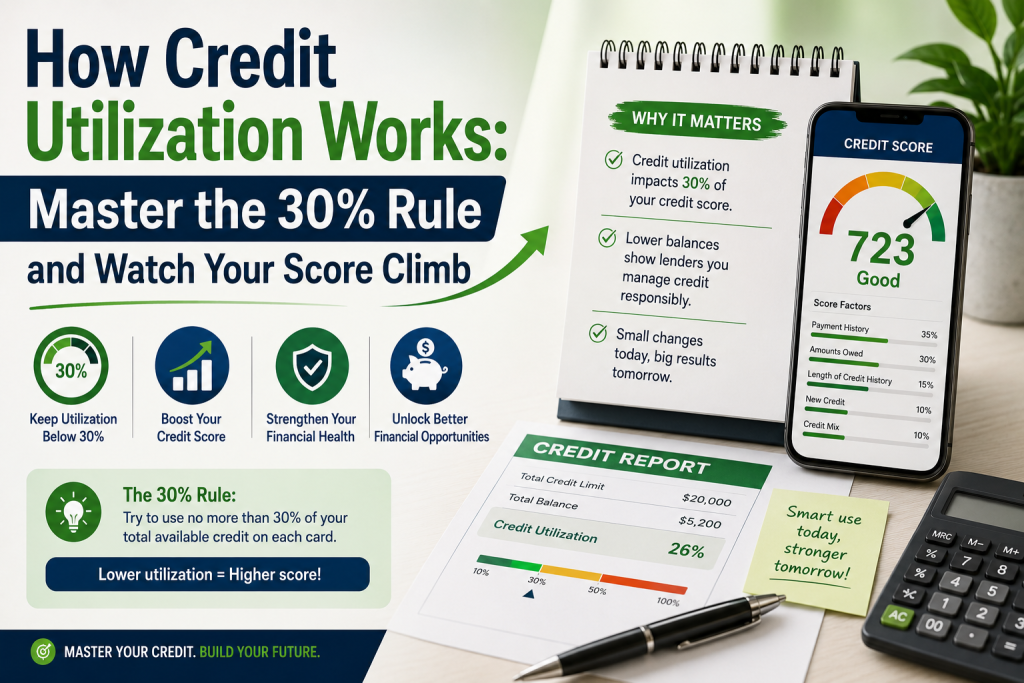
Credit utilization is the second-most important factor in your credit score, accounting for 30% of your FICO Score. Yet it is one of the most misunderstood aspects of credit. Many people do not even know what credit utilization is, let alone how to manage it effectively. If you want to improve your credit score, understanding and mastering credit utilization is essential. This guide explains what credit utilization is, why it matters, how the 30% rule works, and how you can use it to boost your credit score.
Credit utilization is the percentage of your available credit that you are currently using. It is calculated by dividing your total credit card balances by your total credit limits. For example, if you have a credit card with a $10,000 limit and a $3,000 balance, your credit utilization is 30%. Financial experts recommend keeping your credit utilization below 30% for the best scores. However, those with excellent credit scores typically have utilization rates below 10%. The lower your credit utilization, the better your credit score.
WHY CREDIT UTILIZATION MATTERS
Credit utilization is a measure of how much of your available credit you are using. Lenders view high utilization as a sign that you may be overextended and struggling to manage your debt. Low utilization, on the other hand, signals that you are using credit responsibly and not relying too heavily on borrowed money. This is why credit utilization has such a significant impact on your credit score. A person with a credit utilization of 30% will typically have a higher credit score than someone with a utilization of 50%, even if all other factors are the same.
The impact of credit utilization on your score is immediate. Unlike payment history, which takes time to build, credit utilization is calculated based on your current balances. This means you can improve your score quickly by paying down your balances. If you pay down a credit card balance, your credit utilization will drop, and your score can improve within 30 days when the new balance is reported to the credit bureaus.
THE 30% RULE EXPLAINED
The 30% rule is a guideline that recommends keeping your credit utilization below 30% of your total available credit. This rule is based on credit scoring models, which tend to penalize borrowers with utilization above 30%. However, the 30% rule is not a hard and fast rule—it is a general guideline. Borrowers with excellent credit scores typically have utilization rates below 10%. The lower your credit utilization, the better your credit score.
It is important to understand that the 30% rule applies to your overall credit utilization and your individual card utilization. If you have multiple credit cards, you should aim to keep each card’s utilization below 30% and your overall utilization below 30%. For example, if you have two credit cards with limits of $5,000 each, you should keep the balance on each card below $1,500 and your total balance below $3,000.
HOW CREDIT UTILIZATION IS CALCULATED
Credit utilization is calculated by dividing your total credit card balances by your total credit limits. The formula is simple: Credit Utilization = (Total Credit Card Balances / Total Credit Limits) x 100. For example, if you have a credit card with a $10,000 limit and a $3,000 balance, your credit utilization is 30%. If you have multiple credit cards, add up the balances and divide by the total credit limits.
It is important to note that only revolving credit accounts—such as credit cards—are included in credit utilization calculations. Installment loans, such as mortgages and auto loans, are not included. This means that even if you have a large mortgage, it does not affect your credit utilization. Only credit card balances and other revolving accounts matter.
The timing of your credit utilization is also important. Credit utilization is based on the balance reported on your credit card statement, not your current balance. If you pay your balance in full after your statement is generated, the balance on your statement will be reported to the credit bureaus. This means your credit utilization may be higher than it needs to be, even if you pay your balance in full each month.
HOW TO CALCULATE YOUR CREDIT UTILIZATION
Calculating your credit utilization is simple. First, add up the balances on all your credit cards. Next, add up the credit limits on all your credit cards. Then, divide your total balances by your total limits and multiply by 100. For example, if you have three credit cards with balances of $500, $1,000, and $1,500, and limits of $5,000, $10,000, and $15,000, your total balance is $3,000 and your total limit is $30,000. Your credit utilization is 10%.
The lower your credit utilization, the better your credit score. If your credit utilization is above 30%, you should take steps to reduce it. The most effective way to reduce your credit utilization is to pay down your credit card balances. You can also request a credit limit increase, which lowers your utilization ratio if you do not increase your spending.
STRATEGIES TO LOWER YOUR CREDIT UTILIZATION
There are several strategies to lower your credit utilization. The most effective strategy is to pay down your credit card balances. Even a small reduction in your balance can lower your utilization and improve your score. If you have multiple credit cards, focus on paying down the cards with the highest utilization first.
You can also request a credit limit increase. A credit limit increase lowers your utilization ratio if you do not increase your spending. For example, if you have a credit card with a $5,000 limit and a $1,500 balance, your utilization is 30%. If you request a credit limit increase to $10,000 and your balance remains $1,500, your utilization drops to 15%. A credit limit increase can be a quick and easy way to lower your utilization.
Another strategy is to make multiple payments throughout the month. Credit utilization is based on the balance reported on your statement. If you make a payment before your statement closes, the balance reported to the credit bureaus will be lower. This can lower your utilization without reducing your spending.
You can also spread your balances across multiple credit cards. If you have one card with a high balance, transferring some of that balance to another card can lower your utilization on each card. However, be careful with balance transfers, as they often come with fees and may not be worth the cost.
Finally, consider opening a new credit card. Opening a new credit card adds to your available credit, which lowers your utilization ratio. However, opening a new credit card also results in a hard inquiry, which can temporarily lower your score. Only open a new credit card if it makes financial sense for your situation.
THE IMPACT OF CREDIT UTILIZATION ON YOUR SCORE
The impact of credit utilization on your credit score is significant. Credit scoring models penalize borrowers with high utilization. A utilization rate above 30% can lower your score by 20 to 30 points. A utilization rate above 50% can lower your score by 50 points or more. The exact impact depends on your overall credit profile. People with limited credit history are more sensitive to high utilization.
The good news is that credit utilization is easy to improve. Unlike payment history, which takes time to build, credit utilization can be improved quickly by paying down your balances. If you pay down a credit card balance, your credit utilization will drop, and your score can improve within 30 days when the new balance is reported to the credit bureaus.
COMMON MYTHS ABOUT CREDIT UTILIZATION
There are several common myths about credit utilization. Myth 1: Closing credit cards improves your score. Closing credit cards reduces your available credit, which increases your utilization ratio. Unless you have a very good reason to close a card, it is better to keep it open. Myth 2: You should keep your utilization at 30%. While 30% is a good target, lower is better. Borrowers with excellent credit scores typically have utilization below 10%. Myth 3: Utilization only matters when you apply for credit. Utilization is calculated monthly and affects your credit score all year round. Myth 4: You can ignore utilization if you pay your balance in full. Utilization is based on your statement balance, not whether you pay it off each month. Paying your balance before the statement closing date can help lower your utilization.
HOW TO MONITOR YOUR CREDIT UTILIZATION
Monitoring your credit utilization is essential for maintaining a good credit score. You can check your credit card balances and limits on your monthly statements or through your online account. You can also use free credit monitoring services that provide your credit utilization ratio. If your utilization is high, take steps to reduce it.
It is also important to check your credit reports for errors. If your credit report shows a credit limit that is lower than it should be, your utilization will appear higher than it actually is. If you find an error, dispute it with the credit bureau. Correcting the error can lower your utilization and improve your score.
CREDIT UTILIZATION VS. DEBT-TO-INCOME RATIO
Credit utilization is often confused with debt-to-income ratio, but they are different. Credit utilization is the percentage of your available credit you are using. Debt-to-income ratio is the percentage of your monthly income that goes toward debt payments. Credit utilization affects your credit score. Debt-to-income ratio affects your ability to qualify for a loan, but it does not directly affect your credit score. Lenders consider both when evaluating your creditworthiness. A high debt-to-income ratio can make it harder to qualify for a loan, even if you have a good credit score. Keeping both your credit utilization and debt-to-income ratio low is essential for your financial health.
SUMMARY OF KEY POINTS
Credit utilization accounts for 30% of your FICO Score. It is the percentage of your available credit you are using. The 30% rule recommends keeping your utilization below 30%. Lower utilization is better, with excellent scores typically below 10%. You can lower your utilization by paying down balances, requesting credit limit increases, and making multiple payments per month. Credit utilization is calculated monthly and can be improved quickly. Monitoring your utilization regularly helps you maintain a good credit score.
CONCLUSION
Credit utilization is a critical factor in your credit score. Understanding how it works and managing it effectively can help you improve your score and achieve your financial goals. The 30% rule is a good starting point, but remember that lower is better. By paying down your balances, keeping your spending in check, and monitoring your credit utilization regularly, you can build a strong credit score that opens doors to better financial opportunities. Your credit score is a reflection of your financial habits. By mastering credit utilization, you are taking an important step toward achieving financial freedom.
About the Author: The Financial Education Team is dedicated to helping individuals build strong financial foundations through clear, actionable guidance on credit, saving, and wealth-building.
Disclaimer: This article is for informational purposes only and should not be considered financial or investment advice. Always conduct your own research or consult a qualified financial advisor before making financial decisions.