
The S&P 500 Explained: Why This Index Is the Foundation of Most Portfolios

INTRODUCTION
The S&P 500 is the most famous stock market index in the world. It is the benchmark that professional money managers try to beat. It is the index that most 401(k) plans track. It is the foundation of countless investment portfolios. But what exactly is the S&P 500? Why does it matter so much? And why should you care? This guide answers these questions and explains why the S&P 500 should be a core part of your investment strategy.
The S&P 500 has been the backbone of many investors’ portfolios for decades. Its long-term returns have been remarkable. Since its inception in 1957, the S&P 500 has delivered an average annual return of about 10%. This means that $10,000 invested in the S&P 500 in 1957 would be worth over $4 million today. Understanding the S&P 500 is essential for any investor who wants to build long-term wealth.
WHAT IS THE S&P 500?
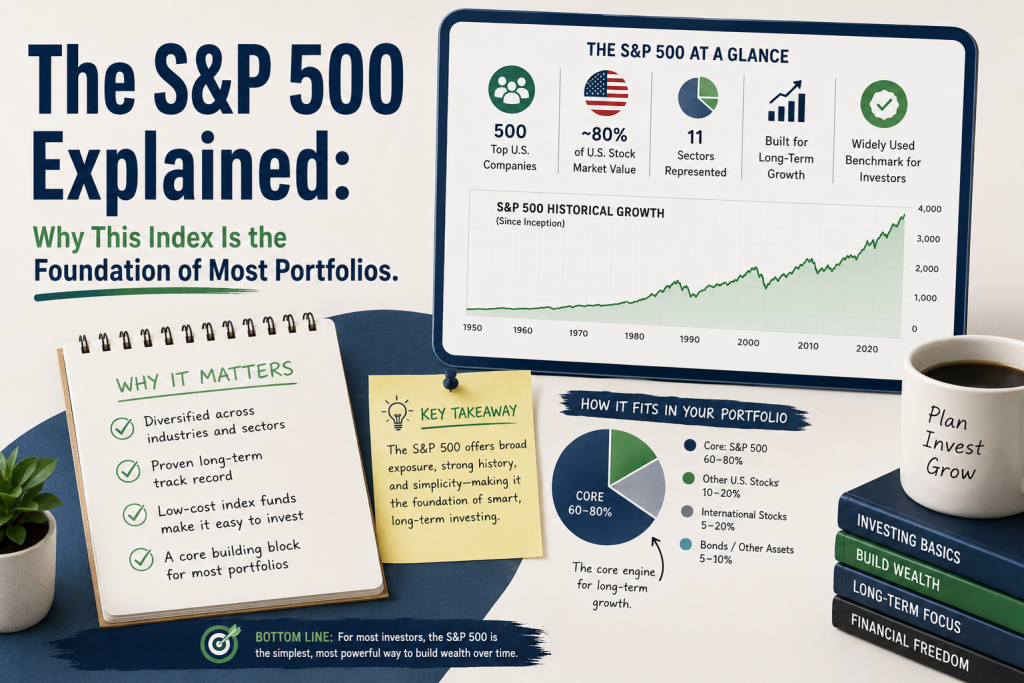
The S&P 500 is a stock market index that tracks the performance of 500 of the largest publicly traded companies in the United States. It is maintained by S&P Dow Jones Indices, a subsidiary of S&P Global. The S&P 500 is widely considered the best single gauge of large-cap U.S. equities. The index includes companies from all sectors of the economy, including technology, healthcare, financials, consumer goods, and energy. The companies in the S&P 500 represent about 80% of the total U.S. stock market capitalization.
The S&P 500 is not the same as the Dow Jones Industrial Average. The Dow tracks only 30 large companies and is price-weighted, meaning higher-priced stocks have more influence. The S&P 500 is market-cap weighted, meaning companies with larger market capitalizations have more influence. This makes the S&P 500 a more accurate reflection of the overall U.S. stock market.
HOW ARE COMPANIES SELECTED FOR THE S&P 500?
Companies are not automatically included in the S&P 500. They must meet specific criteria. The company must be a U.S. company, with a market capitalization of at least $14.6 billion. It must have positive earnings over the most recent four quarters and the most recent quarter. The stock must be highly liquid, meaning it is traded frequently. The company must have at least 50% of its shares available for public trading. The company must have a primary listing on a major U.S. exchange like the NYSE or Nasdaq.
The selection committee at S&P Dow Jones Indices reviews companies regularly. They consider factors like market capitalization, liquidity, and industry representation. The goal is to ensure the S&P 500 represents the U.S. economy accurately.
WHY THE S&P 500 IS THE FOUNDATION OF MOST PORTFOLIOS
The S&P 500 is the foundation of most investment portfolios for several reasons. The first is diversification. The S&P 500 includes 500 companies across all sectors of the economy. This provides instant diversification that reduces risk. If one sector underperforms, others may perform well, balancing out your returns. The second reason is long-term performance. The S&P 500 has delivered consistent long-term returns. Since its inception, it has returned an average of about 10% per year. This makes it an excellent core holding for long-term investors. The third reason is low cost. There are many low-cost index funds and ETFs that track the S&P 500. The Vanguard S&P 500 ETF (VOO) has an expense ratio of just 0.03%. This means you can invest in the S&P 500 for pennies per dollar. The fourth reason is simplicity. Investing in the S&P 500 is simple. You do not need to research individual companies or time the market. You just buy the index and hold it for the long term.
THE BENEFITS OF S&P 500 INDEX FUNDS
Investing in an S&P 500 index fund or ETF offers several benefits. Lower costs are a major advantage. Index funds have significantly lower expense ratios than actively managed funds. This means you keep more of your returns. Performance is another benefit. Most actively managed funds underperform the S&P 500 over the long term. By investing in an S&P 500 index fund, you are likely to outperform most active managers. Simplicity is a key benefit. You do not need to research individual stocks or build a complex portfolio. Just buy the index and hold it. Tax efficiency is another advantage. Index funds have lower turnover than actively managed funds, which means fewer capital gains distributions and lower taxes. Diversification is built into the index. You get exposure to 500 companies across all sectors of the economy.
THE S&P 500 VS. THE TOTAL STOCK MARKET
The S&P 500 tracks large-cap U.S. stocks. The total stock market includes large-cap, mid-cap, and small-cap stocks. While the S&P 500 represents about 80% of the U.S. stock market, the total stock market represents 100%. The performance of the total stock market is very similar to the S&P 500. Since large-cap stocks dominate the market, the two indexes move together. However, the total stock market provides slightly more diversification by including mid-cap and small-cap stocks. For most investors, the S&P 500 is sufficient. It provides excellent diversification and low cost. If you want more diversification, you can consider a total stock market ETF like VTI.
INTERNATIONAL DIVERSIFICATION: WHY IT MATTERS
While the S&P 500 provides excellent diversification within the U.S., it does not provide international diversification. The U.S. stock market represents about 60% of the global stock market. By not investing internationally, you are missing 40% of the global market. International diversification can reduce risk and improve returns. Different economies perform well at different times. By investing internationally, you are not reliant on a single economy. Most experts recommend allocating 20% to 40% of your stock portfolio to international stocks. This can be achieved through international index funds or ETFs.
THE HISTORICAL RETURNS OF THE S&P 500
The S&P 500 has delivered remarkable returns over the long term. Since its inception in 1957, the average annual return has been about 10%. This includes periods of significant volatility, including the 2008 financial crisis, the 2020 pandemic crash, and the 2022 bear market. The S&P 500 has also experienced long periods of underperformance. There were entire decades where the S&P 500 delivered negative returns. But over the long term, the index has consistently gone up. This is why the S&P 500 is such a powerful investment. Over periods of 20 years or more, the S&P 500 has never lost money.
WHY THE S&P 500 IS NOT A GET-RICH-QUICK SCHEME
The S&P 500 is a long-term investment. It is not a get-rich-quick scheme. The index can be volatile in the short term. It can drop 20%, 30%, or even 50% in a single year. This is why the S&P 500 is not appropriate for short-term goals. If you need money in the next five years, you should not invest it in the S&P 500. The long-term returns of the S&P 500 require patience and discipline. You must be willing to hold through market downturns. Those who panic and sell during downturns miss the recovery and lock in their losses.
COMMON MISTAKES TO AVOID
Avoid these common mistakes when investing in the S&P 500. Mistake 1: Trying to time the market. The S&P 500 is for long-term investing. Do not try to predict short-term movements. Mistake 2: Panic selling during downturns. Market downturns are normal. Stay invested and let the market recover. Mistake 3: Investing money you need in the short term. The S&P 500 is volatile in the short term. Only invest money you can leave for at least five years. Mistake 4: Paying high fees. Choose low-cost index funds or ETFs. Mistake 5: Not rebalancing. Rebalance your portfolio to maintain your target asset allocation.
CONCLUSION
The S&P 500 is the foundation of most investment portfolios for good reason. It offers diversification, long-term performance, low cost, and simplicity. By investing in an S&P 500 index fund or ETF, you can capture the returns of the U.S. stock market at a low cost. The S&P 500 is not a get-rich-quick scheme. It is a long-term investment that requires patience and discipline. But over time, the S&P 500 has consistently rewarded investors who stay the course. Start investing in the S&P 500 today and let compound interest work its magic.
About the Author: The Financial Education Team is dedicated to helping individuals build strong financial foundations through clear, actionable guidance on credit, saving, and wealth-building.
Disclaimer: This article is for informational purposes only and should not be considered financial or investment advice. Always conduct your own research or consult a qualified financial advisor before making investment decisions.