
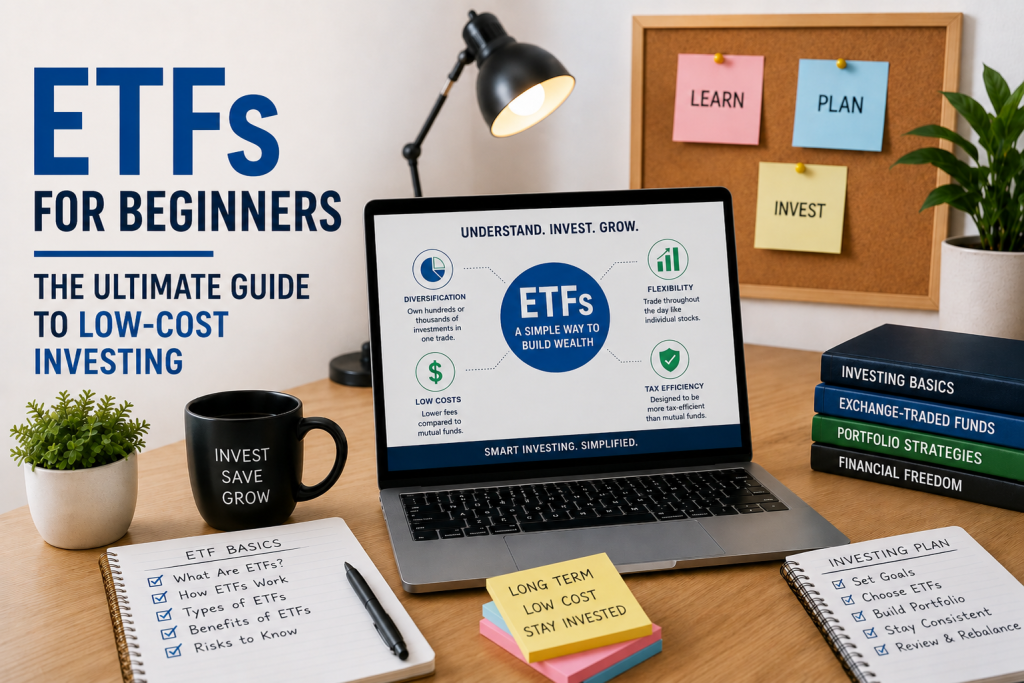
ETFs for Beginners: The Ultimate Guide to Low-Cost Investing

INTRODUCTION
Exchange-Traded Funds, or ETFs, have revolutionized investing. They offer a simple, low-cost way to build a diversified portfolio. In just a few decades, ETFs have grown from a niche product to one of the most popular investment vehicles in the world. Today, there are over 3,000 ETFs in the U.S. alone, with trillions of dollars in assets under management.
If you are new to investing, ETFs are one of the best places to start. They are easy to understand, accessible to investors with small budgets, and offer instant diversification. This guide explains what ETFs are, how they work, and how you can use them to build a low-cost, diversified portfolio.
WHAT ARE EXCHANGE-TRADED FUNDS?
An ETF is a type of investment fund that trades on stock exchanges like individual stocks. When you buy a share of an ETF, you are buying a basket of stocks, bonds, or other assets. This basket is designed to track the performance of a specific index, sector, or asset class. For example, the Vanguard S&P 500 ETF (VOO) tracks the S&P 500 index, which includes 500 of the largest U.S. companies. By buying one share of VOO, you are buying a small piece of all 500 companies in the index.
ETFs are similar to mutual funds but have some important differences. ETFs trade throughout the day like stocks, while mutual funds are priced once per day. ETFs generally have lower expense ratios than mutual funds. ETFs are more tax-efficient than mutual funds because they have lower turnover.
HOW ETFS WORK
ETFs are structured as investment companies or trusts that hold a portfolio of assets. The ETF issuer creates shares of the ETF and sells them on the stock exchange. When you buy a share of an ETF, you are buying a small piece of the underlying portfolio. The ETF trades on the stock exchange, and its price fluctuates throughout the day based on supply and demand.
The ETF’s price is generally close to the value of its underlying assets, known as the Net Asset Value (NAV). If the ETF’s price deviates from the NAV, arbitrageurs step in to bring the price back in line. This ensures that the ETF’s price reflects the value of its holdings.
THE ADVANTAGES OF ETFS
ETFs offer several advantages over other investment options. Lower costs are a major advantage. ETFs have significantly lower expense ratios than actively managed mutual funds. Many ETFs have expense ratios below 0.10%. Diversification is another key benefit. An ETF can provide exposure to hundreds or thousands of stocks or bonds in a single transaction. This reduces your risk compared to buying individual stocks. Trading flexibility is an advantage. ETFs trade throughout the day, allowing you to buy and sell at market prices. This is different from mutual funds, which are priced once per day. Tax efficiency is another benefit. ETFs have lower turnover than mutual funds, which means fewer capital gains distributions and lower taxes. Accessibility is a key factor. ETFs are accessible to investors with small budgets. Many brokers now offer fractional shares, allowing you to invest with as little as $1. Transparency is an advantage. ETFs disclose their holdings daily, so you always know what you are invested in.
TYPES OF ETFS
There are many different types of ETFs, each serving a different purpose. Stock ETFs track stock indexes like the S&P 500, Nasdaq, or Russell 2000. They provide exposure to the stock market. Bond ETFs track bond indexes and provide exposure to government, corporate, or municipal bonds. Sector ETFs track specific sectors of the economy like technology, healthcare, or energy. International ETFs track international stock markets outside the U.S. Commodity ETFs track commodities like gold, silver, or oil. Factor ETFs track specific factors like value, growth, or momentum. Thematic ETFs track specific themes like clean energy, cybersecurity, or artificial intelligence.
THE BEST ETFS FOR BEGINNERS
For beginners, the best ETFs are those that provide broad diversification at a low cost. The Vanguard S&P 500 ETF (VOO) tracks the S&P 500 and has an expense ratio of 0.03%. It is one of the most popular ETFs in the world. The Vanguard Total Stock Market ETF (VTI) tracks the entire U.S. stock market and includes small, mid, and large-cap stocks. The Vanguard Total International Stock ETF (VXUS) provides exposure to international stocks outside the U.S. The iShares Core U.S. Aggregate Bond ETF (AGG) tracks the U.S. bond market and is a good choice for bond exposure. The Schwab U.S. Dividend Equity ETF (SCHD) focuses on high-quality dividend-paying stocks and is a good choice for income investors.
HOW TO CHOOSE AN ETF
Choosing an ETF can be overwhelming given the number of options. Here are some factors to consider. Expense ratio is one of the most important factors. Lower is better. Look for ETFs with expense ratios below 0.20%. The index tracked by the ETF matters. Choose an ETF that tracks a well-known index like the S&P 500 or the total stock market. Assets under management are an important consideration. Larger funds are more liquid and less likely to close. The bid-ask spread is the difference between the buying and selling price. A narrower spread is better, especially for frequent traders. Dividends and distributions are a consideration. Some ETFs pay dividends, which may be important for income investors. The tracking error is how closely the ETF tracks its index. A lower tracking error is better.
HOW TO BUY ETFS
Buying ETFs is simple. First, open a brokerage account if you do not already have one. Then, deposit money into your account. Next, research the ETFs you want to buy. Decide which ETFs match your investment goals and risk tolerance. Place an order to buy the ETFs. You can place a market order to buy at the current price or a limit order to buy at a specific price. Monitor your investments regularly and rebalance as needed.
ETFS VS. MUTUAL FUNDS
ETFs and mutual funds are both investment funds, but they have important differences. ETFs trade throughout the day like stocks, while mutual funds are priced once per day. ETFs generally have lower expense ratios than mutual funds. ETFs are more tax-efficient than mutual funds. ETFs have lower minimum investment requirements, often as low as the price of one share. Mutual funds often have higher minimums, sometimes $1,000 or more. ETFs are generally more transparent than mutual funds, with daily disclosure of holdings.
COMMON MISTAKES TO AVOID
Avoid these common mistakes when investing in ETFs. Mistake 1: Trading too frequently. ETFs are designed for long-term investing. Frequent trading generates unnecessary costs and taxes. Mistake 2: Choosing ETFs with high fees. High fees eat into your returns. Choose low-cost ETFs. Mistake 3: Not diversifying. ETFs are a tool for diversification. Do not put all your money in a single ETF. Mistake 4: Ignoring the bid-ask spread. For smaller ETFs, the bid-ask spread can be significant. Mistake 5: Chasing past performance. Past performance does not guarantee future results. Choose ETFs based on your investment strategy, not recent performance.
CONCLUSION
ETFs are one of the best investment vehicles for beginners and experienced investors alike. They offer low cost, instant diversification, trading flexibility, and tax efficiency. By choosing a few low-cost ETFs that track broad market indexes, you can build a diversified portfolio that will help you achieve your financial goals. The key is to keep costs low, stay diversified, and invest for the long term.
About the Author: The Financial Education Team is dedicated to helping individuals build strong financial foundations through clear, actionable guidance on credit, saving, and wealth-building.
Disclaimer: This article is for informational purposes only and should not be considered financial or investment advice. Always conduct your own research or consult a qualified financial advisor before making investment decisions.