
How to Choose the Best Brokerage Account for Your Needs

INTRODUCTION
Choosing the right brokerage account is one of the most important decisions you will make as an investor. Your broker is the gateway to the financial markets. The right broker makes investing easy, affordable, and accessible. The wrong broker can cost you money in fees, limit your investment options, and make the process frustrating. With so many options available, it can be overwhelming to choose. This guide breaks down everything you need to know about choosing a brokerage account.
Whether you are a complete beginner or an experienced investor, the right brokerage account can make a significant difference in your investment experience. The key is understanding your needs and finding a broker that meets them. This guide covers the different types of brokerage accounts, what to look for in a broker, and which brokers are best for different situations.
TYPES OF BROKERAGE ACCOUNTS
There are several types of brokerage accounts, each serving different purposes. Standard taxable brokerage accounts are the most common. You can open one with any broker and invest in stocks, bonds, ETFs, and mutual funds. There are no contribution limits, but you pay taxes on capital gains and dividends. This is a good choice for general investing and short to medium-term goals.
Retirement accounts offer tax advantages for retirement savings. Traditional IRAs offer tax-deductible contributions and tax-deferred growth, but you pay taxes on withdrawals in retirement. Roth IRAs offer tax-free growth and tax-free withdrawals in retirement, but contributions are made with after-tax dollars. 401(k) and employer-sponsored plans are offered through employers and often include matching contributions. These accounts have higher contribution limits and potential employer matches.
Custodial accounts are opened by adults for minors. They are useful for gifting investments to children or teenagers. Education accounts like 529 plans are designed for education savings and offer tax advantages for qualified education expenses.
WHAT TO LOOK FOR IN A BROKERAGE
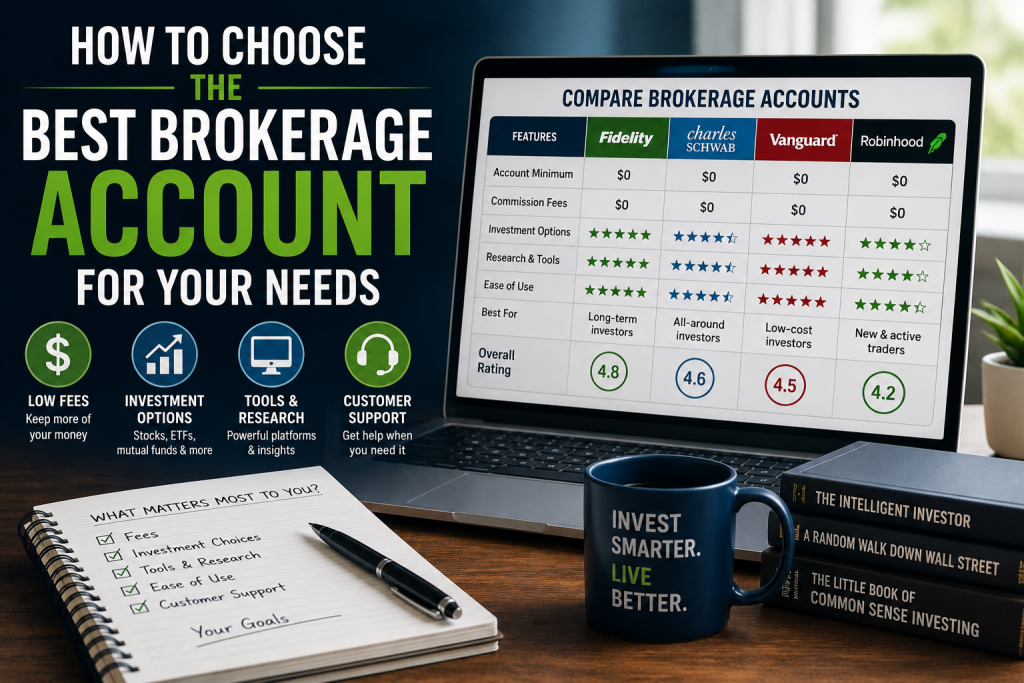
When choosing a brokerage account, several factors should guide your decision. Costs and fees are one of the most important considerations. Look for commission-free trading on stocks and ETFs. Check for account maintenance fees, account minimums, and other hidden costs. Investment options are also crucial. Does the broker offer the investments you want? Most brokers offer stocks, ETFs, and mutual funds. But some offer more options like options trading, bonds, and fractional shares.
Trading platform and tools matter for your investment experience. The platform should be easy to use and accessible on mobile and desktop. If you are an active trader, you may want advanced tools like real-time data, charting, and research. Customer support and education are also important. Look for brokers with responsive customer support and educational resources like articles, videos, and webinars. Security and regulation are non-negotiable. Ensure the broker is registered with the SEC and FINRA. Look for features like two-factor authentication and SIPC insurance, which protects your securities up to $500,000.
TOP BROKERAGES FOR BEGINNERS
For beginners, the best brokers are those with low fees, user-friendly platforms, and strong educational resources. Fidelity offers no account minimums, no trading commissions, and excellent educational resources. It is one of the best all-around brokers. Vanguard is known for its low-cost index funds and ETFs. It has no account minimums for many of its funds. Charles Schwab offers no account minimums, no trading commissions, and excellent customer support. It is ideal for beginners who want a full-service experience. SoFi Invest offers no commissions, no minimums, and a user-friendly app. It is a good choice for younger investors. Robinhood is a mobile-first platform with no commissions and no minimums. It is great for beginners but offers fewer educational resources.
TOP BROKERAGES FOR ACTIVE TRADERS
Active traders need more advanced tools and features. Interactive Brokers offers low commissions, advanced trading platforms, and access to global markets. It is ideal for experienced active traders. TD Ameritrade offers a powerful trading platform with advanced charting and research tools. E*TRADE offers a robust platform with advanced trading tools and research. Webull offers commission-free trading with advanced charting and real-time data. It is a good choice for active traders who want a modern platform.
TOP BROKERAGES FOR RETIREMENT INVESTORS
Retirement investors should focus on low fees, strong retirement tools, and good investment options. Vanguard is the top choice for retirement investors with its low-cost index funds and ETFs. Fidelity offers excellent retirement tools and low fees. Charles Schwab is another excellent choice for retirement investors. Betterment is a robo-advisor that offers automated retirement portfolios. It is a good choice for hands-off investors.
FRACTIONAL SHARES: WHY THEY MATTER
Fractional shares are becoming increasingly important. They allow you to buy a portion of a share rather than a whole share. This is especially valuable for high-priced stocks like Amazon, which trade for more than $100 per share. With fractional shares, you can invest the exact amount you want. Fractional shares make it easier to diversify with small amounts of money. They are particularly useful for dollar-cost averaging and regular investing. Several brokers offer fractional shares, including Fidelity, Robinhood, SoFi, and Charles Schwab.
ROBO-ADVISORS: AN ALTERNATIVE APPROACH
Robo-advisors are automated investment platforms that build and manage a diversified portfolio for you. They are ideal for hands-off investors who want a low-cost, diversified portfolio. Betterment offers automated investing with no minimum balance and low fees. Wealthfront offers automated investing with tax-loss harvesting and financial planning tools. SoFi Automated Investing offers robo-advisory services with no management fees. Ellevest offers automated investing designed for women with specific financial goals.
Robo-advisors are a good option for beginners who want a hands-off approach. They are also suitable for investors who want to automate their savings and investments. However, they offer less control over specific investments compared to self-directed accounts.
HOW TO OPEN A BROKERAGE ACCOUNT
Opening a brokerage account is a straightforward process. First, choose a broker that meets your needs. Then, go to the broker’s website or download their app. Click “Open Account” and provide your personal information, including your name, address, Social Security number, and employment information. Choose the type of account you want, such as a standard brokerage account or an IRA. Fund your account by linking your bank account and transferring money. Once your account is funded, you can start investing.
COMMON MISTAKES TO AVOID
Avoid these common mistakes when choosing a brokerage account. Mistake 1: Choosing a broker based solely on fees. While fees are important, they are not the only consideration. Look at the whole picture, including investment options, platform, and customer support. Mistake 2: Not checking for hidden fees. Some brokers have fees for inactivity, account maintenance, or transferring assets. Read the fine print. Mistake 3: Choosing a broker without considering your investment needs. If you are a long-term investor, you do not need advanced trading tools. If you are an active trader, you need robust tools. Mistake 4: Ignoring fractional shares. If you are investing small amounts, fractional shares are essential. Mistake 5: Not checking security features. Ensure the broker is registered and offers strong security features.
CONCLUSION
Choosing the right brokerage account is essential for your investment success. The best broker for you depends on your individual needs, investment goals, and experience level. Beginners should focus on low fees, user-friendly platforms, and strong educational resources. Active traders should focus on advanced tools and low commissions. Retirement investors should focus on low fees and strong retirement tools. Robo-advisors are a good option for hands-off investors. By taking the time to choose the right broker, you can make investing easier, more affordable, and more enjoyable. Your investment journey starts with choosing the right brokerage account.
About the Author: The Financial Education Team is dedicated to helping individuals build strong financial foundations through clear, actionable guidance on credit, saving, and wealth-building.
Disclaimer: This article is for informational purposes only and should not be considered financial or investment advice. Always conduct your own research or consult a qualified financial advisor before making investment decisions.