

Tax-Advantaged Accounts: The Smartest Way to Grow Your Wealth

INTRODUCTION
Taxes are one of the biggest expenses you will face as an investor. Every dollar you pay in taxes is a dollar that is not working for you. Tax-advantaged accounts offer a powerful solution. These accounts provide tax benefits that can significantly boost your investment returns over time. Whether you are saving for retirement, education, or healthcare, tax-advantaged accounts can help you reach your goals faster. This guide explains the different types of tax-advantaged accounts, how they work, and how to use them to maximize your wealth.
Many people do not take full advantage of tax-advantaged accounts. They may not understand the benefits, or they may be intimidated by the rules. But the benefits are substantial. A dollar saved in taxes is a dollar that can grow and compound over time. By using tax-advantaged accounts strategically, you can keep more of your money and build wealth faster.
UNDERSTANDING TAX-ADVANTAGED ACCOUNTS
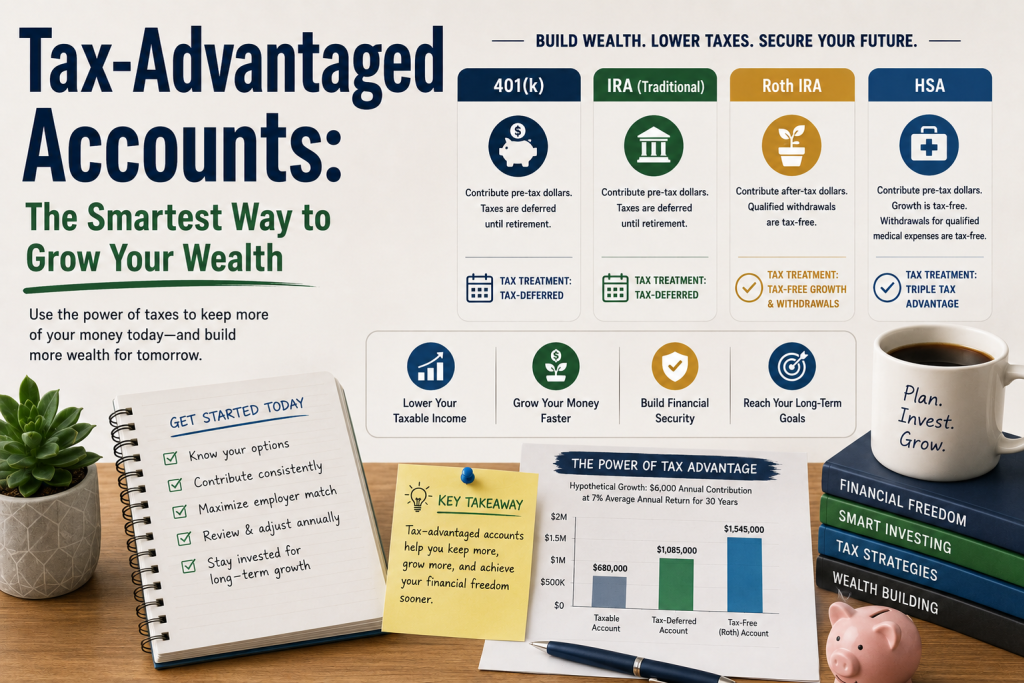
Tax-advantaged accounts are accounts that provide tax benefits to encourage saving and investing. The tax benefits come in different forms. Some accounts offer tax-deductible contributions, meaning you can reduce your taxable income in the year you contribute. Traditional IRAs and 401(k)s offer this benefit. Some accounts offer tax-free growth, meaning your investments grow without being taxed each year. Roth IRAs and Roth 401(k)s offer this benefit. Some accounts offer tax-free withdrawals, meaning you do not pay taxes when you withdraw the money in retirement. Roth IRAs offer this benefit. Some accounts offer tax-deferred growth, meaning you do not pay taxes on growth until you withdraw the money. Traditional IRAs and 401(k)s offer this benefit.
401(K) PLANS
A 401(k) is an employer-sponsored retirement account. It is one of the most powerful tools for building wealth. You contribute a portion of your paycheck to your 401(k) before taxes are taken out. This reduces your taxable income. Your employer may also match a portion of your contributions, which is essentially free money. Your investments grow tax-deferred, meaning you do not pay taxes on growth until you withdraw the money in retirement. You pay taxes on withdrawals in retirement, which is when you may be in a lower tax bracket.
The 2026 contribution limit for 401(k) plans is $23,000, with an additional $7,500 catch-up contribution for those over 50. If you are self-employed, you can open a Solo 401(k) with similar benefits. The employer match is a significant benefit. If your employer offers a match, you should contribute at least enough to get the full match. It is free money that you should not leave on the table.
TRADITIONAL IRA
A Traditional IRA is an individual retirement account that offers tax-deductible contributions. You can contribute up to $7,000 per year ($8,000 if you are over 50) in 2026. Your contributions may be tax-deductible depending on your income and whether you are covered by a retirement plan at work. Your investments grow tax-deferred until you withdraw the money in retirement. You pay taxes on withdrawals in retirement. Traditional IRAs are ideal for people who expect to be in a lower tax bracket in retirement. They are also good for people who want to reduce their current tax bill.
ROTH IRA
A Roth IRA is an individual retirement account that offers tax-free growth and tax-free withdrawals. You contribute after-tax dollars, meaning you do not get a tax deduction in the year you contribute. However, your investments grow tax-free, and you do not pay taxes on withdrawals in retirement. This is a significant benefit for people who expect to be in a higher tax bracket in retirement. You can contribute up to $7,000 per year ($8,000 if you are over 50) in 2026, subject to income limits. Roth IRAs also offer more flexibility than Traditional IRAs. You can withdraw your contributions at any time without penalty, and there are no required minimum distributions during your lifetime.
HEALTH SAVINGS ACCOUNT
A Health Savings Account (HSA) is a tax-advantaged account for healthcare expenses. It is often overlooked but is one of the most powerful investment accounts. You contribute pre-tax dollars to your HSA, reducing your taxable income. You can invest your HSA funds in stocks, bonds, and ETFs, and your investments grow tax-free. You can withdraw money tax-free for qualified medical expenses at any time. After age 65, you can withdraw money for any purpose without penalty, though you will pay taxes on non-medical withdrawals. HSAs offer triple tax benefits: tax-deductible contributions, tax-free growth, and tax-free withdrawals for qualified medical expenses. They are an excellent way to save for healthcare expenses in retirement.
529 COLLEGE SAVINGS PLANS
529 plans are tax-advantaged accounts for education savings. They are offered by states and can be used for qualified education expenses, including college, graduate school, and trade schools. Your contributions grow tax-free, and you do not pay taxes on withdrawals for qualified education expenses. The contribution limits are high, with many plans allowing contributions up to $300,000 or more per beneficiary. Some states also offer tax deductions for contributions to their 529 plans. 529 plans are an excellent way to save for education expenses and offer significant tax advantages.
SEP IRA AND SIMPLE IRA FOR SELF-EMPLOYED
Self-employed individuals have additional retirement account options. A SEP IRA allows you to contribute up to 25% of your net earnings from self-employment, up to $69,000 in 2026. It is simple to set up and has high contribution limits. A SIMPLE IRA is designed for small businesses. It allows employee contributions of up to $16,000 in 2026, with employer matching contributions. Both are excellent options for self-employed individuals and small business owners.
CHOOSING THE RIGHT ACCOUNT
Choosing the right tax-advantaged account depends on your situation. If your employer offers a 401(k) match, contribute enough to get the full match. If you are eligible for a Roth IRA, contribute to it after getting your 401(k) match. Roth IRAs offer tax-free growth and flexibility. If you are not eligible for a Roth IRA, consider a Traditional IRA. If you have a high-deductible health plan, max out your HSA. It offers triple tax benefits and can be used for retirement healthcare expenses. If you have children or grandchildren, consider a 529 plan for education savings.
THE ORDER OF OPERATIONS FOR MAXIMIZING TAX-ADVANTAGED ACCOUNTS
The following order of operations can help you maximize your tax-advantaged accounts. First, contribute enough to your 401(k) to get the full employer match. This is free money that you should not leave on the table. Second, contribute to a Roth IRA. Roth IRAs offer tax-free growth and more flexibility than Traditional IRAs. Third, return to your 401(k) and contribute more if you still have money to save. Fourth, contribute to an HSA if you have a high-deductible health plan. Fifth, consider a 529 plan if you have education expenses.
COMMON MISTAKES TO AVOID
Avoid these common mistakes with tax-advantaged accounts. Mistake 1: Not contributing enough to get the employer match. This is free money you are leaving on the table. Mistake 2: Withdrawing money early. Early withdrawals from retirement accounts often come with penalties and taxes. Mistake 3: Not investing your contributions. Leaving money in cash defeats the purpose of a tax-advantaged account. Invest your contributions for long-term growth. Mistake 4: Ignoring HSAs. HSAs offer triple tax benefits and are often overlooked. Mistake 5: Not rebalancing your portfolio. Rebalancing ensures your portfolio stays aligned with your goals.
CONCLUSION
Tax-advantaged accounts are one of the most powerful tools for building wealth. They provide tax benefits that can significantly boost your investment returns over time. By understanding the different types of accounts and using them strategically, you can keep more of your money and build wealth faster. Start by contributing enough to your 401(k) to get the full employer match. Then, consider Roth IRAs, HSAs, and other tax-advantaged accounts. Your future self will thank you.
About the Author: The Financial Education Team is dedicated to helping individuals build strong financial foundations through clear, actionable guidance on credit, saving, and wealth-building.
Disclaimer: This article is for informational purposes only and should not be considered financial or investment advice. Always conduct your own research or consult a qualified financial advisor before making investment decisions.