
What Is Dollar-Cost Averaging and Why It’s the Smartest Way to Invest
INTRODUCTION
If you have ever worried about buying stocks at the wrong time, you are not alone. Market timing is one of the biggest challenges for investors. Even professionals struggle to predict when to buy and sell. Dollar-cost averaging offers a simple solution to this problem. Instead of trying to time the market, you invest a fixed amount at regular intervals, regardless of the price. This strategy removes emotion from investing and helps you build wealth over time.
Dollar-cost averaging is one of the most recommended strategies for beginners and experienced investors alike. It takes the guesswork out of investing and makes it easier to stay disciplined. This guide explains what dollar-cost averaging is, why it works, and how you can use it to build long-term wealth.
WHAT IS DOLLAR-COST AVERAGING?
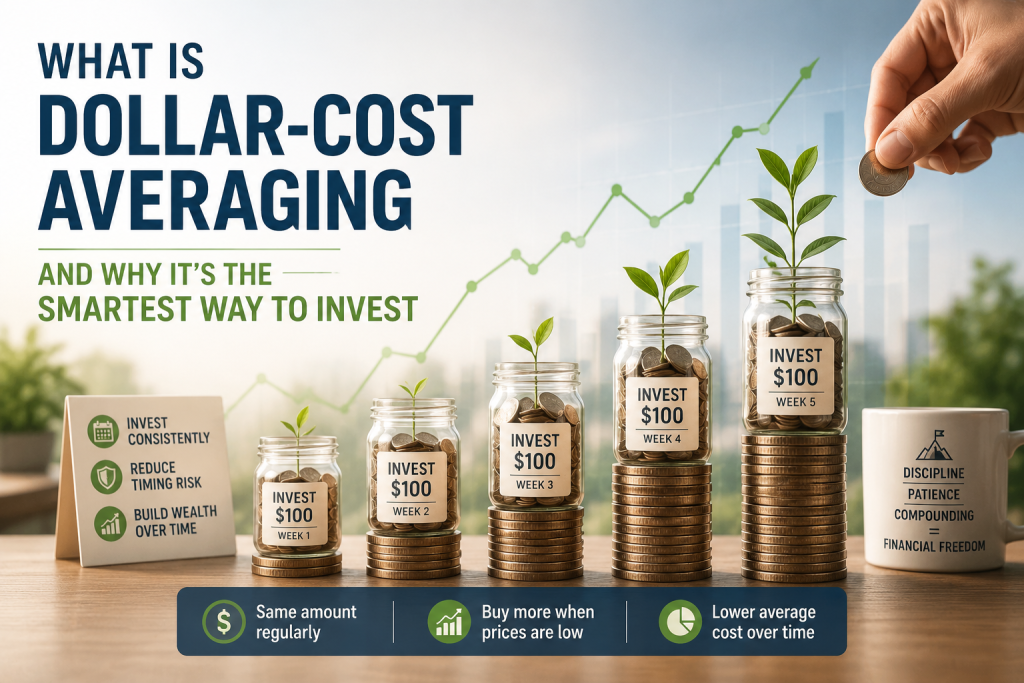
Dollar-cost averaging is an investment strategy where you invest a fixed amount of money at regular intervals, regardless of the asset’s price. You invest the same amount on a schedule—monthly, quarterly, or weekly—no matter what the market is doing. When prices are low, your fixed investment buys more shares. When prices are high, it buys fewer shares. Over time, this averages out the price you pay.
This strategy is the opposite of trying to time the market. With market timing, you try to buy when prices are low and sell when prices are high. But no one can consistently predict market movements. Dollar-cost averaging accepts that you cannot time the market and instead focuses on consistency.
WHY DOLLAR-COST AVERAGING WORKS
Dollar-cost averaging works because it removes emotion from investing. When you have a set schedule, you do not have to decide when to invest. You simply invest automatically. This prevents you from making emotional decisions based on fear or greed.
It also helps you avoid buying at the wrong time. With dollar-cost averaging, you are buying at all price levels. Some purchases will be at high prices, and some will be at low prices. Over time, the average price you pay will be lower than the average market price if you had tried to time your purchases.
Additionally, dollar-cost averaging creates discipline. By investing on a regular schedule, you build the habit of saving and investing. This habit is one of the most important factors in long-term wealth building.
HOW DOLLAR-COST AVERAGING WORKS IN PRACTICE
Imagine you invest $100 per month in an ETF. In month one, the price is $10 per share, so you buy 10 shares. In month two, the price drops to $5 per share, so your $100 buys 20 shares. In month three, the price rises to $8 per share, so your $100 buys 12.5 shares. Over these three months, you have invested $300 and bought 42.5 shares at an average price of $7.06 per share.
If you had invested your $300 all at once in month one, you would have paid $10 per share and owned only 30 shares. By using dollar-cost averaging, you owned more shares because you bought when the price was lower. This illustrates the power of buying consistently regardless of price.
THE PSYCHOLOGICAL BENEFITS
Dollar-cost averaging has significant psychological benefits. First, it reduces anxiety. When you are investing consistently, you do not need to worry about whether the market will go up or down. You know you are buying regularly. Second, it removes the fear of buying at the top. Since you are buying at all price levels, you do not need to worry about a single purchase being at the wrong time. Third, it encourages long-term thinking. Dollar-cost averaging is a long-term strategy. It helps you focus on the big picture rather than short-term market movements.
DOLLAR-COST AVERAGING VS. LUMP SUM INVESTING
Many investors wonder whether dollar-cost averaging is better than investing a lump sum all at once. The answer depends on your situation. Lump sum investing involves investing a large amount of money all at once. If you receive a windfall, such as an inheritance or bonus, you might consider lump sum investing. Historically, lump sum investing has performed better about two-thirds of the time because the market tends to go up over time.
However, lump sum investing requires a strong stomach. If you invest a large sum and the market drops shortly after, you may panic and sell. Dollar-cost averaging is more emotionally manageable because you are investing smaller amounts over time. For most people, dollar-cost averaging is the better choice because it reduces risk and encourages consistent investing.
HOW TO IMPLEMENT DOLLAR-COST AVERAGING
Implementing dollar-cost averaging is simple. First, choose a fixed amount to invest regularly. This could be $100 per month, $50 per week, or any amount that fits your budget. Second, set up automatic transfers from your bank account to your brokerage account. Most brokers allow you to schedule recurring transfers. Third, choose your investment. A low-cost ETF is an excellent choice for dollar-cost averaging. Fourth, stay consistent. Continue investing through market ups and downs. Do not stop when the market drops—that is when you get the best deals.
REAL-WORLD EXAMPLE
Consider an investor who started dollar-cost averaging $500 per month into an S&P 500 ETF in January 2020. The market experienced a sharp drop in March 2020 due to the pandemic. Many investors panicked and sold. But our investor continued to invest $500 per month. Over the next several years, they bought shares at various prices. By 2026, their portfolio had grown significantly, and they had benefited from the market recovery.
If they had stopped investing during the market drop, they would have missed the opportunity to buy shares at low prices. Dollar-cost averaging allowed them to stay invested and benefit from the market’s long-term growth.
WHEN DOLLAR-COST AVERAGING WORKS BEST
Dollar-cost averaging works best in volatile markets. When prices are fluctuating, you benefit from buying more shares when prices are low. It also works best for long-term investing. Dollar-cost averaging is not a strategy for short-term gains. It is a strategy for building wealth over decades.
It works best with low-cost, diversified investments like ETFs. You do not want to use dollar-cost averaging with highly speculative investments like penny stocks or options.
COMMON MISTAKES TO AVOID
Avoid these common mistakes when using dollar-cost averaging. Mistake 1: Stopping during market downturns. When the market drops, you are getting shares at a discount. Do not stop investing. Mistake 2: Changing your strategy based on market conditions. Stick to your plan regardless of what the market is doing. Mistake 3: Investing money you need in the short term. Only invest money you can leave invested for at least five years. Mistake 4: Paying high fees. Choose low-cost ETFs to maximize your returns.
CONCLUSION
Dollar-cost averaging is one of the simplest and most effective investment strategies. It removes emotion from investing, builds discipline, and helps you buy more shares when prices are low. By investing a fixed amount at regular intervals, you can build wealth over time without worrying about market timing. Whether you are investing $100 per month or $1,000, dollar-cost averaging can help you achieve your financial goals. Start today and let consistency work its magic.
About the Author: The Financial Education Team is dedicated to helping individuals build strong financial foundations through clear, actionable guidance on credit, saving, and wealth-building.
Disclaimer: This article is for informational purposes only and should not be considered financial or investment advice. Always conduct your own research or consult a qualified financial advisor before making investment decisions.