
Understanding Risk and Return: The Key to Smart Investing

INTRODUCTION
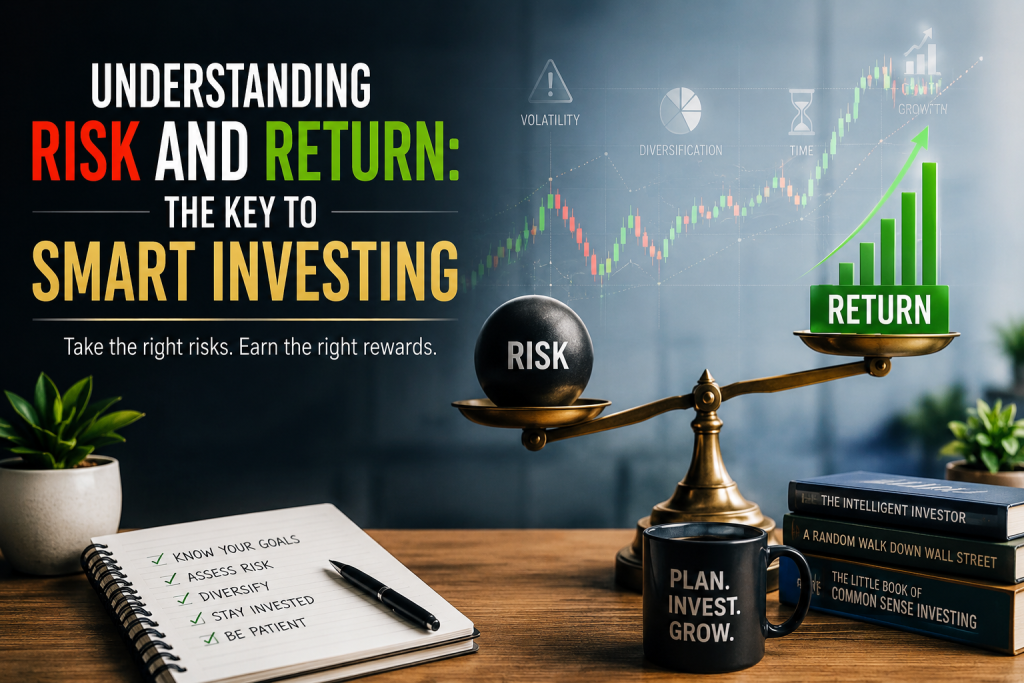
Every investment decision involves a trade-off between risk and return. Higher potential returns come with higher risk. Lower risk investments typically offer lower returns. Understanding this relationship is essential for making smart investment decisions. Many investors make the mistake of chasing high returns without understanding the risks involved. Others become paralyzed by fear and avoid investing entirely. Neither approach is optimal. The goal is to find the right balance for your situation.
Risk and return are not just theoretical concepts. They affect your everyday investment decisions. When you choose a stock, you are accepting the risk that the company may underperform. When you choose a bond, you are accepting the risk that interest rates may rise. This guide explains how risk and return work, how to measure them, and how to find the right balance for your portfolio.
WHAT IS RISK?
In investing, risk is the possibility that your investment will lose value or underperform your expectations. There are several types of risk that investors face. Market risk is the risk that the overall market will decline, affecting all investments. This is also known as systematic risk. It cannot be eliminated through diversification. Company-specific risk is the risk that a particular company will underperform due to management decisions, competition, or other factors. This risk can be reduced through diversification. Inflation risk is the risk that inflation will erode the purchasing power of your returns. This is particularly relevant for bonds and cash. Interest rate risk is the risk that rising interest rates will cause bond prices to fall. Liquidity risk is the risk that you will not be able to sell your investment quickly at a fair price. Currency risk is the risk that fluctuations in exchange rates will affect the value of foreign investments.
WHAT IS RETURN?
Return is the profit you earn on your investment. It is the reward for taking risk. Return can come in different forms. Capital appreciation is an increase in the value of your investment. When a stock price rises, you have capital appreciation. Income is regular payments you receive from your investment, such as dividends from stocks or interest from bonds. Total return is the combination of capital appreciation and income.
Returns are typically expressed as a percentage. For example, if you invest $1,000 and your investment grows to $1,100, your return is 10%. Returns can be positive or negative. A negative return means you have lost money.
THE RISK-RETURN TRADEOFF
The risk-return tradeoff is the principle that higher potential returns come with higher risk. This is one of the most important concepts in investing. The tradeoff exists because investors demand compensation for taking on risk. If an investment is risky, investors will only buy it if they expect a higher return. If an investment is safe, investors will accept a lower return.
The tradeoff is not a guarantee. Sometimes risky investments perform poorly, and sometimes safe investments perform well. But over the long term, the relationship holds. Investors who take more risk are rewarded with higher returns.
HOW TO MEASURE RISK
There are several ways to measure risk. Standard deviation measures how much an investment’s returns fluctuate around its average. A higher standard deviation means more volatility and higher risk. Beta measures how much an investment moves relative to the overall market. A beta of 1 means the investment moves in line with the market. A beta greater than 1 means the investment is more volatile than the market. A beta less than 1 means the investment is less volatile. Maximum drawdown measures the largest peak-to-trough decline in an investment’s value. This is a useful measure for understanding potential losses. Sharpe ratio measures risk-adjusted returns. It compares an investment’s return to a risk-free investment, adjusted for volatility. A higher Sharpe ratio means better risk-adjusted returns.
ASSET CLASS RISK PROFILES
Different asset classes have different risk profiles. Cash is the safest investment, with no risk of losing principal. However, it offers the lowest returns and is vulnerable to inflation. Bonds are generally lower risk than stocks, but they carry interest rate and credit risk. Government bonds are the safest bonds, while corporate bonds carry more risk. Stocks have the highest risk of the major asset classes. They are volatile and can experience significant losses. However, they offer the highest long-term returns. Real estate falls between stocks and bonds in risk. It offers income and potential appreciation but can be illiquid. Alternative investments like commodities and hedge funds have varying risk profiles and are generally more complex.
YOUR RISK TOLERANCE
Risk tolerance is your ability and willingness to handle fluctuations in your investment value. It is a personal characteristic that depends on several factors. Time horizon is one of the most important factors. The longer your time horizon, the more risk you can afford to take because you have time to recover from losses. Financial situation matters. Your income, expenses, and net worth affect your ability to take risk. Personality and emotional temperament play a role. Some people are naturally more comfortable with risk than others. Investment goals are crucial. Are you saving for retirement, a house, or a child’s education? Different goals require different risk levels.
HOW TO DETERMINE YOUR RISK TOLERANCE
Determining your risk tolerance is an important step in building your portfolio. Start by asking yourself questions. How would you feel if your portfolio lost 20% of its value in a year? Would you stay invested or sell? What is your investment time horizon? When will you need the money? What is your financial situation? Can you afford to lose money?
You can also take a risk tolerance questionnaire. Many financial websites offer free questionnaires that assess your risk tolerance. These questionnaires ask about your investment goals, time horizon, and emotional reactions to market fluctuations.
BUILDING A PORTFOLIO THAT MATCHES YOUR RISK TOLERANCE
Once you understand your risk tolerance, you can build a portfolio that matches it. Conservative investors should have a higher allocation to bonds and cash, with lower stock exposure. This portfolio is less volatile but offers lower returns. Moderate investors should have a balanced allocation to stocks and bonds. This portfolio offers a mix of growth and stability. Aggressive investors should have a higher allocation to stocks, with lower bond exposure. This portfolio offers higher potential returns but is more volatile.
COMMON MISTAKES TO AVOID
Avoid these common risk-related mistakes. Mistake 1: Taking on too much risk. Some investors overestimate their risk tolerance and take on too much risk. When the market drops, they panic and sell. Mistake 2: Taking on too little risk. Some investors are too conservative and miss out on growth. Their portfolios may not keep pace with inflation. Mistake 3: Not diversifying. Concentration in a single stock or sector increases risk. Diversification is essential. Mistake 4: Chasing past performance. Investors often chase investments that have performed well recently, assuming they will continue to perform well. This is a mistake. Past performance does not guarantee future results. Mistake 5: Ignoring risk. Some investors focus only on returns and ignore the risks involved. This can lead to costly mistakes.
CONCLUSION
Understanding risk and return is essential for smart investing. The risk-return tradeoff is a fundamental principle that applies to all investments. By understanding your risk tolerance and building a portfolio that matches it, you can achieve your financial goals while managing risk. Remember that risk is not something to be avoided entirely. It is a necessary part of investing. The key is to take the right amount of risk for your situation. Start building your portfolio today with a clear understanding of risk and return.
About the Author: The Financial Education Team is dedicated to helping individuals build strong financial foundations through clear, actionable guidance on credit, saving, and wealth-building.
Disclaimer: This article is for informational purposes only and should not be considered financial or investment advice. Always conduct your own research or consult a qualified financial advisor before making investment decisions.