
Investing for Beginners: Your Complete Guide to Getting Started in 2026
INTRODUCTION
Investing can feel overwhelming. The jargon, the risks, the endless options—it is enough to make anyone freeze. But here is the truth: investing is the single most powerful way to build wealth over time. The average millionaire has seven sources of income, and investing is almost always one of them. If you never learned about money growing up, you are not alone. Millions of people are in the same position. The good news is that it is never too late to start learning and building wealth. This guide provides a clear, practical path from understanding the basics to using investing confidently in real situations. The journey to financial independence starts with a single step: deciding to invest. Whether you have $100 or $100,000, the principles are the same. Start early, be consistent, and let compound interest work its magic.
THE INVESTING MINDSET
Before you buy your first stock or ETF, you need to develop the right mindset. Investing is not gambling. It is not a get-rich-quick scheme. It is a long-term strategy for building wealth. The most successful investors are patient, disciplined, and focused on the long term. They do not panic when the market drops, and they do not get greedy when it rises. They stick to their plan and let time do the work. A key part of the investing mindset is understanding that risk and return are linked. Higher potential returns come with higher risk. Lower risk investments typically offer lower returns. Your job as an investor is to find the right balance for your situation.
WHY YOUR SAVINGS ACCOUNT IS COSTING YOU MONEY
Many people keep their savings in a bank account earning less than 1% interest. Meanwhile, inflation is running at 2-3% per year. This means your money is actually losing purchasing power every year. Over 20 years, the value of cash is cut nearly in half. Investing is the solution to this problem. By investing in assets that grow faster than inflation—stocks, bonds, and real estate—you can preserve and grow your purchasing power over time. This is why investing is not optional for building long-term wealth. It is essential.
THE DEBT DILEMMA: SHOULD YOU INVEST OR PAY OFF DEBT?
One of the most common questions beginners ask is whether to invest or pay off debt first. The answer depends on the type of debt and its interest rate. If you have high-interest debt, such as credit card debt with rates above 20%, pay that off first. The interest you are paying is higher than what you can reasonably expect from investments. If you have low-interest debt, such as a mortgage or student loans with rates below 5%, it may make more sense to invest while making minimum payments.
YOUR EMERGENCY FUND: THE FOUNDATION BEFORE YOU INVEST
Before you invest a single dollar, you need an emergency fund. This is money set aside for unexpected expenses—car repairs, medical bills, or job loss. Financial experts recommend keeping three to six months of living expenses in an easily accessible account. This fund ensures you do not have to sell your investments at a loss when an emergency arises.
INVESTING JARGON BUSTED
Investing comes with its own language. Here are the key terms you need to know. Stocks are shares of ownership in a company. When you buy a stock, you become a part-owner of that business. Stocks offer high growth potential but also come with higher risk. Bonds are loans you make to governments or corporations. In return, you receive regular interest payments and your principal back at maturity. Bonds are generally lower risk than stocks. ETFs are baskets of stocks or bonds that trade on exchanges like individual stocks. ETFs offer instant diversification and low costs. Mutual funds are professionally managed portfolios of stocks, bonds, or other assets. Mutual funds are similar to ETFs but are priced once per day. Compound interest is interest earned on both your original investment and the interest that has already been added to it. Compound interest is one of the most powerful wealth-building tools. Risk tolerance is your ability and willingness to handle fluctuations in the value of your investments. A higher risk tolerance means you can handle more volatility. Diversification is spreading your investments across different assets to reduce risk. Diversification helps protect your portfolio from the failure of any single investment.
THE POWER OF COMPOUND INTEREST
Warren Buffett, one of the most successful investors of all time, says compound interest is one of the reasons he has made so much money. “My wealth has come from a combination of living in America, some lucky genes, and compound interest,” Buffett said back in 2010. And you do not have to be an oracle to take advantage of it—you just need patience, discipline, and time. Compound interest is quite simply your money making money. More technically, it is the interest you earn on top of your principal and interest over time. Let us look at how compounding works. Say you set aside $10,000 in a savings account that pays out a 3% interest rate. That $10,000, after one year, would grow to $10,300—so you made $300 in interest. After year two, that 3% gain is on $10,300, including the $300 in interest you made the previous year. So now that $10,300 grows to $10,609. That $300 in interest you made last year made $9 on its own. That might not sound like much, but when you let compounding do its thing over many, many years, that interest you earn on top of the interest just keeps piling up. After 20 years, that $10,000 becomes $18,061.11.
Now apply that to investing, where you are making returns instead of interest. The S&P 500 has averaged about a 10% annual return over time. You invest $10,000 in an S&P 500 ETF like the Vanguard S&P 500 ETF, and that ETF averages a 10% annual return. After 10 years, that amount would grow to $25,937.42—a roughly $16,000 gain on the initial investment. But now look at how compounding kicks into high gear as it works. After 20 years, with a 10% annual return, you would have $67,275—a gain of almost $40,000 in just the previous 10 years. When you calculate 30 years of compounding, that initial $10,000 would grow to $174,494.02, with more than $100,000 of that added in the previous 10 years. If you contributed $100 per month to that initial investment, that would compound, too. Specifically, after 10 years, the $10,000 initial investment, with $100 added every month, with a 10% return, would turn into $45,923.81. After 20 years it would be $139,100.92, and after 30 years $380,086.91.
STOCKS VS. BONDS VS. ETFS: WHAT SHOULD YOU BUY?
Choosing what to invest in can be overwhelming. Here is a simple breakdown of the main options. Stocks offer high growth potential but are volatile. They are best for long-term investors who can handle ups and downs. Bonds offer lower but more stable returns. They are best for conservative investors or those nearing retirement. ETFs offer instant diversification and low costs. They are ideal for beginners and long-term investors. Mutual funds offer professional management but often have higher fees. They are best for those who want hands-off management.
HOW TO START INVESTING IN 5 STEPS
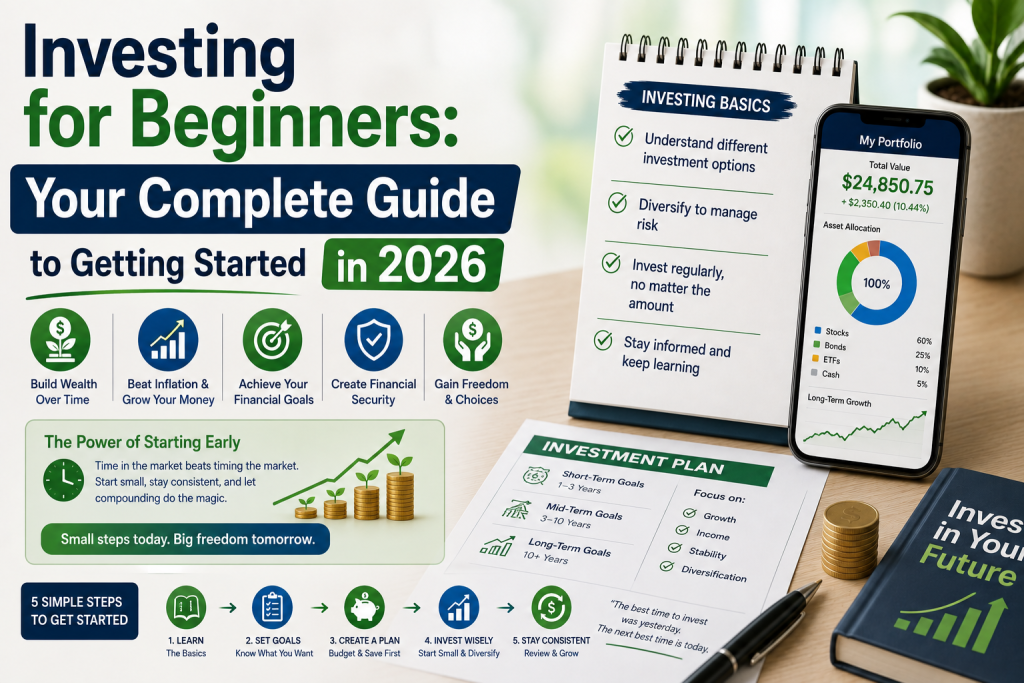
Step 1: Build your emergency fund. Save 3-6 months of expenses before investing. Step 2: Pay off high-interest debt. Eliminate credit card debt before investing. Step 3: Open a brokerage account. Choose a reputable online broker. Step 4: Choose your investments. Start with low-cost index funds or ETFs. Step 5: Set up automatic contributions. Invest consistently, regardless of market conditions.
COMMON MISTAKES BEGINNERS MAKE
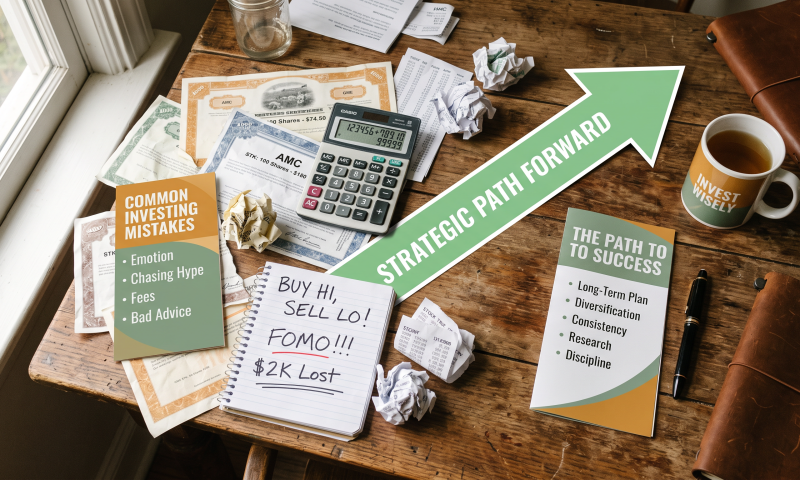
Beginners often make several common mistakes. Mistake 1: Trying to time the market. No one can consistently predict market movements. Stay invested for the long term. Mistake 2: Not diversifying. Putting all your money in one stock or sector is risky. Spread your investments across different assets. Mistake 3: Panic selling. When the market drops, many investors sell out of fear. This locks in losses and misses the recovery. Mistake 4: Chasing past performance. Just because a stock or fund performed well in the past does not mean it will in the future. Mistake 5: Paying high fees. High fees eat into your returns. Look for low-cost index funds and ETFs.
HOW MUCH SHOULD YOU INVEST?
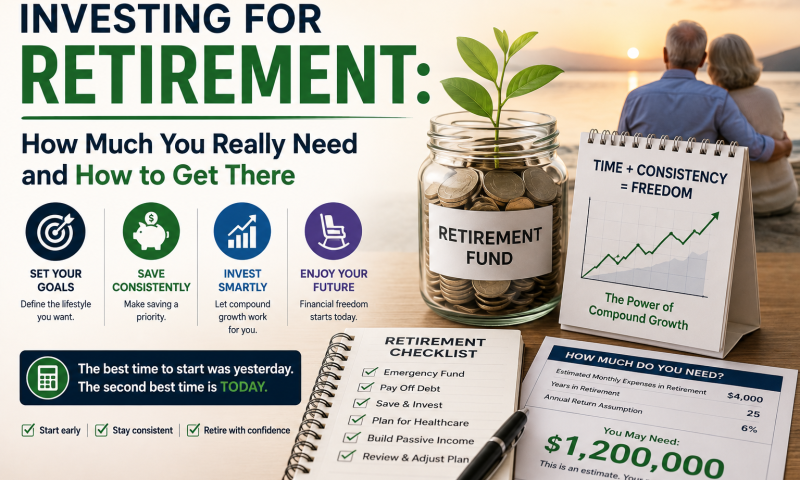
There is no one-size-fits-all answer. A common rule of thumb is to invest 15% of your income for retirement. However, your specific situation may call for more or less. The key is to start with what you can and increase your contributions over time. The earlier you start, the less you need to save overall because compound interest does more of the work.
CONCLUSION
Investing is the most powerful tool for building long-term wealth. It does not require a finance degree or a large inheritance—just patience, discipline, and a willingness to learn. By understanding the basics, developing the right mindset, and taking consistent action, you can achieve financial independence and build the future you deserve. Your investing journey starts today. Take the first step and begin building your wealth.
About the Author: The Financial Education Team is dedicated to helping individuals build strong financial foundations through clear, actionable guidance on credit, saving, and wealth-building.
Disclaimer: This article is for informational purposes only and should not be considered financial or investment advice. Always conduct your own research or consult a qualified financial advisor before making investment decisions.