
Index Funds vs. Actively Managed Funds: Which Is Better for You?
INTRODUCTION
One of the most important decisions you will make as an investor is choosing between index funds and actively managed funds. This decision can have a significant impact on your returns over time. Index funds are passive investments that track a market index like the S&P 500. Actively managed funds are run by professional managers who try to beat the market. Both have their supporters, and both have their drawbacks. Understanding the differences is essential for making the right choice for your portfolio.
The debate between index funds and actively managed funds has been ongoing for decades. The evidence overwhelmingly supports index funds for most investors. However, active funds still have a place in some portfolios. This guide explains the differences between index funds and actively managed funds, the evidence for and against each, and how to choose the right approach for your situation.
WHAT ARE INDEX FUNDS?
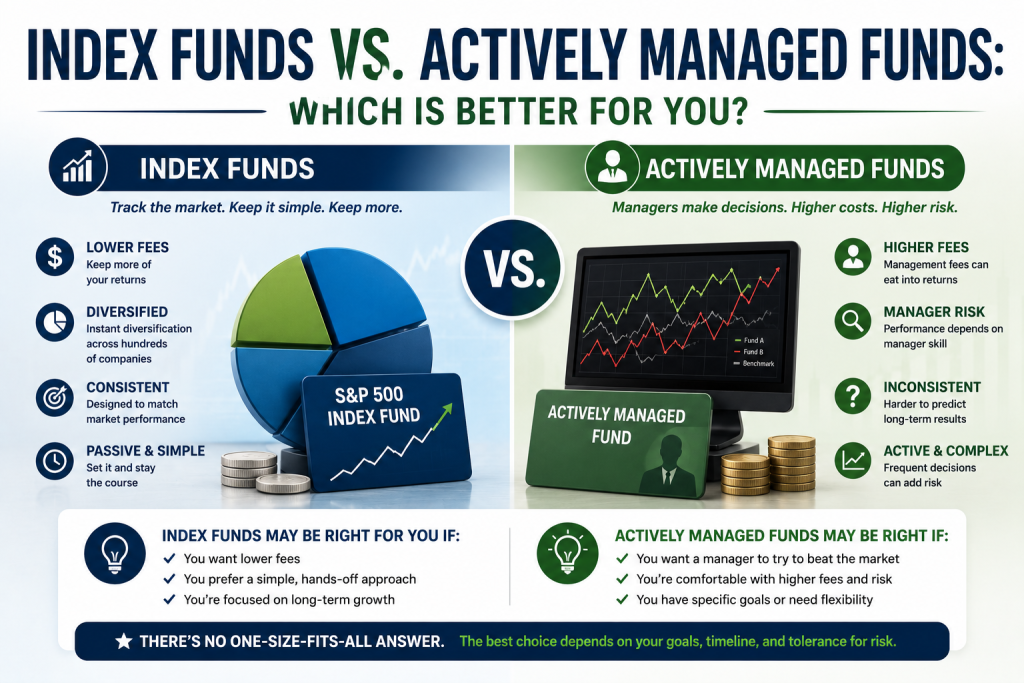
Index funds are mutual funds or ETFs that track a specific market index. They are passive investments, meaning they do not try to beat the market. Instead, they aim to match the market’s performance. The most well-known index funds track the S&P 500, which includes 500 of the largest U.S. companies. Other index funds track different indexes, such as the total stock market, international markets, or specific sectors.
Index funds are simple and transparent. You know exactly what you are investing in because the fund tracks a known index. They are also low cost because they do not require a team of analysts and portfolio managers. Because they are passive, index funds have low turnover, which reduces transaction costs and tax implications.
WHAT ARE ACTIVELY MANAGED FUNDS?
Actively managed funds are mutual funds or ETFs run by professional portfolio managers who try to beat the market. They make decisions about which stocks, bonds, or other assets to buy and sell. They aim to outperform a benchmark index through stock selection, market timing, or sector allocation.
Actively managed funds offer the potential for higher returns. If a manager makes good decisions, the fund can outperform its benchmark. They also offer downside protection. Active managers can reduce their exposure to declining sectors or stocks. They provide professional management for investors who do not have the time or expertise to manage their own investments.
THE COST DIFFERENCE
The cost difference between index funds and actively managed funds is substantial. Index funds are significantly cheaper. The average expense ratio for an index fund is around 0.05% to 0.20%. Some index funds have expense ratios as low as 0.03%. Actively managed funds are much more expensive. The average expense ratio for an actively managed fund is around 0.50% to 1.50%. Some actively managed funds have expense ratios of 2% or more.
Over time, these cost differences add up. A 1% difference in fees can reduce your portfolio by more than 25% over 30 years. This is why cost is one of the most important factors to consider when choosing between index funds and actively managed funds.
THE PERFORMANCE EVIDENCE
The evidence on performance is clear. Over the long term, most actively managed funds underperform their benchmarks. A study by S&P Dow Jones Indices found that over a 15-year period, more than 90% of actively managed funds underperformed their benchmarks. The results are consistent across different asset classes and time periods.
There are several reasons for this underperformance. First, fees and expenses eat into returns. An actively managed fund must overcome its higher fees to outperform an index fund. Second, market efficiency makes it difficult to consistently identify undervalued stocks. Third, many active managers take on too much risk, which can lead to poor performance. Fourth, manager turnover can disrupt the fund’s strategy.
WHEN ACTIVE MANAGEMENT WORKS
Despite the evidence, there are situations where active management can work. Certain market segments are less efficient, making it easier for active managers to find mispriced securities. These include small-cap stocks, international stocks, and emerging markets. Active management may also be beneficial in volatile markets, where managers can protect against downside risk. Some investors value the downside protection that active managers can provide.
However, it is important to note that even in these areas, most active managers still underperform. The odds of picking a winning active manager are low. If you do choose active management, look for managers with a consistent long-term track record and low fees.
THE CASE FOR INDEX FUNDS
The case for index funds is compelling. They are low cost, which means you keep more of your returns. They are simple and transparent. You know exactly what you are investing in. They are diversified, which reduces your risk. They have a proven track record of outperforming most active funds. They are tax efficient, with lower turnover generating fewer capital gains distributions.
For most investors, index funds are the best choice. They provide market returns at low cost, and they eliminate the risk of picking a manager who underperforms.
THE CASE FOR ACTIVE MANAGEMENT
The case for active management is less compelling but still worth considering. Active managers offer the potential for market-beating returns. They can provide downside protection in volatile markets. They offer professional management for investors who want a hands-off approach. Some investors are willing to pay higher fees for the chance of outperformance.
However, it is important to be realistic about the odds. The probability of outperformance is low, and the probability of significant outperformance is even lower. If you choose active management, do so with a clear understanding of the risks and costs involved.
HYBRID APPROACHES
Some investors choose a hybrid approach, combining index funds and actively managed funds. For example, you might use index funds for core holdings and active funds for satellite positions. This allows you to benefit from the low cost and diversification of index funds while potentially benefiting from the outperformance of active managers in specific areas.
Another approach is to use index funds for most of your portfolio and allocate a small portion to active funds. If the active funds underperform, the impact on your overall portfolio is limited. If they outperform, you benefit.
HOW TO CHOOSE
Choosing between index funds and actively managed funds depends on your individual situation. Consider these factors. Cost is one of the most important factors. Index funds are significantly cheaper. Performance history is important. If you choose active management, look for managers with a consistent long-term track record. Your investment philosophy matters. Some investors are comfortable with passive investing, while others prefer active management. Your financial goals are crucial. If your goal is to build long-term wealth, low-cost index funds are an excellent choice. If your goal is to outperform the market, you may need to consider active management.
COMMON MISTAKES TO AVOID
Avoid these common mistakes. Mistake 1: Chasing past performance. Past performance does not guarantee future results. Many investors buy funds that have performed well recently, only to be disappointed when they underperform. Mistake 2: Paying high fees. High fees eat into your returns. Choose low-cost funds. Mistake 3: Not diversifying. Even if you choose active funds, diversify across different fund types. Mistake 4: Switching strategies frequently. Switching between index and active funds can be costly and may not improve your returns. Mistake 5: Ignoring taxes. High turnover in active funds can generate capital gains distributions, which are taxable.
CONCLUSION
The evidence overwhelmingly supports index funds for most investors. They are low cost, simple, diversified, and have a proven track record of outperforming most active funds. If you choose active management, do so with a clear understanding of the risks and costs involved. Remember that past performance does not guarantee future results. The most important factor is to invest regularly, keep costs low, and stay disciplined. Your journey to building wealth starts with making informed investment decisions.
About the Author: The Financial Education Team is dedicated to helping individuals build strong financial foundations through clear, actionable guidance on credit, saving, and wealth-building.
Disclaimer: This article is for informational purposes only and should not be considered financial or investment advice. Always conduct your own research or consult a qualified financial advisor before making investment decisions.