

How to Build a Diversified Portfolio: The Simple Strategy That Protects Your Wealth

INTRODUCTION
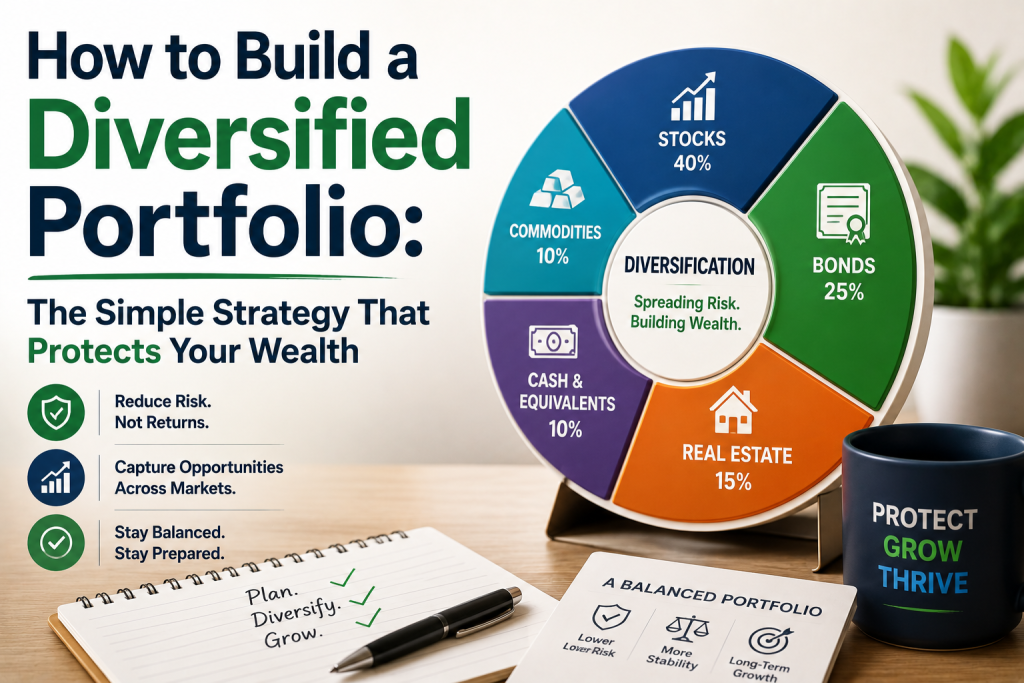
Imagine building a house with only one wall. It would not stand for long. The same principle applies to investing. If your entire portfolio is in one stock or one sector, you are exposing yourself to unnecessary risk. Diversification is the solution. It is the strategy of spreading your investments across different assets to reduce risk. The goal is not to eliminate risk entirely—that is impossible—but to manage it so that a single failure does not devastate your portfolio.
Diversification is one of the most important concepts in investing. Yet many people do not understand how to build a properly diversified portfolio. Some think owning ten stocks is diversification. It is not. True diversification means spreading your investments across different asset classes, sectors, and geographic regions. This guide explains how to build a diversified portfolio that protects your wealth and helps you achieve your financial goals.
WHAT IS DIVERSIFICATION?
Diversification is the practice of spreading your investments across different assets to reduce risk. The idea is simple: do not put all your eggs in one basket. If one investment performs poorly, others may perform well, balancing out your overall returns. Diversification does not guarantee profits or protect against losses, but it does reduce the volatility of your portfolio.
The benefits of diversification are well documented. A diversified portfolio is less volatile than a concentrated one. It provides more consistent returns over time. It protects you from the failure of any single investment. It allows you to participate in different areas of the market.
THE DIFFERENT TYPES OF DIVERSIFICATION
There are several ways to diversify your portfolio. Each type reduces risk in a different way. Asset class diversification involves spreading your investments across different types of assets—stocks, bonds, real estate, and cash. Each asset class behaves differently under different economic conditions. When stocks are down, bonds may be up, and vice versa.
Sector diversification involves spreading your investments across different sectors of the economy—technology, healthcare, financials, consumer goods, etc. Different sectors perform well at different times. For example, technology stocks may do well during innovation booms, while consumer staples may do well during economic downturns.
Geographic diversification involves spreading your investments across different countries and regions. Different economies have different growth rates and risk levels. By investing internationally, you reduce your exposure to any single country’s economic performance. Company diversification involves not putting too much money in any single company. Even the best companies can fail. By owning many companies, you reduce the impact of any single company’s failure.
THE MODERN PORTFOLIO THEORY
Modern Portfolio Theory is the foundation of diversification. Developed by economist Harry Markowitz in the 1950s, it shows how investors can build portfolios that maximize returns for a given level of risk. The key insight is that by combining assets that do not move in perfect sync, you can reduce overall portfolio risk without sacrificing returns.
In practice, this means combining assets that have low or negative correlation. For example, stocks and bonds often move in opposite directions. When stocks are down, bonds may be up. By holding both, you smooth out your returns. This is why a diversified portfolio is less volatile than a portfolio concentrated in a single asset class.
HOW MANY STOCKS DO YOU NEED?
Many people wonder how many stocks they need to be properly diversified. The answer is surprising: you do not need hundreds of stocks. Research shows that owning 20 to 30 stocks from different sectors is enough to eliminate most company-specific risk. However, owning more than 50 stocks does not provide much additional diversification benefit.
The more important consideration is that the stocks should be from different sectors and industries. Owning 30 technology stocks does not diversify you. You are still exposed to the technology sector. To be properly diversified, you need stocks from different sectors.
THE SIMPLEST WAY TO DIVERSIFY
For most investors, the simplest way to diversify is to buy low-cost index funds or ETFs. An S&P 500 ETF gives you exposure to 500 of the largest U.S. companies across all sectors. A total stock market ETF gives you exposure to thousands of companies across the entire U.S. market. A total international stock ETF gives you exposure to companies outside the U.S. A total bond market ETF gives you exposure to the bond market.
With just three or four ETFs, you can build a globally diversified portfolio. This is the strategy recommended by many financial advisors. It is simple, low-cost, and effective.
ASSET ALLOCATION: THE MOST IMPORTANT DECISION
Asset allocation is the process of deciding how much of your portfolio to allocate to different asset classes. This is the most important investment decision you will make. Your asset allocation determines most of your portfolio’s long-term returns and risk.
There is no single right asset allocation for everyone. The right allocation depends on your age, goals, and risk tolerance. As a general rule, younger investors can afford to take more risk because they have time to recover from market downturns. Older investors should be more conservative to protect their savings.
A common rule of thumb is to subtract your age from 110 to determine the percentage of your portfolio that should be in stocks. For example, at age 30, you would have 80% in stocks and 20% in bonds. At age 60, you would have 50% in stocks and 50% in bonds. This rule is a starting point, not a hard rule.
SAMPLE PORTFOLIOS FOR DIFFERENT GOALS
Here are some sample portfolios for different situations. For a young investor (under 40): 80% stocks, 15% bonds, and 5% cash. The stocks should be split between domestic (70%) and international (30%). For a mid-career investor (40-55): 65% stocks, 30% bonds, and 5% cash. The stocks should be split between domestic (65%) and international (35%). For a pre-retirement investor (55-65): 50% stocks, 45% bonds, and 5% cash. The stocks should be split between domestic (60%) and international (40%). For a retired investor: 35% stocks, 60% bonds, and 5% cash. The stocks should be split between domestic (60%) and international (40%).
REBALANCING: KEEPING YOUR PORTFOLIO ON TRACK
Over time, your portfolio will drift away from your target allocation. Some investments will perform better than others, causing their weight to increase. Rebalancing is the process of bringing your portfolio back to your target allocation. Rebalancing forces you to sell high and buy low. When one asset class has performed well, you sell some of it and buy more of the underperforming asset. This is the opposite of what most investors do emotionally.
Most experts recommend rebalancing once or twice a year. You can also rebalance when an asset class moves more than 5% from its target allocation. Rebalancing does not have to be complicated. You can simply direct new contributions to the underweight asset classes.
COMMON MISTAKES TO AVOID
Avoid these common diversification mistakes. Mistake 1: Owning too few stocks. Owning fewer than 20 stocks leaves you exposed to company-specific risk. Mistake 2: Owning stocks in the same sector. This is not true diversification. You need stocks from different sectors. Mistake 3: Ignoring international stocks. U.S. stocks represent only about 60% of the global market. By ignoring international stocks, you are missing opportunities and increasing risk. Mistake 4: Owning too many funds. You do not need to own ten different ETFs. Three or four well-chosen ETFs can provide all the diversification you need. Mistake 5: Not rebalancing. Without rebalancing, your portfolio becomes overweight in assets that have performed well. This increases your risk.
CONCLUSION
Building a diversified portfolio is one of the most important steps you can take to protect your wealth. Diversification does not eliminate risk, but it reduces the impact of any single investment failure. By spreading your investments across different asset classes, sectors, and geographic regions, you can achieve more consistent returns and reduce the volatility of your portfolio. The simplest way to diversify is to buy low-cost index funds or ETFs. With just three or four ETFs, you can build a globally diversified portfolio. Start building your diversified portfolio today.
About the Author: The Financial Education Team is dedicated to helping individuals build strong financial foundations through clear, actionable guidance on credit, saving, and wealth-building.
Disclaimer: This article is for informational purposes only and should not be considered financial or investment advice. Always conduct your own research or consult a qualified financial advisor before making investment decisions.