
The Power of Compound Interest: How Time Can Make You a Millionaire

INTRODUCTION
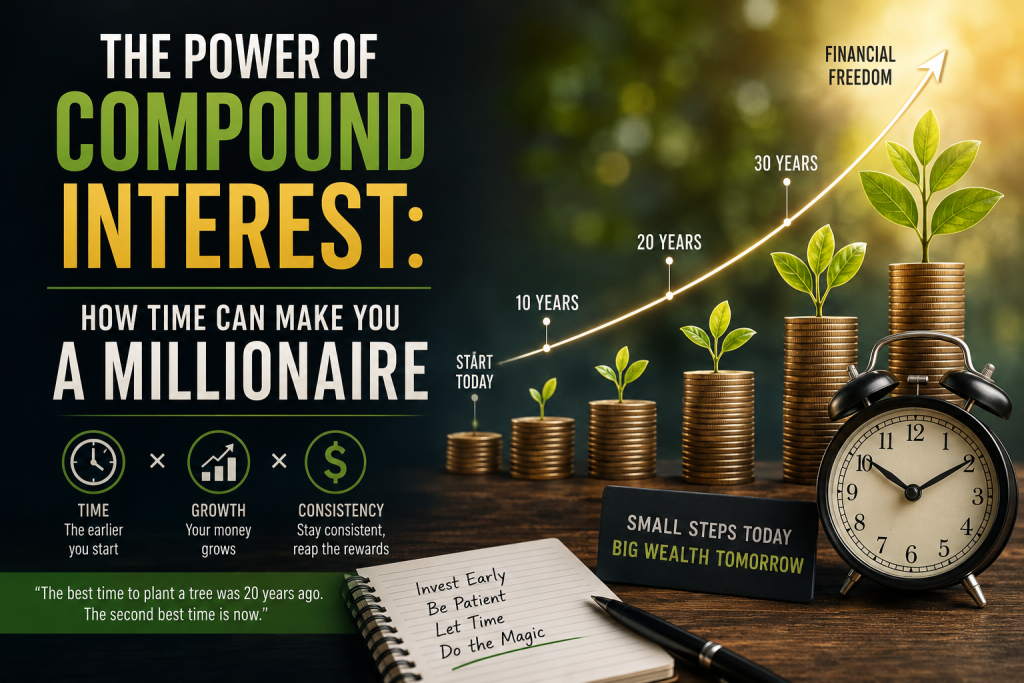
Albert Einstein reportedly called compound interest the eighth wonder of the world. Whether he actually said it or not, the sentiment is accurate. Compound interest is one of the most powerful forces in finance. It can turn small, regular investments into substantial wealth over time. The key is time. The earlier you start, the more powerful the effect.
Many people underestimate the power of compound interest. They think they need to save large amounts to become wealthy. But compound interest shows that even small amounts, invested consistently over long periods, can grow into significant sums. This guide explains how compound interest works, why it is so powerful, and how you can harness it to build wealth.
WHAT IS COMPOUND INTEREST?
Compound interest is interest earned on both your original investment and the interest that has already been added to it. This is different from simple interest, which is only earned on the original amount. With compound interest, you earn interest on interest. This creates a snowball effect where your money grows faster over time.
Here is a simple example. You invest $1,000 at a 5% annual return. After one year, you have $1,050. In year two, you earn 5% on $1,050, not just your original $1,000. This means you earn $52.50 in interest in year two, compared to $50 in year one. Over time, the difference grows significantly.
THE SNOWBALL EFFECT
Compound interest works like a snowball rolling down a hill. At first, the snowball is small and grows slowly. But as it rolls, it picks up more snow and grows faster. Eventually, it becomes a massive snowball. The same happens with compound interest. In the early years, growth is modest. But as the amount grows, the growth accelerates. This is why starting early is so important.
Consider two investors. Investor A starts investing $200 per month at age 25. Investor B starts investing $400 per month at age 35. Both earn an 8% annual return. By age 65, Investor A has invested a total of $96,000 and has a portfolio worth approximately $678,000. Investor B has invested a total of $144,000 and has a portfolio worth approximately $522,000. Investor A invested less money but ended up with more wealth because they started earlier.
THE RULE OF 72
The Rule of 72 is a simple way to estimate how long it will take for your money to double. Divide 72 by your annual return rate. The result is the number of years it will take for your money to double. For example, if you earn an 8% annual return, it will take approximately 9 years for your money to double. If you earn a 10% return, it will take approximately 7.2 years. If you earn a 6% return, it will take approximately 12 years.
This rule is a rough estimate, but it is useful for understanding the power of compound interest. It shows how higher returns and longer time horizons can significantly increase your wealth.
THE IMPACT OF TIME
Time is the most important factor in compound interest. The earlier you start, the more time your money has to grow. A 25-year-old who invests $5,000 per year until age 65, earning an 8% return, will have approximately $1.3 million at retirement. A 35-year-old who does the same will have approximately $566,000. A 45-year-old who does the same will have approximately $220,000.
This illustrates the importance of starting early. Even if you can only invest a small amount, starting early gives your money more time to compound. The difference between starting at 25 and starting at 35 is hundreds of thousands of dollars.
THE IMPACT OF CONTRIBUTIONS
While time is the most important factor, contributions also matter. Increasing your contributions accelerates the growth of your portfolio. A person who invests $500 per month will have significantly more than someone who invests $100 per month, assuming the same return and time horizon.
The key is to increase your contributions over time. As your income grows, increase the percentage you are saving. Even small increases can have a significant impact over time. A person who increases their contributions by 1% each year will have substantially more wealth than someone who keeps their contributions constant.
THE IMPACT OF FEES
Fees eat into your returns and reduce the power of compound interest. A 1% annual fee may not sound like much, but over 30 years, it can reduce your portfolio by more than 25%. This is why choosing low-cost investments is so important. By investing in low-cost index funds or ETFs with expense ratios of 0.1% or less, you keep more of your returns.
Consider two investors with the same portfolio and contributions. Investor A pays an annual fee of 0.1%. Investor B pays an annual fee of 1%. After 30 years, Investor A’s portfolio is approximately 28% larger than Investor B’s. This is the hidden cost of fees.
REAL-WORLD EXAMPLE
Let us put compound interest into a real-world example. Sarah is 25 years old and wants to retire at 65. She invests $300 per month in a low-cost S&P 500 ETF. The S&P 500 has historically returned about 10% per year. At age 65, Sarah will have invested a total of $144,000. But her portfolio will be worth approximately $1.6 million.
If Sarah had started at age 35, she would have invested $108,000 and her portfolio would be worth approximately $576,000. If she had started at age 45, she would have invested $72,000 and her portfolio would be worth approximately $180,000. This illustrates the power of starting early and the importance of compound interest.
HOW TO MAXIMIZE COMPOUND INTEREST
To maximize compound interest, follow these strategies. Start as early as possible. Even small amounts invested early are valuable. Invest consistently. Make regular contributions, regardless of market conditions. Choose investments with high long-term returns. Stocks have historically returned about 10% per year. Keep fees low. High fees eat into your returns. Be patient. Compound interest takes time to work its magic. Do not panic and sell during market downturns.
COMMON MISTAKES TO AVOID
Avoid these common mistakes that undermine compound interest. Mistake 1: Starting too late. Every year you delay costs you thousands of dollars in future wealth. Mistake 2: Investing too conservatively. While bonds are safe, they offer lower returns. For long-term goals, you need growth investments like stocks. Mistake 3: Paying high fees. Fees reduce the power of compound interest. Choose low-cost investments. Mistake 4: Stopping contributions. Consistency is key. Do not stop investing during market downturns. Mistake 5: Withdrawing early. Compound interest works best when you leave your money invested. Avoid withdrawing from your investment accounts.
THE MILLIONAIRE FORMULA
Becoming a millionaire through compound interest is achievable for many people. Here is a simple formula: invest $500 per month for 30 years in a low-cost S&P 500 ETF with an average 10% annual return. At the end of 30 years, you will have approximately $1 million. You will have invested $180,000 and earned $820,000 in returns. This is the power of compound interest.
If you cannot invest $500 per month, start with what you can. Even $100 per month for 40 years at a 10% return will grow to approximately $584,000. The key is to start and be consistent.
CONCLUSION
Compound interest is one of the most powerful tools for building wealth. It can turn small, regular investments into significant sums over time. The key factors are time, consistency, and the rate of return. By starting early, investing regularly, and choosing investments with strong long-term returns, you can harness the power of compound interest to achieve your financial goals. Your journey to becoming a millionaire starts with a single investment. Start today and let compound interest do the work.
About the Author: The Financial Education Team is dedicated to helping individuals build strong financial foundations through clear, actionable guidance on credit, saving, and wealth-building.
Disclaimer: This article is for informational purposes only and should not be considered financial or investment advice. Always conduct your own research or consult a qualified financial advisor before making investment decisions.