
How to Start Investing with Just $100: A Practical Guide for Small Budgets
INTRODUCTION
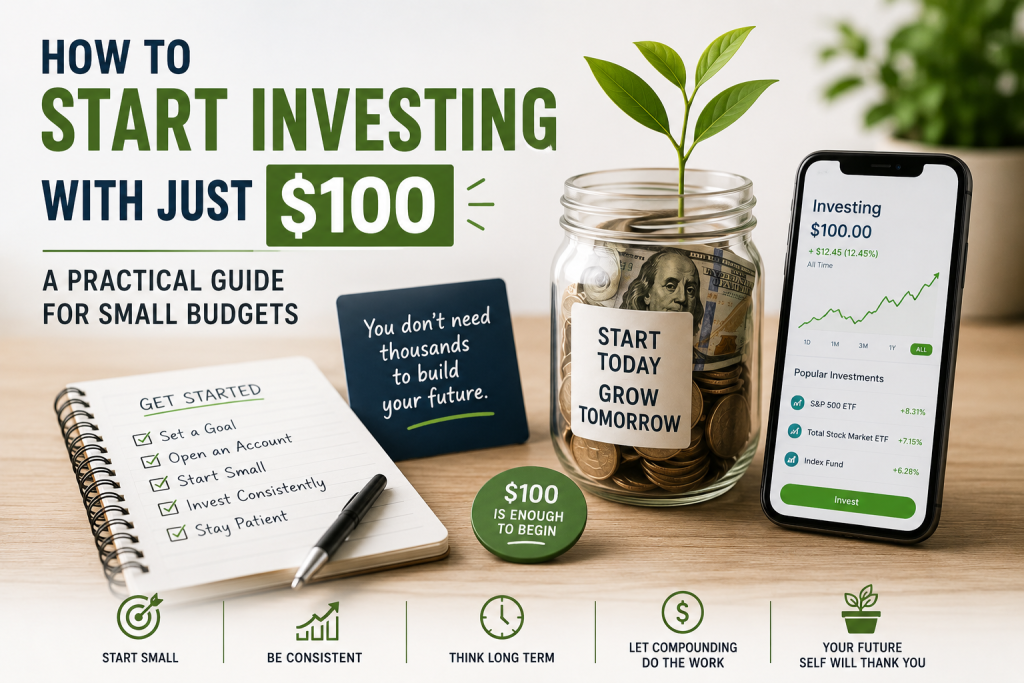
Can you really start investing with just $100? The short answer is yes. You do not need thousands of dollars to begin building wealth. In fact, starting small is often the best way to learn the ropes without risking significant money. The key is to start now and be consistent. Even small amounts invested regularly can grow into substantial sums over time thanks to the power of compound interest.
Many people delay investing because they think they need a large sum to get started. This is a myth. Thanks to technology and the rise of commission-free trading, you can now invest with as little as $1. This guide shows you exactly how to start investing with $100, what to buy, and how to grow your small investment into a significant portfolio over time.
WHY STARTING SMALL IS BETTER THAN NOT STARTING AT ALL
The most important thing is not how much you invest—it is that you start. Investing is a habit, and like any habit, it gets easier with practice. Starting small allows you to build the habit of investing regularly without the pressure of risking large sums. It also gives you the opportunity to learn how the market works without significant financial consequences.
Perhaps most importantly, starting small gets you into the market sooner. Time in the market is more important than timing the market. The earlier you start, the more time your money has to compound. A person who invests $100 per month starting at age 25 will have significantly more money at retirement than someone who starts investing $500 per month at age 40.
THE POWER OF STARTING EARLY
Consider this example: Two people, Alex and Jamie, both want to save for retirement. Alex starts investing $100 per month at age 25 and continues until age 65. Jamie waits until age 35 and invests $200 per month until age 65. Both earn an average 8% annual return. At age 65, Alex has invested a total of $48,000, but their portfolio is worth approximately $349,000. Jamie has invested a total of $72,000, but their portfolio is worth approximately $298,000. Alex started earlier with less money and ended up with more wealth. This is the power of compound interest and starting early.
WHERE TO OPEN AN ACCOUNT
The first step to investing with $100 is opening a brokerage account. There are many excellent options for beginners with no minimum deposit requirements and commission-free trading. Here are some of the best.
Fidelity is one of the best all-around brokers, offering no account minimums, no trading commissions, and a wide range of investment options. Vanguard is known for its low-cost index funds and ETFs. It has no account minimums for many of its funds. Charles Schwab offers no account minimums, no trading commissions, and excellent educational resources. Robinhood is a mobile-first platform with no commissions and no minimums. It is great for beginners but offers fewer educational resources. SoFi Invest offers no commissions, no minimums, and a user-friendly app that integrates banking and investing.
HOW TO OPEN YOUR ACCOUNT
Opening an account is simple. Choose your broker and go to their website or download their app. Click “Open Account” and provide your personal information, including your name, address, and Social Security number. Choose the type of account you want. A standard brokerage account is the easiest to start. For retirement, consider a Roth IRA. Fund your account by linking your bank account and transferring your $100. Once your account is funded, you are ready to start investing.
WHAT TO BUY WITH YOUR $100
With $100, your options are somewhat limited, but there are still excellent choices. Here are some recommendations for what to buy.
Fractional Shares of ETFs: Many brokers now allow you to buy fractional shares of ETFs. This means you can invest your entire $100 into a diversified ETF even if one share costs more than $100. The Vanguard S&P 500 ETF (VOO) trades at over $400 per share, but with fractional shares, you can buy a portion of one share. This is one of the best options for beginners.
Fractional Shares of Blue-Chip Stocks: You can also buy fractional shares of individual stocks. For example, you could buy a fraction of a share of Apple, Microsoft, or Amazon. While these are great companies, buying a single stock is riskier than buying an ETF.
**ETFs That Trade Below $100:** Some ETFs have share prices below $100. Examples include the SPDR Portfolio S&P 500 ETF (SPLG) at around $50 per share and the Schwab U.S. Dividend Equity ETF (SCHD) at around $75 per share. These are excellent low-cost options.
Dividend Reinvestment Plans: Some companies offer direct stock purchase plans with low minimums. However, these are less common and often have fees.
THE BEST INVESTMENT FOR $100
For most beginners, a low-cost S&P 500 ETF is the best investment for $100. The S&P 500 has historically returned about 10% per year and includes 500 of the largest U.S. companies. This gives you instant diversification. If one company fails, the impact on your portfolio is minimal. With just $100, you can buy a fractional share of VOO, VTI, or SPLG, giving you exposure to the entire U.S. stock market. This is the simplest and most effective way to start investing.
THE SECOND $100: BUILDING YOUR PORTFOLIO
Once you have invested your first $100, the next step is to invest your second $100. And then your third. Consistency is more important than the amount. Even if you can only invest $20 per month, that is better than investing nothing.
As your portfolio grows, you can start to diversify. You might add an international ETF like VXUS or a bond ETF like AGG. But in the beginning, a single low-cost S&P 500 ETF is a perfectly fine choice.
SETTING UP AUTOMATIC INVESTMENTS
One of the best ways to build wealth is to set up automatic investments. Most brokers allow you to schedule recurring transfers from your bank account. You can set up a monthly transfer of $50 or $100 to your brokerage account and have it automatically invested in your chosen ETF. This removes the need to remember to invest and ensures you are consistently building your portfolio.
WHAT NOT TO BUY WITH YOUR FIRST $100
As a beginner, avoid these common mistakes. Avoid individual stocks. While it is tempting to buy a single stock, you are taking on unnecessary risk. You cannot diversify with $100, and if the company fails, you lose everything. Avoid penny stocks. Penny stocks are highly speculative and often lose value. Avoid options. Options are complex and risky. They are not appropriate for beginners. Avoid cryptocurrencies. Crypto is extremely volatile and not suitable for beginners.
HOW TO GROW YOUR $100 INVESTMENT
Once your $100 is invested, there are two things that will help it grow: time and consistency. Time in the market is the most important factor. Let your money compound over the years. Do not panic and sell when the market drops. Stay invested. Consistency is the second factor. Add to your investment regularly, even if it is just a small amount. Over time, these small contributions will compound into a significant sum.
COMMON MISTAKES TO AVOID
Beginners often make these common mistakes. Mistake 1: Not investing because you think you need more money. Even $100 is enough to start. Mistake 2: Checking your portfolio constantly. Daily market fluctuations are normal. Do not panic. Mistake 3: Selling when the market drops. This locks in your losses and misses the recovery. Stay invested for the long term. Mistake 4: Chasing hot stocks. Investing in what is popular is not a strategy. Focus on a diversified portfolio. Mistake 5: Ignoring fees. Even small fees eat into your returns. Choose low-cost ETFs.
CONCLUSION
Starting to invest with $100 is not only possible—it is a smart move. The most important thing is to start and be consistent. By opening a brokerage account, buying a low-cost ETF, and setting up automatic investments, you can build a significant portfolio over time. Do not wait until you have more money. Start now with what you have. Your future self will thank you.
About the Author: The Financial Education Team is dedicated to helping individuals build strong financial foundations through clear, actionable guidance on credit, saving, and wealth-building.
Disclaimer: This article is for informational purposes only and should not be considered financial or investment advice. Always conduct your own research or consult a qualified financial advisor before making investment decisions.