
Stocks vs. Bonds vs. ETFs: What’s the Difference and Which Should You Buy?
INTRODUCTION
One of the most common questions new investors ask is: What should I buy? Stocks? Bonds? ETFs? The answer depends on your goals, your risk tolerance, and your timeline. Each investment type has different characteristics, risks, and potential returns. Understanding these differences is essential for building a portfolio that works for you.
Many people assume that investing is complicated. But at its core, investing is simple: you are putting your money to work in assets that have the potential to grow over time. The challenge is choosing the right assets for your situation. This guide breaks down stocks, bonds, and ETFs in plain language, explaining what they are, how they work, and which ones might be right for you. Whether you are a complete beginner or looking to refine your strategy, this information will help you make informed investment decisions.
UNDERSTANDING YOUR INVESTMENT OPTIONS
Before we dive into the details of stocks, bonds, and ETFs, it is important to understand the bigger picture. Every investment falls somewhere on a spectrum of risk and return. Higher potential returns usually come with higher risk. Lower risk investments typically offer lower returns. Your job as an investor is to find the right balance for your situation.
Your investment timeline is one of the most important factors in determining the right mix of investments. If you are investing for retirement that is 30 years away, you can afford to take more risk because you have time to recover from market downturns. If you are saving for a down payment on a house in three years, you should take less risk because you cannot afford a significant loss.
STOCKS: OWNERSHIP IN COMPANIES
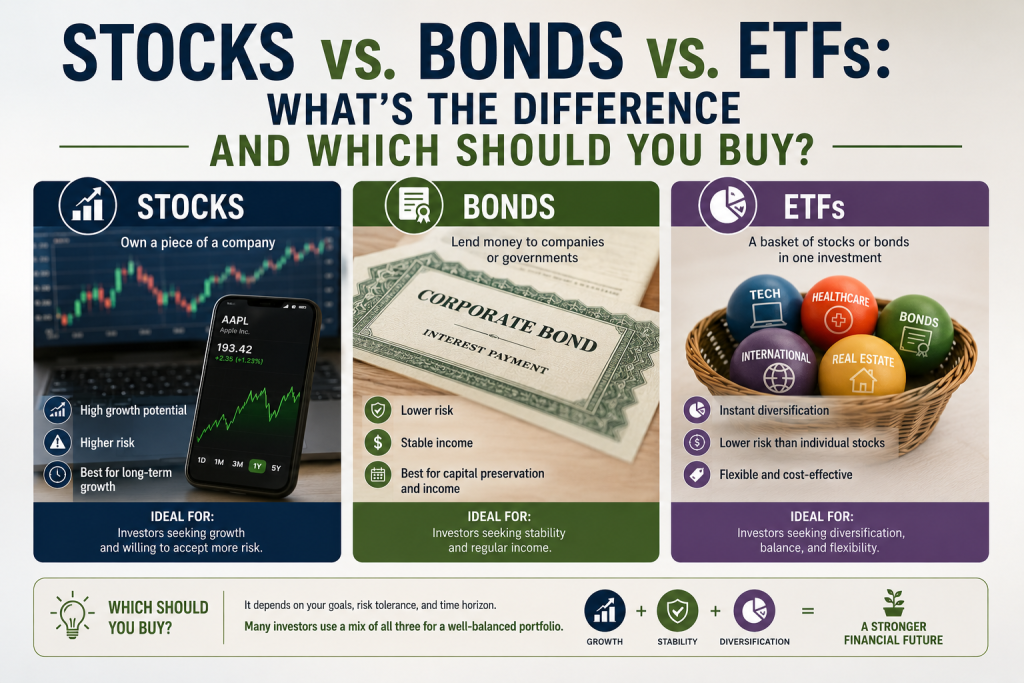
Stocks represent shares of ownership in a company. When you buy a stock, you become a part-owner of that business. As a shareholder, you benefit when the company grows and profits. Your returns come from two sources: capital appreciation (the stock price going up) and dividends (regular payments made to shareholders from company profits).
Stocks offer the highest potential returns of the three investment types. Historically, the S&P 500 has returned about 10% per year on average. However, stocks are also the most volatile. Prices can drop significantly in a short period, especially during economic downturns.
There are different types of stocks. Large-cap stocks are shares of large, established companies like Apple, Microsoft, and Amazon. These tend to be more stable and pay dividends. Mid-cap stocks are shares of medium-sized companies. They offer a balance of growth and stability. Small-cap stocks are shares of smaller companies. They offer high growth potential but are more volatile. Growth stocks are companies expected to grow faster than the market. They reinvest profits into expansion rather than paying dividends. Value stocks are companies that appear undervalued by the market. They often pay dividends.
The risks of stocks include market risk, which means the overall market can decline due to economic conditions. Company-specific risk means individual companies can underperform due to poor management, competition, or other factors. Volatility risk means stock prices can fluctuate significantly in the short term.
BONDS: LOANS TO GOVERNMENTS AND CORPORATIONS
Bonds are loans you make to governments or corporations. When you buy a bond, you are lending money to the issuer in exchange for regular interest payments. At the end of the bond’s term, you receive your principal back. Bonds are generally lower risk than stocks because they are backed by the issuer’s promise to repay.
Your returns from bonds come from interest payments, which are typically fixed and paid regularly. You also get your principal back at maturity. If you sell a bond before maturity, you may realize a capital gain or loss depending on interest rate changes.
There are different types of bonds. Government bonds are issued by national governments and are considered the safest, especially U.S. Treasury bonds. Municipal bonds are issued by state and local governments and often have tax advantages. Corporate bonds are issued by companies and offer higher yields but come with higher risk.
The risks of bonds include interest rate risk, which means bond prices fall when interest rates rise. Credit risk is the risk that the issuer may default on interest payments or principal. Inflation risk is the risk that inflation erodes the purchasing power of your interest payments.
ETFS: BASKETS OF STOCKS OR BONDS
ETFs are baskets of stocks, bonds, or other assets that trade on exchanges like individual stocks. When you buy an ETF, you are buying a diversified portfolio of assets in a single transaction. ETFs offer the diversification of mutual funds with the trading flexibility of stocks.
ETFs offer instant diversification. By buying one ETF, you get exposure to hundreds or thousands of stocks or bonds. This reduces your risk compared to buying individual stocks. ETFs are also low-cost. Most ETFs have expense ratios below 0.1%, much lower than actively managed mutual funds. ETFs also have tax efficiency, as they typically generate fewer capital gains distributions than mutual funds. Finally, ETFs offer trading flexibility, as they trade throughout the day like stocks.
There are different types of ETFs. Stock ETFs track indexes like the S&P 500 or specific sectors like technology. Bond ETFs track bond indexes and provide diversification across many bonds. Commodity ETFs track commodities like gold or oil. International ETFs track markets outside your home country.
The risks of ETFs include market risk, as the underlying investments can decline in value. Tracking error is the risk that the ETF does not perfectly track its underlying index. Liquidity risk is the risk that some ETFs have lower trading volumes.
COMPARISON TABLE
| Feature | Stocks | Bonds | ETFs |
|---|---|---|---|
| What you own | Ownership in a company | Loans to issuers | Baskets of stocks/bonds |
| Potential return | High (10% average) | Low to moderate (2-6%) | Varies by underlying assets |
| Risk level | High | Low to moderate | Varies by underlying assets |
| Income | Dividends (optional) | Interest (guaranteed) | Dividends from underlying stocks |
| Diversification | Low (individual stock) | Low to moderate | High (many holdings) |
| Cost | Trading commissions | Trading commissions | Low expense ratios |
| Best for | Long-term growth | Income and stability | Diversification and low cost |
WHICH SHOULD YOU BUY?
The answer depends on your situation. Here are some guidelines for different scenarios.
If you are under 40 and investing for retirement, the majority of your portfolio should be in stocks. You have time to recover from market downturns and need the growth potential. A simple approach is to buy an S&P 500 ETF, which gives you exposure to 500 of the largest U.S. companies. This is a low-cost, diversified way to invest in stocks.
If you are between 40 and 60, consider a mix of stocks and bonds. As you get closer to retirement, you want to reduce your risk. A common approach is to have a percentage of bonds roughly equal to your age. For example, at age 50, you might have 50% in stocks and 50% in bonds. You can achieve this with a target-date fund or a combination of stock and bond ETFs.
If you are over 60 or already retired, your portfolio should be more conservative. A larger portion should be in bonds and cash to protect against market downturns. You still need some growth to keep up with inflation, but you cannot afford significant losses.
HOW TO CHOOSE THE RIGHT ETFS
For beginners, ETFs are often the best choice. They provide instant diversification at a low cost. Here are some of the best ETFs for beginners.
The Vanguard S&P 500 ETF (VOO) tracks the S&P 500 and has an expense ratio of 0.03%. It is one of the most popular ETFs in the world. The Vanguard Total Stock Market ETF (VTI) tracks the entire U.S. stock market and includes small, mid, and large-cap stocks. The iShares Core U.S. Aggregate Bond ETF (AGG) tracks the U.S. bond market and is a good choice for bond exposure. The Vanguard Total International Stock ETF (VXUS) provides exposure to international stocks outside the U.S.
COMMON MISTAKES TO AVOID
When choosing investments, avoid these common mistakes. Mistake 1: Putting all your money in one stock. This is the opposite of diversification. If that company fails, you could lose everything. Mistake 2: Avoiding bonds entirely. While stocks offer higher growth potential, bonds provide stability and income. A mix of both is usually best. Mistake 3: Choosing funds with high fees. Fees eat into your returns over time. Look for low-cost ETFs. Mistake 4: Trying to time the market. No one can consistently predict market movements. Stay invested for the long term.
CONCLUSION
Stocks, bonds, and ETFs each have a place in a well-diversified portfolio. Stocks offer the highest growth potential but come with the highest risk. Bonds offer stability and income but lower returns. ETFs offer instant diversification at a low cost and are ideal for beginners. The right mix depends on your age, goals, and risk tolerance. By understanding the differences between these investment types, you can build a portfolio that helps you achieve your financial goals. Your investing journey starts with understanding your options and making informed decisions.
About the Author: The Financial Education Team is dedicated to helping individuals build strong financial foundations through clear, actionable guidance on credit, saving, and wealth-building.
Disclaimer: This article is for informational purposes only and should not be considered financial or investment advice. Always conduct your own research or consult a qualified financial advisor before making investment decisions.