
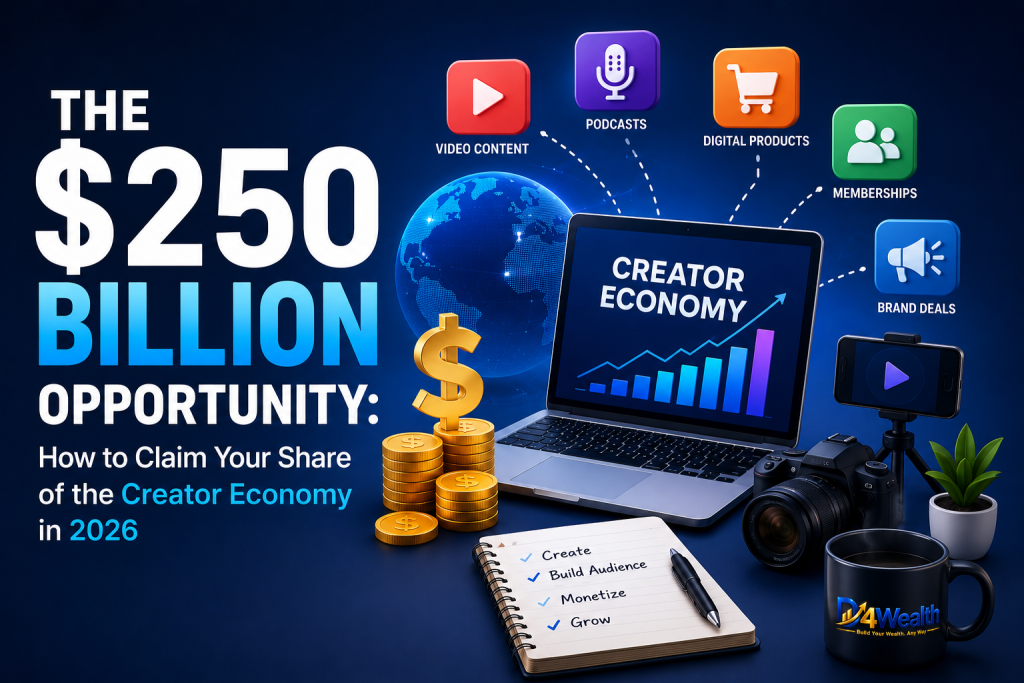
The $250 Billion Opportunity: How to Claim Your Share of the Creator Economy in 2026

INTRODUCTION
The creator economy is estimated to exceed $250 billion globally in 2026. Analysts project the market could reach $500 billion by 2030, with some forecasts suggesting it could surpass $1.35 trillion by 2035. More than 200 million people worldwide now identify as content creators, with approximately 50 million considered professional or semi-professional.
Yet here is the staggering reality: 67% of creators earn less than $10,000 annually from content creation, and just under 5% earn more than $100,000. The creator economy is worth $250 billion this year, but only 4% of creators can touch it.
This massive gap between market size and creator earnings represents the single greatest opportunity in the modern economy. The $250 billion creator economy is not just a headline—it is an invitation. This article reveals how to claim your share of this booming market, whether you are a complete beginner or an established creator looking to scale.
1. Understand the Creator Economy Landscape
To claim your share of the $250 billion opportunity, you must first understand how the creator economy is structured and where the money is flowing. The creator economy has expanded dramatically over the past decade as social media platforms introduced monetization programs and brand partnerships.
Market Size and Growth:
The creator economy crossed $250 billion in value in 2026, up from approximately $100 billion in 2020. Analysts at Goldman Sachs project it could hit $480 billion by 2027. The market is growing at a compound annual growth rate exceeding 22%.
Platform Breakdown:
The creator economy is segmented across multiple platform types. Video streaming platforms like YouTube, TikTok, and Instagram Reels dominate the space. Podcasting platforms like Spotify and Apple Podcasts continue to grow. Blogging platforms like Substack and Medium provide text-based opportunities. Live streaming platforms like Twitch and Kick offer real-time engagement. Short-form video platforms like TikTok, Instagram Reels, and YouTube Shorts are expanding rapidly.
Revenue Channels:
Creators generate income through multiple channels. Advertising and sponsorships remain the largest source. Subscriptions and memberships provide recurring revenue. Merchandise and product sales offer tangible income. Fan donations and tipping provide direct support. Affiliate marketing generates commission-based income.
The Opportunity Gap:
The creator economy is worth $250 billion this year, yet more than half of creators earn less than $15,000 annually. This gap exists because most platforms were built to serve the top 4% of creators. The other 96% lack the infrastructure to discover, price, and monetize their work effectively. This is not a talent gap—it is an infrastructure gap.
2. Diversify Your Income Streams
The difference between creators who struggle and those who thrive almost always comes down to one thing: how many income streams they have. People who rely on a single revenue source are the most vulnerable. Creators with three or more revenue streams earned $75,000 more on average than those relying on a single source in 2025. Nearly 58% of creators now depend on at least three monetization channels simultaneously.
Primary Revenue Streams:
Brand partnerships and sponsored content is still the largest income stream for most creators. Creators earn almost 70% of their income through partnerships with brands. Brands pay significant sums to show their products in your content because their audience trusts you. Micro-creators also get multiple brand partnerships because their engagement rates are higher.
Platform ad revenue is available through every major platform. YouTube’s Partner Program pays creators based on views and watch time. TikTok, Instagram, and Facebook offer similar programs. However, ad revenue should be treated as a base layer, not your main income, because platforms change their algorithms and payment structures regularly.
Affiliate marketing is one of the most accessible income streams. You recommend a product, share a buying link, and earn a commission when someone purchases. Affiliate marketing works on trust. When you recommend something you genuinely use, people listen. Affiliate-driven creator partnerships are one of the fastest-growing deal structures brands are adopting in 2026.
Digital products are one of the smartest moves you can make as a creator. You create the product once and sell it unlimited times. E-books, guides, preset packs, templates, and online courses let you package your expertise into something people pay for once and revisit for years. The advantage here is ownership—when you sell through your own platform, you keep the relationship with your customer.
Memberships and subscriptions are becoming more common as creators shift toward recurring revenue. Platforms like Patreon and YouTube Memberships let your audience pay a monthly fee for exclusive content. Subscriptions grow slower than ad revenue, but they are far more stable. A creator with 2,000 paying subscribers at $10 per month earns $20,000 monthly.
User-generated content (UGC) is a fast-growing opportunity that many creators overlook. Brands pay you to produce content they use on their own channels, not yours. You do not need a large personal following—you need the skill to create content that looks and feels authentic. UGC has partially decoupled creator income from follower count.
3. The New Monetization Playbook
The creators building steady income in 2026 treat monetization like a portfolio. They spread work, audience ties, and income across many channels. Then they double down on content that lasts.
Stop Betting on One Platform:
For years, the dominant creator monetization model looked like this: build an audience on one platform, wait for ad revenue, and hope the algorithm works in your favor. Research shows YouTubers cannot survive on ad revenue alone. A single policy change or algorithm shift could erase years of income overnight.
Spread the Work First:
The savviest creators do not start by choosing a monetization model. They test and distribute as widely as possible and watch where engagement is genuine. Each channel is a test. Once you see where real engagement happens, build your monetization plan there.
Non-Exclusivity Is the Strategy:
Non-exclusivity is not a compromise—it is the strategy. You are a creator with a body of work and an audience relationship, and every platform is a potential revenue stream. Publish everywhere. Let the engagement data tell you where to invest more deeply.
Build a Portfolio of Revenue Streams:
Creators generating the most stable income report running two to five revenue streams simultaneously. A free distribution layer drives discovery. A direct-support layer converts engaged fans into paying subscribers. A transaction layer handles one-time purchases and premium content. A brand layer leverages audience trust commercially. None of these works well in isolation. Together, they compound.
4. The Authenticity Advantage
Brands have spent years saying that authenticity, relevance, and community trust are what make creators valuable. But the economics of the industry still disproportionately reward scale—like larger followings. That disconnect risks pushing creators toward the very behaviors audiences distrust.
The Authenticity Gap:
CreatorIQ’s State of Creators 2026 report, based on a survey of more than 5,095 creators, reveals that 42% of creators report tension between the content their audiences want and the content brands ask them to produce. Among creators with 500,000 or more Instagram followers, that figure rises to 53%.
Why Authenticity Matters:
92% of consumers trust influencer endorsements more than traditional ads. This is exactly why brands keep trying to buy into creator trust. Creators should leverage this by prioritizing authenticity over scale. A creator with a genuinely engaged 4,000-person audience does not lack value—she lacks the tools that would let a brand find her, price a partnership fairly, and pay her without an agency taking 30% off the top.
Audience Trust as a Long-Term Asset:
For brands, the finding underscores the importance of giving creators sufficient creative latitude and treating audience trust as a long-term asset—not simply a vehicle for short-term campaign performance.
5. Leverage AI in Your Creator Workflow
AI adoption is widespread among creators, but remains focused on basic creative tasks. 72% of creators report having used AI tools, most commonly for brainstorming, writing, or editing. Only 4% use AI for strategy, and just 1% use it to automate workflows. The highest earners use AI roughly twice as often as the average creator and report significantly higher engagement as a result.
AI-Powered Content Workflow:
For writing and captions, ChatGPT and Claude are the default for drafting, brainstorming, and matching a creator’s established voice across a batch of posts.
For image and design work, Canva’s Magic Write and Dream Lab features let creators generate on-brand captions and product visuals in seconds. The platform’s Bulk Create feature can take a spreadsheet of product names and turn it into dozens of unique description-and-image pairs automatically.
For short-form video, CapCut remains the fastest path for TikTok and Reels edits, while Canva’s newer AI video tools now handle auto-captioning and highlight-reel generation from longer footage.
The Human Touch:
AI-generated scripts still need a human pass. Even strong models sit around 89% accuracy on straightforward topics, which means the last 10 percent—the part that keeps content sounding like a specific creator instead of a generic one—still needs a personal edit.
The Opportunity:
AI changed what “creator” even means. A creator marketplace built in 2023 assumed content production was the bottleneck. In 2026, it is not. The bottleneck moved to discovery, trust verification, and getting paid fairly for work that is now faster and cheaper to produce than ever.
6. The Undermonetized Middle
Despite the large creator population, only 4% of global creators earn over $100,000 annually, while 50% earn less than $15,000. This income concentration reveals a massive undermonetized middle tier of creators producing quality content but lacking business infrastructure to scale.
The Infrastructure Gap:
Every major creator platform—Instagram, TikTok, YouTube—was built to serve the top 4%. That is not an oversight. It is the business model. A creator marketplace built for the other 96% is the market everyone is ignoring while quoting the same headline number.
The Discovery Problem:
Brands struggling to find creators are not struggling because there is no database. There are dozens. They are struggling because follower count is a bad proxy for the thing they are actually buying—trust with a specific audience. A creator marketplace that matches on audience behavior and content outcomes solves the problem brands actually have.
The Middle Class Opportunity:
The “middle class” of creators—those with 100,000 to 5 million subscribers—is currently underserved by enterprise ad-tech. This is not about competing with Hollywood. It is about serving the creators Hollywood ignores. A platform that helps a mid-tier creator stack revenue streams—brand deals, digital products, affiliate income, subscriptions—solves a bigger problem than one more brand-deal marketplace.
The 30-Day Creator Economy Action Plan
📋 Your Step-by-Step Guide
Week 1: Foundation
Identify your niche and target audience. Research platforms where your audience spends time. Study successful creators in your niche.
Week 2: Content and Platform Setup
Create or update your creator profiles. Start publishing content consistently. Build your portfolio and showcase your work.
Week 3: Monetization Setup
Identify 2-3 income streams to pursue. Set up affiliate marketing accounts. Create your first digital product. Apply to brand partnership platforms.
Week 4: Scale and Optimize
Analyze what content performs best. Double down on what is working. Start building your email list. Plan your next product or offering.
Conclusion
The creator economy is worth $250 billion and growing rapidly. But the opportunity is not equally distributed. The creators who thrive in 2026 are those who treat their work like a business, diversify their income, leverage AI, and prioritize authenticity over scale.
The gap between the creator economy’s size and most creators’ earnings is not a talent gap—it is an infrastructure gap. The $250 billion opportunity is waiting for those who build the right systems, diversify their income, and claim their share of this booming market.
The tools are available. The platforms exist. The demand is growing. The only question is whether you will take the next step toward building your creator business.