

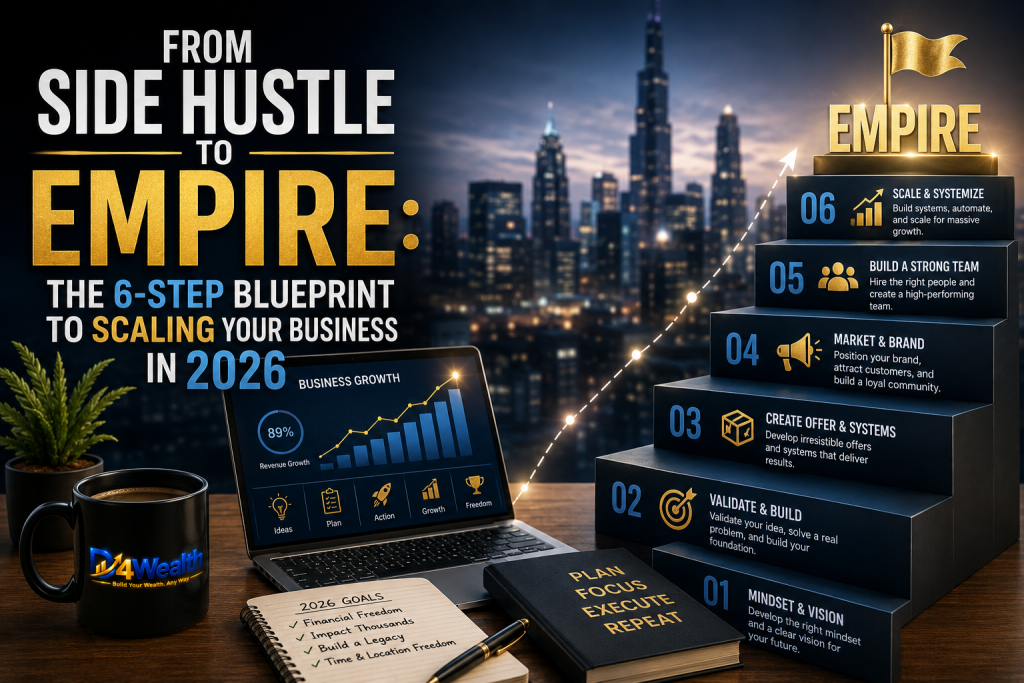
From Side Hustle to Empire: The 6-Step Blueprint to Scaling Your Business in 2026
INTRODUCTION
Let me take you back to 2012. A woman named Roslyn was running errands for people across eastern North Carolina—literally. That was the seed that would grow into Express Errands & Courier, a company now headquartered in Atlanta and operating across multiple states. But here is the thing: back then, it was just her and a Chrysler Pacifica, with a whole lot of ambition and not a lot of answers. She was doing everything herself—driving, scheduling, billing, and customer service. She was the business. And like so many side hustlers, she was exhausted.
If you are building something on the side right now—after your 9-to-5, while the kids are sleeping, or between shifts—this is for you. Yes, you can turn your side hustle into a real, sustainable, six-figure (or more) business. But you have got to scale strategically. The journey from side hustle to empire is not about overnight success. It is about sustained strategy, intentional growth, and building systems that work without your constant involvement. Whether you are a freelancer, a UGC creator, an affiliate marketer, or a service provider, the principles of scaling remain the same. This article provides a practical, six-step blueprint to take your side hustle from where it is now to where you want it to be—without working 80-hour weeks or burning out.
Market validation and customer demand
1. Validate Before You Elevate
Before you hire, before you rebrand, before you drop thousands into ads—validate that there is demand for what you are offering. The biggest mistake side hustlers make is scaling something nobody actually wants or building a solution in search of a problem. This is the most critical step in the scaling process, yet it is often skipped in the rush to grow. Validation is not about proving that your idea is good; it is about confirming that there is a market willing to pay for what you offer at a price that makes your business sustainable.
How to Validate:
Look at repeat business. Are customers coming back? That is a green light. Repeat business is the single most powerful indicator of product-market fit. If people are not returning, you need to understand why. Customer feedback is essential. Are they telling you what you do well and what could be better? Pay attention. Feedback is not criticism; it is data that can guide your growth. Referrals are powerful signals. If people are sending their friends and colleagues to you, you have something worth scaling. Referrals mean trust, and trust is the currency of sustainable growth.
Practical Steps:
Start by having real conversations with your first customers. Ask them: What problem did our product or service solve for you? Would you pay more for an expanded version? What is missing? This qualitative data is invaluable. Next, consider a minimal viable product launch with a small, targeted audience. Gather feedback before scaling production or service delivery. This approach prevents costly mistakes and ensures you are building something people actually want. Finally, create a simple feedback loop. A one-question survey or a quick follow-up email can provide insights that prevent costly scaling mistakes. Validation is not a one-time event. It is an ongoing process that should continue as you grow and evolve your offerings. The market changes, customer needs evolve, and your validation process should keep pace.
2. Build Systems Early
The biggest mistake I see side hustlers make is waiting too long to build systems. Start now. Document your processes. Automate what you can. Do not wait until you are overwhelmed and buried in tasks. Without systems, you are the business. With systems, you own a business. The difference between a side hustle and a scalable business is the presence of systems that function independently of your personal involvement.
What to Systematize:
Client onboarding and communication is a critical area. Create standardized templates for proposals, contracts, and welcome emails. These templates should be professional, clear, and consistent, ensuring every client has the same positive experience. Project management is another area that benefits from systems. Tools like Asana, Trello, or Notion can help you track tasks and projects efficiently. Appointment scheduling can be automated with Calendly or similar tools to eliminate the back-and-forth of booking meetings. Financial tracking is essential. Use QuickBooks or a similar tool to track income, expenses, and invoices. Automation tools like Zapier can connect different applications and automate repetitive tasks, saving you hours each week. These systems may seem small individually, but collectively they create a foundation for sustainable growth.
Practical Steps:
Start by documenting everything you do to deliver your product or service. Write down each step, no matter how small. This creates a Standard Operating Procedure (SOP) that you can reference, refine, and eventually delegate. Next, identify the repetitive tasks that eat up your time. Can any of these be automated with tools like Zapier or automated email sequences? Finally, begin delegating tasks that are not your highest-value activity. This might mean hiring a virtual assistant or using freelance platforms for specific tasks. Systems are not about removing the human element. They are about freeing you to focus on the strategic, creative, and high-impact work that only you can do. When you have systems in place, you can step away from the daily operations without fear of everything falling apart.
3. Don’t Just Work in the Business—Work on It
When it is a one-person show, it is easy to get caught in the daily grind. But to scale, you need to think like a CEO. That means stepping back, planning, delegating, and leading. As the founder of a small business, it is natural to want to do everything yourself, especially when you are passionate about your work. However, this approach creates a bottleneck. You become the single point of failure, and your business cannot grow beyond your personal capacity.
The CEO Mindset Shift:
Set time aside each week to review your business performance, set goals, and refine your strategy. This is not a luxury—it is a necessity. During this time, you should be asking questions like: What is working and what is not? Where are we losing money or time? What is our next growth milestone? You are also planning your transition from doer to leader. This means identifying tasks to delegate, developing processes for training, and creating a vision for the business that does not depend solely on your personal involvement. The CEO mindset is about seeing the big picture and making decisions that position your business for long-term success, not just short-term survival.
How to Transition from Doing to Leading:
Start small. Block out two hours every Friday morning for strategic planning. Use this time to look at your numbers, review client feedback, and plan for the coming week. The key is to make it a non-negotiable habit. Next, identify one task to delegate in the next 30 days. This could be something as simple as social media scheduling or as complex as client onboarding. Finally, begin developing a leadership mindset by asking “How can we achieve this?” instead of “How can I achieve this?” Your language shapes your reality and your team’s expectations. When you start thinking in terms of “we” rather than “I,” you open yourself up to collaboration, delegation, and scalable growth.
4. Grow with People, Not Just Projects
I scaled because I invested in the right people—not just in hiring but also in mentorship and partnerships. Collaboration has been a secret weapon in building multiple successful ventures. The right person can open doors a marketing budget never could. Scaling a business is not just about increasing revenue; it is about building a network and a team that can take your business further than you could alone. No entrepreneur builds an empire in isolation. Behind every successful business is a network of mentors, peers, partners, and team members who contributed to its growth.
Who to Bring Into Your Network:
Mentors are essential. Find people who have already built what you are trying to build. They provide guidance, shortcut your learning curve, and offer perspective. Peers are equally valuable. Connect with other side hustlers and entrepreneurs. Share challenges, resources, and celebrate wins together. Strategic partners can open doors to new markets or audiences. Look for businesses that serve similar customers but offer complementary products or services. Finally, employees or contractors are critical as you scale. Hire for tasks you are not great at or that drain your energy. Let them handle operations while you focus on strategy. Each of these relationships adds value to your business in different ways, creating a support system that fuels growth.
How to Find the Right People:
Start by joining communities where your ideal mentors and peers gather. This could be industry-specific forums, local business groups, or online communities like LinkedIn or specialized Facebook groups. When you identify someone you admire, reach out with a specific, respectful request. Many successful people are willing to share their experience if approached thoughtfully. Finally, invest time in relationships before you need them. Build your network proactively, not reactively. A strong network is one of the most valuable assets you can develop. It provides support, opens doors, and offers perspectives you might not have considered.
5. Keep the Mission Bigger Than the Money
Money is fuel, not the destination. Your “why” needs to be rock solid—especially when scaling gets tough because trust me, it will. A mission-driven business is not only more resilient but also attracts better customers, partners, and employees. When the numbers are down or challenges arise, a clear mission keeps you moving forward. When you are faced with difficult decisions, your mission provides clarity and direction.
Why Mission Matters:
A clear mission provides clarity during difficult decisions. When you are faced with a choice, you can ask: Does this move us closer to our mission or further away? It also provides motivation when things get hard. Your mission is the reason you will keep going when the numbers are not working. It creates a sustainable business model. Profit is important, but if it is your only driver, you will make short-term decisions that hurt your long-term success. Finally, a strong mission attracts better customers, partners, and employees who believe in what you are doing. People want to be part of something meaningful, and a compelling mission gives them that opportunity.
Finding Your Why:
Ask yourself: What is the problem I want to solve in the world? Who am I serving? What is the legacy I want to leave? The answers to these questions will give you a mission that is bigger than just making money. Keep that mission visible. Write it down and put it somewhere you will see it every day. Let it guide your decisions and remind you of what you are building and why it matters. When your mission is clear, scaling becomes easier because you have a compass that guides every decision.
6. Design Your Scaling Strategy
Scaling is not about overnight success. It is about sustained strategy. And if I can go from running errands in one city to leading three companies, so can you. Scaling requires a deliberate approach that balances ambition with practicality. It means making strategic investments in the areas that will generate the highest return and avoiding the temptation to do everything at once.
Key Scaling Principles:
Start with a solid foundation. Before you scale, ensure your business model, systems, and team are stable. Scaling a flawed business only amplifies its problems. Focus on one channel at a time. Do not try to do everything at once. Master one channel, then expand. This focused approach allows you to learn deeply and optimize before moving on to the next opportunity. Invest in what works. Once you find a profitable strategy, double down on it. Stop spending time on things that are not working and allocate your resources to what is producing results. Build a strong team. You cannot scale alone. Invest in people who can help you grow. Hire for cultural fit and train for skills. Stay adaptable. The market will change. Be willing to pivot and adjust your strategy. Flexibility is a strength, not a weakness, when it comes to scaling a business.
Scaling Metrics to Track:
• Customer Acquisition Cost
• Customer Lifetime Value
• Revenue Growth Rate
• Profit Margins
• Employee Retention Rate
• Net Promoter Score
The 30-Day Scaling Action Plan
📋 Your Step-by-Step Guide
Week 1: Foundation
Document your current processes (SOPs). Identify bottlenecks and system gaps. Define your mission statement. This week is about understanding where you are and where you want to go. You cannot scale what you do not understand.
Week 2: Team and Network
Identify one mentor to reach out to. List potential strategic partners. Define roles you need to fill. This week is about building the relationships that will support your growth. Scaling is a team sport.
Week 3: Strategy and Planning
Set specific growth goals for the next quarter. Identify one income stream to optimize. Plan your next hiring or partnership. This week is about creating a roadmap for the next 90 days. Clear goals create clear paths.
Week 4: Action and Review
Implement one new system. Start building your network actively. Review your progress and adjust. This week is about taking action and learning from the results. Iteration is the engine of growth.
Conclusion
The journey from side hustle to empire is not easy, but it is achievable. Validation, systems, leadership, people, mission, and strategy are the building blocks of sustainable growth. The transition is about working on the business, not just in it. It is about building a team and a network to support you. It is about keeping your mission bigger than the money. The tools are available. The strategies are proven. The only question is whether you will take the next intentional step toward scaling your business into the empire you envision. The journey of a thousand miles begins with a single step—and that step is yours to take.