

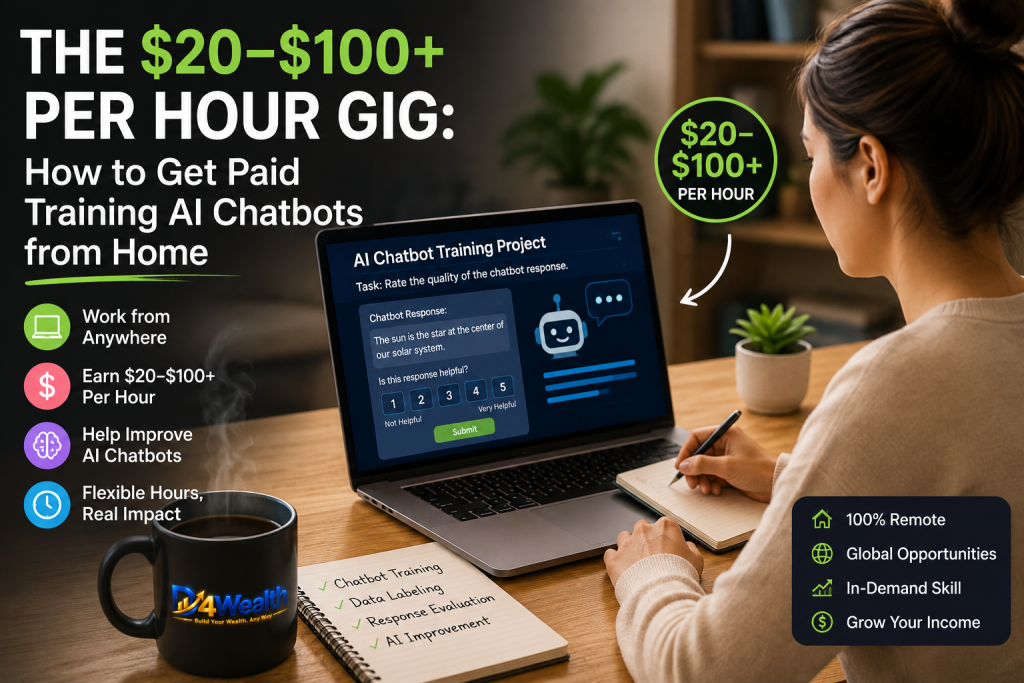
The $20-$100+ Per Hour Gig: How to Get Paid Training AI Chatbots from Home

INTRODUCTION
Imagine getting paid $40 to $100 per hour to chat with bots, rate their responses, and help make artificial intelligence smarter. This is not a fantasy—it is a rapidly growing remote work opportunity that is accessible to anyone with a computer, an internet connection, and strong English skills.
The AI training industry has exploded in recent years. Companies like OpenAI, Google, Meta, and countless startups need human workers to train, test, and refine their AI models. The work is simple to understand but requires attention to detail and critical thinking. The pay is significantly higher than most remote side hustles.
This article explores how you can get paid training AI chatbots from home, what the work involves, which platforms are legitimate, and how much you can realistically earn.
AI training dashboard and data analysis on laptop screen
What Is AI Training and Why Is It Paying So Well?
Artificial intelligence models are not born smart. They learn through exposure to vast amounts of data. But raw data is messy. AI models need human guidance to understand what good responses look like, what is accurate, and what is appropriate.
AI training involves a variety of tasks designed to improve AI systems. You might be asked to rate chatbot responses on a scale of 1 to 5, ranking them for accuracy, helpfulness, and tone. You could be asked to rewrite awkward or incorrect responses to make them more natural and clear. You might compare two different AI responses and select the better one. Some projects require you to fact-check AI-generated content against reliable sources. Others involve creating sample prompts and responses to help the AI learn new topics, or flagging harmful, biased, or misleading content to make AI systems safer and more ethical.
The demand for AI trainers is growing rapidly. As companies race to improve their AI models, they need thousands of human workers to provide the feedback that makes these systems better. According to Freelancer.com, AI-related freelance jobs pay approximately 2.5 times more than non-AI projects, with $8.27 million spent on nearly 77,000 AI-tagged projects in the past year.

Data annotation and AI training concept on computer screen
Realistic Earning Expectations
The earning potential in AI training is substantial. Entry-level tasks typically pay $15 to $25 per hour. As you gain experience and qualify for more complex projects, rates can increase to $30 to $50 per hour. Expert-level roles that require specialized skills in areas like coding, finance, law, or healthcare can command $80 to $150+ per hour.
Amanda Overcash, a single mother in Texas, earned nearly $8,000 in under three weeks from writing and rating chatbot responses. She started at $22 an hour, which increased to $40 an hour as the project progressed. Some expert projects pay $80 to $150 per hour, with top roles reaching $140 per hour for those with specialized skills.
Many platforms offer performance bonuses and incentives that can significantly boost your earnings. Fast workers who maintain high quality can earn substantial bonuses. Some platforms also offer referral bonuses for bringing in other workers.
The work is typically freelance and task-based. You can work as much or as little as you want. There are no fixed hours or shift requirements. The flexibility allows you to fit the work around your existing commitments.
AI model training and data analysis on computer screen
What You Will Be Doing
The work of training AI chatbots falls into several main categories. Rating and ranking responses is a common task. You will be presented with a prompt and multiple AI-generated responses. Your job is to evaluate and rank them based on criteria like accuracy, helpfulness, relevance, and tone.
Rewriting and editing is another key area. AI-generated responses are often awkward, wordy, or incorrect. You will be asked to rewrite them to be more natural, clear, and accurate. This requires strong writing skills and attention to detail.
Fact-checking involves verifying that AI-generated information is accurate. You will check facts, dates, names, and other details against reliable sources. Critical thinking is essential here.
Some projects require creating prompts and responses to help the AI learn new topics. You might be asked to generate sample conversations, write answers to common questions, or create training data for specific subject areas.
Safety and ethics work involves identifying and flagging harmful, biased, or misleading content. You help make AI systems safer and more ethical by spotting problems and suggesting improvements.
The work requires strong English skills, attention to detail, critical thinking, good judgment, and consistent quality. Specialist skills like coding, math, finance, law, medicine, or foreign languages can qualify you for higher-paying projects.

AI training platform interface and dashboard
Which Platforms Are Legitimate
Several legitimate platforms offer AI training work. DataAnnotation is considered one of the best entry points. It is beginner-friendly with consistent task availability and rates from $20 to $60+ per hour. The platform pays via PayPal and is known for reliable payments.
Mercor is known for fast onboarding and high rates. It offers $40 to $150 per hour with quick approval processes. It is a good option for those with specialized skills.
Outlier AI provides consistent task availability and clear instructions. Rates range from $25 to $100 per hour. The platform is well-regarded for its user-friendly interface.
Scale AI offers enterprise-level work with higher rates. It is ideal for those with coding, math, or specialist expertise. Rates can reach $80 to $150 per hour.
Appen has been operating for over 20 years and offers a variety of AI training projects. Rates vary by project, typically $12 to $40 per hour. It is a reliable, established option.
LinkedIn is testing a marketplace where selected professionals can train AI models by chatting with bots and rating their answers. This is an emerging option worth watching.
For those with coding skills, Upwork offers AI and automation training projects. One recent job posting for an AI Creative Automation Specialist offered $1,500 fixed-price for building and optimizing AI automation workflows.

Earnings and payment concept for AI training work
How to Get Started
Getting started in AI training is straightforward. Here is a step-by-step guide.
📋 Your Step-by-Step Guide
Week 1: Set Up Your Profiles
Sign up for two to three platforms. Recommended starting points include DataAnnotation for the easiest entry point ($20 to $60 per hour), Mercor for fast onboarding ($40 to $150 per hour), and Outlier AI for consistent task availability ($25 to $100 per hour). Complete every profile field, upload your resume, and list specific skills rather than generic ones.
Week 2: Pass Assessments
Most platforms require qualification tests. Block out two to three hours of uninterrupted time for each assessment. Take your time and focus on quality. Your scores from these early tasks determine what work you get access to later. Treat each assessment seriously—good scores open doors to higher-paying projects.
Weeks 3 to 4: Start Working
Begin with shorter task sessions of one to two hours. Focus entirely on quality. Consistency beats marathon sessions. Working 1.5 hours every weekday is more sustainable and productive than cramming 10 hours on Sunday. Quality scores matter more than quantity.
Ongoing: Scale Your Income
After two to three months with strong quality scores, you can apply for higher-tier projects. Specialize in a niche for higher rates. Add another platform for more work. Refer others for referral bonuses. Consider taking on specialist projects that pay more.

Remote work lifestyle and freedom with AI training
Important Considerations
Before diving in, there are important factors to consider. Work is often freelance, task-based, and irregular. Earnings can fluctuate sharply from month to month. Some weeks there may be plenty of work; other weeks may be quieter. You need to be comfortable with this uncertainty.
Data privacy is a concern. As AI trainers access sensitive text, medical, or financial data, regulators have raised alarms about potential leaks and mishandling of personal information. Some labeling companies have faced scrutiny over data breaches. Be cautious about what information you share on these platforms.
Avoid anything that asks you to pay upfront. Legitimate platforms do not charge you to join. Social media tends to show the best-case scenario, but real experiences often start slowly and require consistency before earnings become steady.
You need to consider taxes. As a gig worker, you are a 1099 contractor. Set aside 25 to 30 percent of earnings for taxes. You can deduct home office, computer, and internet costs. Pay quarterly estimated taxes to avoid penalties. Keep detailed records of hours worked and income received.
The work can be mentally demanding. Reading and rating AI responses for hours requires sustained concentration. Some projects can be repetitive. It is important to take breaks and avoid burnout. The key is to treat it as a consistent small commitment that you gradually build into a reliable income stream.
Conclusion
The AI training industry offers a legitimate, accessible, and well-paying remote work opportunity. You can earn $20 to $100+ per hour training AI chatbots from home. The work requires no special degrees or certifications. You need strong English skills, attention to detail, and the ability to follow instructions.
The demand for AI trainers is growing rapidly. Companies are investing billions in AI development, and they need human workers to train their models. This is not a passing trend—it is a fundamental shift in how AI is built and improved.
The opportunity is there. The tools are free. The demand is growing. The only question is whether you will start.