

The AI Revolution: 10 Industries Being Transformed


INTRODUCTION
Artificial intelligence is no longer a futuristic concept confined to research labs or science fiction. It is here, it is real, and it is fundamentally reshaping the very fabric of our world—one industry at a time. As the invisible engine behind a new era of efficiency, creativity, and insight, AI is not just enhancing existing processes but reimagining them entirely. From the way we diagnose diseases to the way we grow food, from the algorithms that trade stocks to the chatbots that handle customer service, AI has become the silent partner in nearly every sector of the global economy.

Abstract visualization of AI technology and data flow
According to a comprehensive Bloomberg Intelligence survey of 604 C-suite executives across nine major industries, AI has climbed to the top of the corporate agenda. Roughly 80% of respondents expect their industry to face a “high” or “very high” level of disruption, with two-thirds expecting the same inside their own companies. More than one-third of business leaders now call AI their No. 1 strategic priority, and an additional 47% place it in their top three. This is not a technology that can be ignored or postponed; it is a tidal wave that is already reshaping competitive landscapes.
Yet the AI revolution is not playing out exactly as many predicted. While headlines often focus on job displacement, the reality is more nuanced. More than 90% of executives expect AI to unlock sales growth, averaging 7% over the next three years, and a similar proportion anticipate a 7% profit gain over the same period. Perhaps most surprisingly, more than 60% of respondents expect their organization’s headcount to increase because of AI over the next three years, with an average projected growth of about 4%. This suggests that AI is not simply a tool for cost-cutting, but a catalyst for expansion, innovation, and new business models.
The transformation is already well underway. The World Economic Forum’s Chief Economists’ Outlook reflects bullish sentiment on AI-related productivity gains, with meaningful productivity improvements predicted in the biggest economies within the next year or two. From generative AI that can draft legal contracts and write software code, to agentic AI that can autonomously manage supply chains and coordinate logistics, the capabilities are advancing at breakneck speed. But where exactly is this transformation happening, and what does it mean for the future of these industries? In this comprehensive analysis, we explore ten sectors where AI is not just an incremental improvement, but a fundamental redefinition of how work is done and value is created.
1. Healthcare: Precision Medicine and AI-Assisted Discovery

Medical professional using AI-powered diagnostic technology
The healthcare industry is experiencing one of the most profound AI-driven transformations. Today’s AI models can detect early-stage diseases from medical images with superhuman accuracy, accelerating diagnosis and improving patient outcomes. In drug development, AI is revolutionizing the process from discovery to market. Executives in the pharmaceutical sector estimate that 10-30% of preclinical work may shift to AI, reducing drug development costs by an average of 16% and cutting time to market for novel drugs by 6-18 months. This means that life-saving treatments could reach patients years faster than traditional methods allowed.
AI-assisted drug discovery represents one of the most promising applications. By analyzing vast datasets of molecular structures and biological interactions, AI algorithms can identify promising drug candidates in weeks rather than years. This capability is particularly valuable for rare diseases, where traditional drug development economics have made investment difficult. In clinical settings, AI-powered diagnostic tools are becoming increasingly sophisticated. Radiologists use AI to detect abnormalities in medical images with greater accuracy than ever before, while pathologists leverage machine learning to identify cancerous cells in tissue samples with a precision that rivals – and sometimes surpasses – human experts.
The transformation extends to treatment planning and personalized medicine. AI algorithms analyze patient data—from genetic profiles to medical history—to recommend optimal treatment protocols tailored to individual patients. This shift from one-size-fits-all medicine to precision medicine promises to improve outcomes while reducing costs and side effects. As one industry observer noted, the goal is not to replace doctors but to empower them: “Doctors become more focused diagnosticians, spending less time on routine analysis and more time on complex decision-making and patient care.” Furthermore, AI-powered wearables and remote monitoring tools are enabling continuous health tracking, allowing for early intervention and chronic disease management that was previously impossible.
2. Financial Services: Smarter Risk Management and Intelligent Trading

Stock market data visualization and trading screens
Financial services have been among the earliest and most aggressive adopters of AI technology. The sector’s knowledge-intensive, process-driven nature makes it ideally suited for AI disruption. According to Bloomberg Intelligence, winners in financial services will be determined by data readiness and the ability to embed AI across operations. Traditional banks, investment firms, and insurance companies are racing to integrate AI into their core functions, while fintech startups are using AI to challenge incumbents with more agile, data-driven models.
AI is already compressing research, analysis, compliance, drafting, and workflow cycles in financial and professional services. In investment management, algorithmic trading systems powered by machine learning analyze market data in real-time, executing trades at speeds and frequencies impossible for human traders. These systems can identify patterns and predict market movements, though their increasing sophistication raises important questions about market stability and transparency. The rise of AI-driven quantitative hedge funds has fundamentally changed the landscape of asset management.
In risk management, AI models analyze vast datasets to assess credit risk, detect fraud, and identify money laundering patterns. Banks and insurance companies are using AI to automate underwriting processes, though these applications raise regulatory concerns about unintended bias. As one industry expert noted, financial institutions are worried that “if I make a mistake and then we found three years later that for a particular kind of minority, the lending rates were higher by mistake,” it could lead to class action lawsuits. Consequently, explainable AI and fairness audits have become critical areas of focus.
The customer-facing side of finance has also been transformed. AI-powered chatbots and virtual assistants handle routine inquiries, while robo-advisors provide automated investment advice. The potential productivity gains are substantial: EY-Parthenon estimates that AI could lift economy-wide labor productivity by 1.5% to 3% over the next decade, with the largest contributions coming from tech, finance, consulting, legal, and accounting. In wealth management, AI is being used to generate personalized financial plans and retirement strategies, democratizing access to high-quality advice.
3. Manufacturing: Automation and Predictive Maintenance
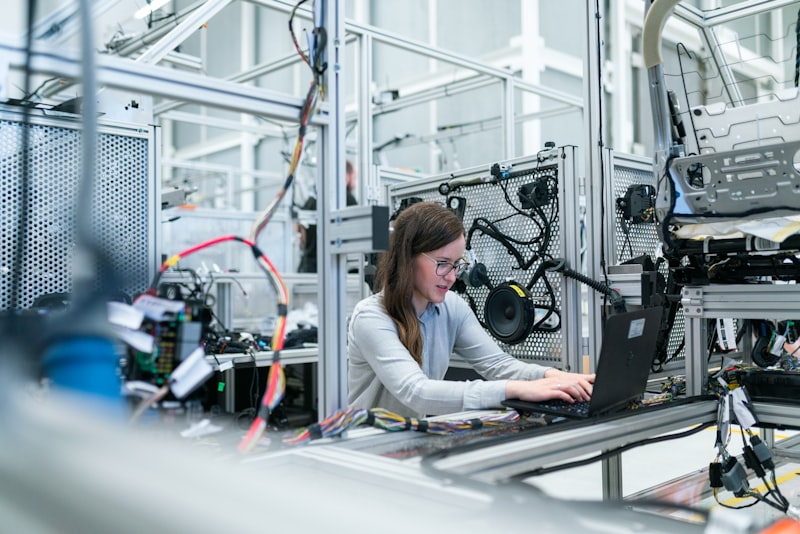
Automated robotics in a modern manufacturing facility
Manufacturing is undergoing a fundamental transformation driven by AI. From autonomous robots on factory floors to predictive maintenance systems that anticipate equipment failures before they occur, AI is reshaping how products are made. The sector faces significant workforce challenges, including an aging workforce and difficulty attracting new talent. AI is helping bridge these gaps by automating repetitive tasks and improving efficiency. The concept of “lights-out manufacturing” – fully automated factories that can run without human intervention – is becoming a reality in some industries.
Siemens, the German industrial giant, offers a compelling example of AI integration in manufacturing. When the company introduced AI to its electronics equipment factory in Amberg, there was initial resistance from shop floor staff who feared for their jobs. By involving workers in the development process and making them part of the solution, Siemens successfully transitioned from skepticism to trust. Workers trained algorithms to identify products that no longer required X-ray quality assurance, and the factory teams eventually reached a point where 30% of products could skip the extra step—a scenario that was economically viable at just 5%.
The future of manufacturing AI involves autonomous, coordinated actions across departments. As IndustryWeek reports, the interaction of generative AI, agentic AI, and machine learning across different areas of an organization holds the greatest promise for solving labor shortages and optimizing talent. Predictive-maintenance AI can analyze sensor data to forecast equipment failures and avoid downtime, while AI vision systems can catch defects on production lines at a pace beyond human capabilities and without repetition-induced fatigue. AI is also being used to optimize supply chains, reducing waste and improving sustainability.
AI’s coding capabilities extend to CNC and other industrial equipment, speeding up setup time and productivity. Manufacturers are also using AI to automate and individualize training, helping upskill staff whether they’re in the plant or in remote field locations. The key challenge for manufacturers now is to establish the digital foundations that enable cross-functional AI, including robust data infrastructure ensuring cleansed, accessible, and high-quality data available across the organization. Those who succeed will gain a significant competitive advantage in efficiency and quality.
4. Retail: Personalization and Customer Experience

Modern retail environment with digital displays and personalized shopping
Retail is being reshaped by AI’s ability to analyze consumer behavior, predict demand, and deliver personalized experiences at scale. Retailers use AI to analyze consumer behavior and predict demand, while AI-powered recommendation engines have become ubiquitous in e-commerce. According to the Bloomberg Intelligence survey, consumer goods and retail executives expect AI to boost sales by mid-single digits, with a focus on personalization and customer experience rather than headcount reduction.
AI is transforming inventory management and supply chain optimization. Machine learning algorithms analyze historical sales data, weather patterns, economic indicators, and other factors to predict demand with increasing accuracy. This reduces waste, ensures products are in stock when customers want them, and improves profitability. The survey found that 92% of retail companies are increasing their AI spending, reflecting confidence in the technology’s ability to deliver returns. In grocery retail, AI is being used to reduce food waste by predicting perishable inventory needs.
In-store experiences are also being enhanced by AI. Computer vision systems can track customer movements and interactions with products, providing valuable insights into shopping behavior. Some retailers use AI-powered digital signage that changes based on who is viewing it, delivering targeted promotions in real-time. However, the sector faces challenges around data privacy and cybersecurity as it collects and analyzes increasing amounts of consumer data. The future of retail is likely to be a seamless blend of online and offline experiences, powered by AI that understands individual preferences and context.
5. Transportation: Autonomous Logistics and Smart Mobility

Smart transportation and autonomous vehicle concept
Transportation is on the cusp of dramatic change driven by AI. The development of autonomous vehicles—from self-driving cars to autonomous trucks—represents one of the most visible AI applications. But the transformation extends far beyond passenger vehicles. AI is optimizing route planning for logistics companies, reducing fuel consumption and delivery times. Smart traffic management systems powered by AI are reducing congestion in cities, and predictive maintenance is keeping fleets on the road longer.
Applied Intuition CEO Qasar Younis argues that AI’s most significant impact over the next 5 to 10 years will be in “physical industries” such as agriculture, mining, construction, and autonomous trucking. “The real AI revolution will happen far from laptops,” he contends, pointing to the severe labor shortages in these fields. The average farmer’s age is approaching 60, meaning the industry will face a massive retirement wave in the coming decade. In these sectors, AI is more about filling critical gaps than replacing existing workers.
Autonomous logistics already show promise. Companies are developing self-driving trucks for long-haul routes, reducing the need for drivers and improving efficiency. In warehouses and distribution centers, autonomous mobile robots transport materials and assist with assembly and repetitive operations. The supply chain benefits are substantial: AI-powered logistics can reduce investigative time by as much as 80% and save enterprises tens of millions of dollars in labor costs. Additionally, AI is being used in maritime and aviation to optimize routes and improve safety.
Telecommunications companies are also preparing for AI-driven transformation. Morgan Stanley reports that European telecom operators are entering a pivotal phase, needing to upgrade networks to handle AI-scale traffic. The focus is on power-efficient compute fabrics, fiber connectivity, and network modernization to handle new traffic patterns, alongside AI-enabled customer experience and cost efficiency. The convergence of 5G and AI is expected to unlock new applications in autonomous vehicles, smart cities, and industrial IoT.
6. Education: Personalized Learning and Intelligent Tutoring

Student using AI-powered educational technology
Education is being transformed by AI’s ability to deliver tailored learning experiences based on individual student behavior and needs. AI algorithms can analyze how students learn, identifying strengths and weaknesses, and adapt content accordingly. This personalized approach promises to improve educational outcomes by meeting each student where they are. The traditional one-size-fits-all classroom model is being challenged by adaptive learning platforms that adjust difficulty and pacing in real-time.
Intelligent tutoring systems powered by AI can provide one-on-one instruction at scale. These systems can answer questions, provide explanations, and offer additional practice when students struggle. The technology is particularly valuable for students with learning differences, who often require more individualized instruction than traditional classrooms can provide. As one observer notes, “Educators become personalized mentors, focusing on social-emotional learning and critical thinking while AI handles routine instruction.”
Behind the scenes, AI is also transforming educational administration. Predictive analytics help identify students at risk of dropping out, allowing early intervention. AI can also assist with grading and assessment, freeing teachers to focus on instruction rather than paperwork. However, the ethical challenges are significant, including concerns about data privacy, algorithmic bias, and the appropriate role of AI in educational decision-making. The future of education will likely see AI as a collaborator, augmenting rather than replacing human educators.
7. Cybersecurity: Proactive Threat Detection

Digital security and cybersecurity protection concept
Cybersecurity has become one of the most critical applications of AI technology. Traditional approaches to security—reactive and signature-based—are no longer sufficient against increasingly sophisticated threats. AI-powered security platforms can fight digital threats with proactive intelligence, detecting anomalies and potential breaches before they cause damage. The cybersecurity landscape has shifted from a game of whack-a-mole to a proactive defense posture enabled by machine learning.
Machine learning algorithms analyze network traffic patterns to identify suspicious activity that might indicate a cyberattack. These systems can adapt to new threats as they emerge, learning from each attempt and strengthening defenses over time. The AI revolution in cybersecurity extends to endpoint protection, where algorithms monitor devices for signs of compromise, and identity management, where AI helps verify users through behavioral analysis. Zero-trust architectures, which assume that no user or device is inherently trustworthy, are being enhanced with AI to continuously assess risk.
The importance of AI in cybersecurity is amplified by the growth of AI itself. As companies deploy more AI-powered systems, they create new vulnerabilities that require AI-powered defenses. Executives consistently cite cybersecurity risks and data privacy as major roadblocks to AI adoption, creating a virtuous cycle where AI both enables and secures digital transformation. In the future, AI will be essential not only for defense but also for orchestrating automated response to cyber incidents, reducing the time between detection and remediation.
8. Media and Entertainment: Content Creation and Distribution

Digital media production and content creation
The media and entertainment industry is experiencing one of the most visible AI transformations. AI is already reshaping how content is created, distributed, and monetized. The Bloomberg Intelligence survey found that media executives expect AI’s greatest benefit to be lower content costs, with generative AI transforming production, distribution, and monetization. AI-generated content is becoming increasingly sophisticated, from deepfake technology and synthetic voices to fully AI-generated video and music.
AI tools are being used to generate scripts, compose music, and create visual effects. In the entertainment industry, AI helps curate what we watch, recommend content, and even generate synthetic media. The technology is particularly significant for the music industry, where AI can analyze musical patterns and compose new melodies. As one observer notes, AI is helping artists gain “new tools of expression” – but it also raises questions about copyright, authenticity, and the value of human creativity.
The business model of media is also being transformed. Morgan Stanley reports that media companies are adapting to shrinking marketing budgets as AI-driven ad solutions cut costs, signaling a shift in agency and advertiser economics. Agentic AI solutions are challenging traditional agency models, moving from time-based billing to output-based pricing. This shift has significant implications for employment: 52% of media executives expect headcount to decline over the next three years as AI takes over routine production tasks, though new roles in AI supervision and creative direction are emerging.
9. Agriculture: Precision Farming and Resource Optimization

Smart farming with AI-powered agricultural technology
Agriculture is being transformed by AI through precision farming techniques that optimize planting, harvesting, and irrigation. AI-powered drones survey fields, collecting data that helps farmers make better decisions about crop management. Machine learning algorithms analyze this data to recommend optimal planting patterns, predict yields, and identify problems before they spread. This level of precision is crucial in an era of climate change and population growth, where every drop of water and every square meter of land must be used efficiently.
The labor challenges facing agriculture make AI adoption particularly compelling. With the average farmer approaching 60 years old, the industry will need to fill a massive gap as current workers retire. AI-powered automation offers a solution, from autonomous tractors and harvesters to robotic systems for weeding and picking. The transformation extends to livestock management, where AI monitors animal health and behavior, enabling early detection of disease and improving animal welfare.
AI is also improving the agricultural supply chain. Predictive analytics help farmers and distributors anticipate demand and optimize logistics. In crop insurance and finance, AI models help assess risk and price policies more accurately. The ethical implications are significant: ensuring that small farmers can access these technologies and that AI doesn’t exacerbate existing inequalities in agricultural production. However, when deployed thoughtfully, AI has the potential to make agriculture more sustainable, productive, and resilient.
10. Customer Service: Intelligent Automation and Personalization

AI-powered customer service and virtual assistant concept
Customer service has been at the forefront of AI adoption, with businesses increasingly using AI to handle routine inquiries and improve customer experience. AI-powered chatbots and virtual assistants have become sophisticated enough to handle a wide range of customer issues, reducing wait times and freeing human agents to focus on complex cases. The natural language processing capabilities of modern AI allow for conversations that are increasingly indistinguishable from human interactions.
The Bloomberg Intelligence survey found that customer-facing functions offer the fastest payoff for AI investment. Executives identify service, sales, and marketing as the lowest-friction, highest-return domains for early adoption. These areas benefit from mature generative tools, like increasingly human-like chatbots to manage sales and service queries, and the rapid expansion of generative AI in producing advertising and marketing content. AI is not just answering questions; it is proactively engaging customers with personalized recommendations and offers.
The transformation is significant. AI can respond with speed, accuracy, and surprising empathy, making customer service “less about waiting and more about understanding.” However, the survey also found that AI’s application in finance and risk management may be slow until there’s a marked uptick in quality and accuracy. Customer-facing AI doesn’t have to be perfect—it just has to be better than form emails, long hold times, and manual responses. As AI continues to improve, the boundary between automated and human-led service will blur, creating new expectations for personalized, always-on support.
Conclusion: The AI Revolution Is Already Here

Collaborative workplace of the future with AI technology
The AI revolution is not loud. It’s not showy. It happens quietly, under the surface, improving systems, enriching lives, and setting the stage for a world that thinks faster, responds smarter, and learns continuously. The transformation is already underway across virtually every industry, from healthcare and finance to manufacturing and agriculture. This is not a distant future; it is the present reality.
What makes this revolution particularly significant is its reach and pace. As the World Economic Forum’s Chief Economists’ Outlook suggests, the productivity gains from AI are arriving faster than expected, with meaningful improvements predicted within the next year or two. Companies have moved beyond experimentation and are now scaling AI across operations. According to Bloomberg Intelligence, two-thirds of companies have moved beyond evaluating AI models and are now developing or scaling tools. The era of pilot projects is giving way to enterprise-wide deployment.
The transformation is not without challenges. Executives cite data privacy, cybersecurity, and clean data availability as top constraints to doing more now. Concerns about bias and regulatory compliance are particularly acute in financial services, where automated decisions could have far-reaching consequences. In manufacturing, the challenge is cultural—helping workers understand that AI is a tool to empower them, not replace them. In education and healthcare, the stakes are even higher, requiring careful ethical consideration.
Yet the overall outlook remains positive. The Bloomberg Intelligence survey reveals that companies see AI as an opportunity to unlock sales growth and improve profits, not just cut costs. More than 90% of respondents expect AI to unlock sales growth, averaging 7% over the next three years. The workforce picture is similarly nuanced: while 66% of companies have made AI-related job cuts, most look like an effort to re-engineer workflows rather than large-scale displacement. As companies shift employee responsibilities toward exception handling, analytical work, and judgment-based tasks, the market for people who understand data, workflows, and model oversight is likely to grow.
The AI revolution is ultimately about people. It’s about empowering doctors, educators, farmers, and workers of all kinds to do their jobs better. It’s about creating new tools of expression and opening up space for creative, strategic, and empathetic human contributions. The transformation is not coming—it is already here. And it is changing everything. As we navigate this new landscape, the most successful organizations and individuals will be those who embrace AI not as a threat, but as a powerful ally in the pursuit of human flourishing.
About the Author: David Williams is a financial journalist with over 15 years of experience covering global financial markets, technology, and investing. He has worked for leading financial publications and is a frequent contributor to major financial news networks.
Disclaimer: This article is for informational purposes only and should not be considered financial or investment advice. Past performance is not indicative of future results. Always consult with a qualified professional before making business or investment decisions.
📋 WordPress Publishing Checklist
- ✅ Title: AI Revolution: 10 Industries Being Transformed
- ✅ Category: Technology & Innovation
- ✅ Tags: AI Revolution, Artificial Intelligence, Industry Transformation, Future of Work, Healthcare, Finance, Manufacturing
- ✅ Featured Image: Digital brain / AI concept
- ✅ Excerpt, Meta Description, Meta Keywords included above
- ✅ Word Count: ~3,800 words
- ✅ Read Time: 12 minutes
📸 Image reference list (all embedded above): Featured: digital brain · Abstract AI flow · Healthcare diagnostic · Financial trading · Manufacturing robotics · Retail digital display · Autonomous vehicle · Student with tech · Cybersecurity shield · Media production · Smart farming · Customer service · Future workplace.